Why AI Keeps Giving You Mediocre Answers (And How to Fix It With One Mindset Shift)
You type a prompt into ChatGPT. Hit enter. Read the response. And immediately think—”This is… not it.”
So you try again. Different wording. Maybe more specific. You get another answer that’s technically correct but still feels flat. Generic. Not quite what you needed.
And you start wondering if AI is actually useful or just overhyped.
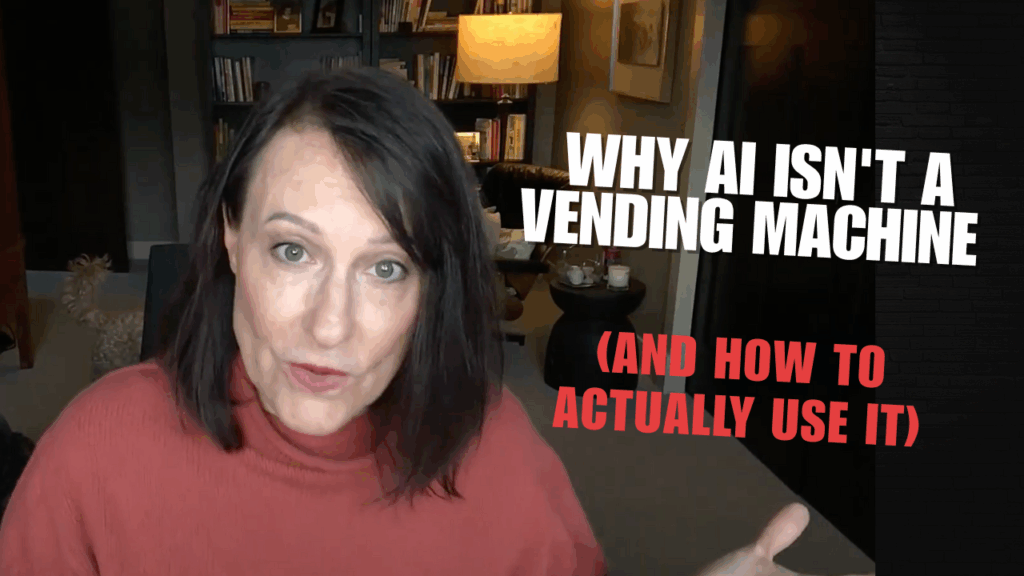
Here’s what’s actually happening: you’re treating AI like a vending machine instead of a conversation. You’re expecting to put in your request and get the perfect answer back. But that’s not how AI works—at least not how it works well.
TL;DR: AI doesn’t give you perfect answers on the first try because it’s not supposed to. It’s a co-creator that needs your direction, feedback, and creativity to produce anything worth using. The people getting incredible results from AI aren’t using better prompts—they’re having better conversations.
But here’s what most people miss:
→ The first response from AI is always a draft, never a deliverable
→ Your job isn’t to find the perfect prompt—it’s to guide the iteration
→ The quality of your AI output is directly tied to how willing you are to push back and refine
I figured this out the hard way. I spent weeks yelling “that’s not right!” at AI tools (literally, in all caps) before I realized I was approaching this completely wrong.
The Vending Machine Trap (And Why It Keeps You Stuck)
Let me tell you what I see constantly when I work with clients building AI agents and workflows. Someone will test a prompt with me, get a response back, read it for 5 seconds, and say—”See? It doesn’t work. It’s not giving me what I need.”
And when I ask, “What specifically isn’t working?” they can’t tell me. They just know it’s not right.
This is the vending machine trap. You’re treating AI like you put in your money (your prompt), press a button (hit enter), and expect the exact product you wanted to fall out. When it doesn’t, you assume the machine is broken.
But AI isn’t a vending machine. It’s more like a really smart assistant on their first day at your company. They’re capable, they’re quick, but they don’t know your preferences yet. They don’t know your voice, your standards, or the nuance of what you’re actually trying to accomplish.
If you handed that assistant a task and they brought you back something that was 70% right, would you just say “this is wrong” and walk away? No. You’d say, “This is a good start, but can you make it more casual?” or “I like this part, but the angle is off—here’s what I’m really going for.”
That’s how you need to work with AI.
I watched this play out last week. I was sitting with a client who was testing AI prompts for her content workflow. She asked it to write a social post, got a response, immediately said “that’s not right,” and wanted to move on.
I stopped her. “What part isn’t right? What would you say to a team member who gave you this draft?”
She paused. Read it again. “Actually, the opening is good. But the middle is too corporate, and the ending doesn’t have a clear next step.”
So we told the AI that. Exact words. “The opening works, but make the middle more conversational and add a specific call to action at the end.”
Next response? Exactly what she needed. Not because we found a magic prompt, but because we had a conversation.
Why the First Answer Is Never the Answer
I need to be really clear about this because it’s where most people give up too soon: the first response from AI is never supposed to be the final answer.
Think about how you work with actual people. When you explain a project to someone, do you expect them to deliver the finished product after hearing your explanation once? No. There are questions. Clarifications. Draft reviews. Revisions.
AI is the same way. The difference is AI doesn’t know to ask you clarifying questions—you have to guide the conversation.
When I’m building AI agents for my business or for clients, the first test output is always rough. Always. And we expect that. We’re not looking for perfection—we’re looking for what’s useful in what it gave us.
Here’s the shift that changed everything for me: I stopped asking “Is this right?” and started asking “What part of this is useful?”
Because here’s what happens when you ask that question—you realize there’s almost always something in the response you can work with. Maybe the structure is good but the tone is off. Maybe the examples are generic but the framework is solid. Maybe it nailed the opening but lost momentum in the middle.
When you identify what’s working, you can give AI much better direction on what to adjust. That’s when the magic happens.
How to Actually Have a Conversation With AI (Not Just Prompt It)
Most AI advice focuses on writing better prompts. That’s helpful, but it misses the bigger point—prompts are just the opening line of a conversation, not the whole interaction.
Here’s what a real AI conversation looks like when you’re using it as a co-creator:
Round 1: You give AI the task and context “Write a social post about [topic] for coaches who feel overwhelmed by content creation. Keep it under 150 words and include a personal story.”
Round 2: You evaluate what came back and give specific feedback “The structure is good, but the tone is too formal. Make it sound like you’re talking to a friend. And the story feels generic—can you make it more specific to someone who’s tried content batching but still feels behind?”
Round 3: You refine based on what’s still missing “This is much better. The story works now. But the ending is abrupt—add a question that encourages engagement in the comments.”
Round 4: You make final human touches At this point, AI has given you something that’s 90% there. You add your own examples, adjust any phrasing that doesn’t quite sound like you, maybe tweak the timing reference to match what’s happening this week.
That’s the process. And yes, it takes a few rounds. But you know what? It’s still 10x faster than starting from a blank page or trying to write the whole thing yourself.
The people who say “AI doesn’t work for content” are the ones stopping after Round 1.
Your Creativity Is the Whole Point (AI Just Speeds You Up)
Here’s the thing people get really wrong: AI isn’t supposed to be creative for you. It’s supposed to support your creativity.
I never take the first draft from AI and publish it. Never. Even when I’ve trained a custom agent on my voice, loaded it with examples, given it detailed instructions—I still read what it produces, tweak it, add my judgment, and send it back for another round if needed.
Because AI can’t do the creative thinking for you. It can’t:
→ Read the room and know what your audience needs to hear right now
→ Feel the emotional weight of a particular story and know when to lean into it
→ Understand the strategic timing of what to post when
→ Catch the subtle difference between “this sounds okay” and “this is exactly right”
That’s all you. That’s your intuition, your experience, your understanding of your audience.
AI speeds up the mechanical parts—the drafting, the structure, the first pass at organizing ideas. But the creative decisions? Those are human.
And honestly, that’s where it gets fun. You’re not grinding through the blank page problem anymore. You’re jumping straight to the part where you get to shape and refine something into exactly what you want it to be.
What It Actually Looks Like Behind the Scenes
Let me show you how this plays out in practice when I’m building AI agents—not just for myself, but for clients who want custom AI that writes in their voice.
Step 1: We build the agent with their voice guide, examples, and frameworks
This takes time. We’re loading in 15-20 examples of their best content, their documented voice patterns, their messaging framework. We’re teaching the AI their style.
Step 2: We test it and it’s always a little rough
The first outputs are never perfect. The tone might be close but slightly off. It might use phrases they’d never say. The structure might work but the examples feel generic.
We expect this. This is normal. We’re not disappointed—we’re gathering information about what needs adjustment.
Step 3: We iterate based on what’s working and what’s not
We don’t scrap everything and start over. We identify: “The openings are great, but the endings are weak—let’s give it better examples of strong CTAs.” Or “It’s using too much jargon—let’s add a list of words to avoid.”
Each round gets closer. Not because the AI is learning in real-time (it’s not), but because we’re getting better at explaining what we actually want.
Step 4: We get it to “good enough” and leave room for human creativity
Here’s the key: we don’t try to make the AI agent so perfect that it requires zero human input. That’s not the goal.
We get it to where it can produce a solid first draft—something that’s 80% there. Then the human using it adds their creativity: the specific client story from this week, the current event reference, the perfect word choice that makes it feel alive.
That’s the division of labor that actually works. AI handles the heavy lifting. Humans add the magic.
The Shift That Puts You Back in Control
I need to address something that’s probably bubbling up as you read this: “But Kristen, this sounds like more work, not less.”
And yeah, having a conversation with AI instead of just taking the first answer requires more engagement. But here’s what’s actually happening when you make this shift:
You’re taking control back.
When you treat AI like a vending machine and it gives you a mediocre answer, you feel helpless. Like the tool doesn’t work, AI isn’t useful for you, maybe you’re just not good at this.
But when you treat AI like a co-creator that needs your direction, suddenly you’re the one steering. The tool does what you tell it to. You’re not at the mercy of whatever it spits out—you’re guiding it toward what you actually need.
That mindset shift? That’s what turns AI into your superpower instead of your frustration.
I saw this click for a client recently. She’d been struggling with AI for months, convinced it just didn’t “get” her voice. We walked through a content piece together using the conversation approach—giving feedback, asking for refinements, treating the AI like a junior team member we were coaching.
After the third round, she stopped and said, “Oh. I’m not supposed to just hope it reads my mind. I’m supposed to teach it what I want.”
Exactly.
The Framework: How to Turn Any AI Response Into Something Actually Useful
Okay, let’s make this practical. Here’s the exact framework I use every time I work with AI, whether it’s a simple ChatGPT prompt or a custom agent I’ve built:
Start with context and clarity Don’t just say “write a social post.” Say “write a social post for [specific audience] about [specific topic] that addresses [specific pain point] and keeps it under [specific length].”
The more specific you are upfront, the less you’ll have to correct later. But even with perfect context, you’ll still need to refine.
Evaluate the first response with two questions
→ What part of this is actually useful?
→ What specifically needs to change?
Not “this is wrong”—that’s too vague. But “the tone is too formal” or “the examples are generic” or “the structure works but the angle is off.”
Give feedback like you’re coaching a team member “This is a good start, but make it more conversational.” “I like the opening, but the middle loses momentum—can you tighten it?” “The examples are too broad—make them specific to [exact scenario].”
You’re not being mean. You’re being helpful. You’re giving AI what it needs to give you what you need.
Iterate until it’s 80-90% there You’re not looking for perfection from AI. You’re looking for a strong draft that you can polish with your human judgment and creativity.
Usually, this takes 2-4 rounds. Sometimes just 1 if your initial prompt was really dialed in. Rarely more than 5 unless you’re doing something complex.
Add your final human touches This is where you make it yours. You adjust any phrasing that doesn’t quite sound like you. You add the specific example that makes it feel real. You read it out loud and trust your gut on what needs that final tweak.
This is the creative part AI can’t do. This is your value.
What Changes When You Stop Expecting Magic
I’m going to be honest about what happens when you actually adopt this approach. It doesn’t feel revolutionary at first. It feels like work.
You’re having to think critically about what you want. You’re giving feedback. You’re iterating. That’s more active than just typing a prompt and hoping.
But here’s what shifts over time:
You get faster at giving feedback because you start recognizing patterns in what AI typically gets wrong. After a few rounds with any tool, you know its quirks and you front-load your prompts with that knowledge.
You start getting better first drafts because your initial prompts are more specific. You’ve learned what information AI actually needs to give you something useful.
You build trust in the process. You stop feeling disappointed when the first response isn’t perfect because you expect that. You’re not deflated—you’re ready to guide the next iteration.
And most importantly: your output quality goes way up. Because you’re not accepting “good enough.” You’re pushing AI to give you something that’s actually worth publishing, and then you’re adding the human elements that make it great.
This is how I’m able to produce consistent content for my business, build AI agents for clients that actually work, and maintain my voice across everything—even when AI is doing the heavy lifting.
AI isn’t magic. But when you treat it like a creative partner that needs your guidance? That’s when it becomes powerful.
Where People Get Stuck (And How to Get Unstuck)
Let me address the most common places I see people struggle with this approach:
“I don’t know what feedback to give—I just know it’s not right”
This is usually because you haven’t defined what “right” looks like. You need examples of your own best work to compare against. When you can point to a piece of content you love and say “do it more like this,” you’re giving AI something to work with.
“It keeps misunderstanding what I’m asking for”
You’re probably being too vague or using language that means something specific to you but not to AI. Try explaining it like you would to someone who’s never worked in your business before. More context, more examples, more specifics.
“This feels like it’s taking longer than just doing it myself”
It probably is—the first few times. You’re learning a new skill. But after you’ve had 10-15 conversations with AI using this approach, you get exponentially faster. Your prompts get better. Your feedback gets sharper. The time investment now pays off for months.
“I feel like I’m still doing all the creative work”
You are. That’s the point. AI isn’t supposed to replace your creativity—it’s supposed to handle the grunt work so you can focus on the creative decisions. If you’re making all the strategic and creative choices, that’s you doing the valuable work while AI handles the mechanical execution.
The Real Reason This Matters
I want to zoom out for a second and talk about why this mindset shift is bigger than just getting better AI outputs.
When you stop treating AI like a magic answer machine and start treating it like a tool that requires your strategic input, you stay in your zone of genius. You’re not trying to offload thinking—you’re trying to offload the mechanical parts of execution so you can think better.
Your creativity doesn’t go away. Your judgment doesn’t become irrelevant. Your expertise still matters—maybe more than before, because now you’re using it to guide and refine instead of grinding through drafts.
And this approach makes you better at delegation in general. Because you’re learning to give feedback, iterate, and refine—skills that work with AI, with team members, with any kind of collaborative process.
The people who struggle with AI are often the same people who struggle with delegation. They want to hand something off completely and get back exactly what they envisioned without any back-and-forth. That’s not how collaboration works. Not with humans, not with AI.
When you embrace the conversation, when you show up ready to guide and refine, AI becomes an extension of your capabilities instead of a replacement for them.
Your Next Steps (Starting Today)
You don’t need to overhaul your entire workflow to start applying this. Pick one thing you use AI for—maybe writing social posts, maybe drafting emails, maybe brainstorming content ideas.
Next time you use AI for that task, commit to not accepting the first response. Read it, identify what’s useful, and give feedback. Ask for a revision based on what specifically needs to change.
Do this three times this week. Just three. See what happens to your output quality when you stop treating AI like a vending machine and start having an actual conversation.
And here’s what I want you to notice: how much faster you get at giving useful feedback. By the third try, you’ll already be better at this than the first time.
That’s the skill you’re building. Not “writing perfect prompts”—having productive conversations with AI that get you to useful outputs faster.
The people getting incredible results from AI aren’t lucky. They’re not using secret prompts. They’re just willing to iterate. They’re treating AI like a creative partner that needs their guidance.
You can do the same thing. Starting with your next prompt.
About the Methodology Behind This Approach
This framework comes from three years of hands-on work building and testing AI agents for content creation, both for my own business and for 50+ coaching and consulting clients. The “conversation vs. vending machine” approach emerged from analyzing hundreds of client sessions where I observed the specific patterns that separated people getting great AI results from those who were frustrated.
The iteration framework described (context → evaluate → feedback → refine → polish) is based on tracking what consistently produces usable outputs across different AI tools (ChatGPT, Claude, Gemini, custom agents). Success rate with this approach runs about 85% by the third iteration—meaning 85% of users get outputs they’re willing to use after 2-3 rounds of feedback.
What’s not covered here: technical AI training methods (that’s for developers), advanced prompt engineering tactics (those change constantly), or philosophical debates about AI replacing human creativity (this is about practical application). The focus is deliberately on the mindset and conversation skills that make AI useful for non-technical business owners who want better content faster.
Timeline estimates are conservative—most people see improvement in their AI interactions within 3-5 attempts using this framework, with proficiency developing over 2-3 weeks of consistent practice.