
This post is part of my complete guide to AI employees.
Read the full guide → AI Employees: How to Hire Your First AI Team Member
Why Hiring More Assistants Won’t Fix Your Execution Problem (And What Actually Will)
If you’ve hired two, three, maybe even four assistants and still feel like every decision runs through you — you’re not failing at delegation. You’re working inside a broken system. Hiring more assistants won’t fix that.
That’s not a harsh thing to say. It’s actually kind of a relief once it clicks.
Most founders think their execution problem is a people problem. It’s not. It’s a systems problem. AI business teams — where AI handles the logic, voice, and workflow so your human team can execute without you — are how smart founders are getting out of the bottleneck for good.
But here’s what most people miss:
→ Adding a better hire to a broken system just creates a better-trained person who still needs your brain to function
→ The real cost of no execution system isn’t just your time — it’s the decisions that never get made and the projects that quietly stall
→ AI doesn’t replace your team. It’s what finally gives your team what they actually need to work without you
The Hire That Was Supposed to Fix Everything
You know the pattern. You’re exhausted. You hire someone. There’s this brief window of relief — finally, a person who gets it.
Then the questions start.
“Hey, quick question…” becomes the soundtrack of your day. Projects need your input to move. Your team is capable, genuinely capable, and somehow they still need you to be the last step in almost everything.
So you try again. Better onboarding this time. More SOPs. Loom videos. You hope this hire will be the one. And the cycle repeats.
Here’s what’s actually happening: you’re handing off tasks. But execution — the logic behind the tasks, the way decisions get made, the voice and standards your work needs to meet — that’s still living in your head. And no hire, no matter how talented, can download your brain.
The Real Difference Between Tasks and Execution
This is the part most delegation advice skips over.
Tasks are the what. Execution is the how, why, and in what sequence. When those two things are separated — when your team has the what but you’re still the keeper of the how — nothing moves without you.
Think about the last time a team member came to you with a question. Odds are, the question wasn’t about the task itself. It was about judgment. Should this go to the client or wait? Does this sound like you? Is this the right call?
That’s not a capability gap. That’s a systems gap.
When execution logic lives only in your head, even the best team will stall. They’re not asking because they can’t — they’re asking because the system doesn’t give them what they need to decide without you.
What an AI Business Team Actually Looks Like
This isn’t about replacing your people with robots. That’s not the goal and honestly not what works.
The goal is giving your team a system that holds the logic, the voice, and the decision frameworks — so they can run without pulling you back in.
Inside a well-built AI business team, three things happen:
Your voice gets systematized. AI learns your tone, your content decisions, the way you explain things and structure your thinking. Your team stops guessing whether something sounds like you. The AI holds the standard. They execute to it.
Automation handles the connective tissue. Follow-ups, tagging, assigning, tracking — the small administrative tasks that don’t need human brains get handled by AI workflows. Your people focus on the work that actually needs them.
Outcomes get delegated, not just tasks. This one is the biggest shift. When your system has real logic built in, your VA stops being a task-executor and starts functioning like a project manager. Your ops person actually runs the backend. You lead. You don’t manage every moving piece.
One founder — on her third assistant in 12 months — rebuilt her backend with AI systems. Within 30 days, she wasn’t answering the same questions. Tasks were getting executed without reminders. Same team. Completely different results. The team didn’t change. The system did.
Why This Works When Hiring Alone Doesn’t
There’s a version of this that sounds like a criticism of your hires. It’s not.
The assistants and ops people who’ve struggled in your business? They probably would thrive in a business that had real systems. They were set up to need you — not because of anything they lacked, but because the infrastructure required them to.
When you build execution into the system itself — when AI holds your voice, your standards, and the workflow logic — your team finally has what they need. They’re not guessing. They’re not waiting. They’re not coming back to you for the tenth time on the same type of question.
You become optional in the day-to-day. Which sounds scary until you realize that’s the only way you actually get to lead.
The Warning Signs You’re Still the System
A few patterns that show up when execution is still living in your head rather than in your infrastructure:
Projects stall when you go quiet. If your team’s progress directly tracks your availability, there’s no execution system — there’s just you, organized into other people’s calendars.
Your onboarding keeps growing but the questions don’t shrink. More documentation isn’t a system. Documentation that gives people the judgment they need to decide without you — that’s a system.
You’re the QA for everything. If every deliverable passes through you for a “once over” before it goes anywhere, you haven’t delegated execution. You’ve delegated drafts.
New hires get slower, not faster. If each new team member takes longer to become useful because there’s more to learn and no clear logic to follow — that’s the system telling you it doesn’t exist yet.
How to Start Rebuilding Without Burning Everything Down
You don’t need to overhaul everything at once. That’s actually one of the fastest ways to create more chaos while trying to fix chaos.
Start with one execution loop that runs through you constantly. Pick the process where you’re most often the bottleneck — content review, client communications, project handoffs. Map what actually happens: the decisions, the judgment calls, the voice standards that exist in your head.
Then ask: what would someone need to make those decisions without me?
That’s your starting point. Not the tools. Not the AI platform. The logic first.
Once you know what the system needs to hold, you build it — with AI doing the heavy lifting on voice replication, workflow logic, and the connective administrative tasks. Your people step into that system and they finally have what they need.
This is what building an AI business team actually looks like in practice. It’s not a product swap. It’s a redesign of how execution happens.
What Comes Next
The founders who are scaling well right now aren’t necessarily working with better people. They’ve built better infrastructure. Their teams execute. Their backend runs. They lead without being the answer to every question.
That’s not a distant thing. It’s a systems thing.
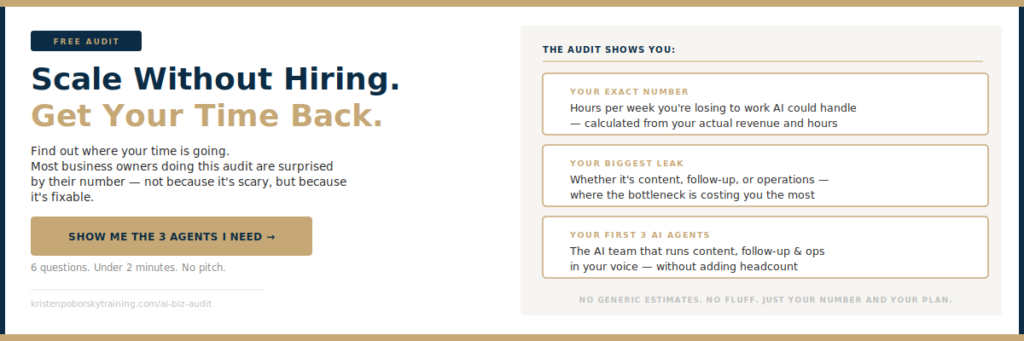
If you want to see how this could work inside your specific business, take the free 2-Minute AI Business Audit below. It shows you the first three agents to build, what not having them is costing you, and what changes once they’re running.
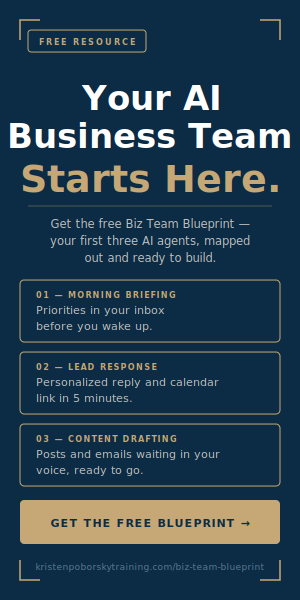
Take the free 2-Minute AI Business Audit, or steal my AI org chart, and see which seats your AI team still has empty.
Kristen Poborsky helps coaches, consultants, and course creators rebuild their backend operations using AI and lean systems — so their teams can execute without constant input. Her work focuses on building AI business teams that hold your voice, your standards, and your workflow logic, so you can finally lead without being the bottleneck.