
Last updated: September 2026
The person in your business who “just knows how things work” is quietly your biggest risk — because when they leave, everything they know leaves with them. AI business continuity means getting that knowledge out of heads and into documented systems your agents (and any future hire) can run. Here’s how to spot the risk and fix it before it costs you.
Key Takeaways
- Why the person in your business who “just knows how things work” is quietly your biggest hidden risk — and what it actually costs you when they walk out the door
- The real reason most business owners are one bad week away from total chaos (it has nothing to do with how organized you are)
- What happened when one client said “I think we’re about to lose someone” — and what was in her hands 30 minutes later
- The one shift that turns a potential crisis into a plan before anything goes wrong
This post is part of my complete guide to AI business teams — what they are, what they cost compared to hiring, and how to build one.
Read the full guide → The AI Business Team
I was on a call recently. She runs operations for a retail business with multiple locations — smart, organized, genuinely good at what she does. And she said to me: “I think we’re about to lose someone, and I have no idea what he actually does every single day.”
No resignation letter. Just a feeling.
That feeling is one of the most unsettling moments in a small business. Not because of the person leaving — but because of everything they’re taking with them that was never written down.
Here’s what we did. And more importantly, here’s what you can do before you ever have to feel that feeling.
The Person Who “Just Knows” Is Your Biggest Business Risk
Every business has one.
The person who handles client onboarding and somehow knows every quirk of your process. The VA who manages your inbox and has figured out every workaround that never made it into a document. The bookkeeper who knows which clients pay late and exactly how to follow up without you ever asking.
You know who I’m talking about.
If that person called you tomorrow and said “I’m done” — or even just “I’m sick this week” — you’d feel it in your stomach.
And here’s what most people don’t realize until it’s too late: when they leave, they don’t just take that job with them. They take the routines. The workarounds. The stuff that never got written down because it never had to be. None of that lives in a document. It lives in their head.
Most business owners don’t deal with this ahead of time. Not because they’re bad at running a business — but because they’re busy running one. There’s always something more pressing. Until the moment there isn’t, and it’s too late to do it right.
Building a real AI business continuity plan means acknowledging that reality and doing something about it before the call comes.
What AI Business Continuity Actually Looks Like in Practice
We got to work the same day she mentioned this to me.
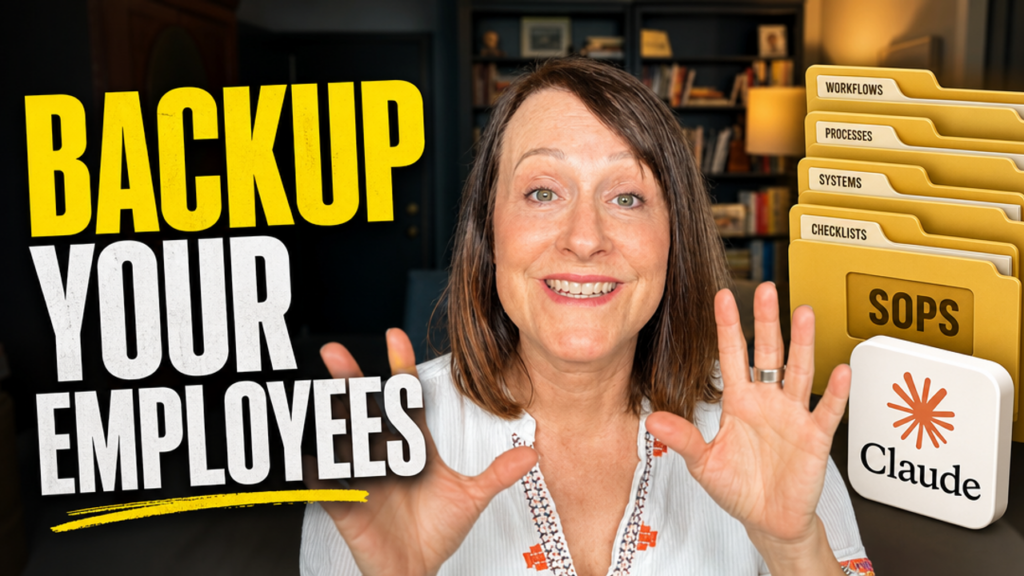
We opened up the AI HR assistant we’d already built and customized for her business — right inside Claude. She described the situation: possibly losing someone, not sure how much time they had. And because that assistant already knew her business, her team structure, her industry, and her operations, it didn’t hand her some generic checklist.
It built her a three-session interview guide. In about 30 minutes.
Specific questions. Built for that specific person and role. Covering daily routines, weekly rhythms, platform logins, and the stuff he probably doesn’t even realize he knows. Three documents. Session one, session two, session three — done and ready to go.
When we finished, she sat back and said, “I think I just saved myself seven days.”
Honestly? More than that. Those three interviews feed into everything her business needs going forward: SOPs, a job description, a playbook for a new hire, a 30-60-90 day ramp-up plan. Everything documented in one place, so she never has to scramble like this again.
One session. A clear plan. No more scrambling.
That’s what AI business continuity actually looks like when it’s built right — not a generic tool, but a system that already knows your business and is ready for exactly the moments you need it.
Why Building During the Crisis Is Always Already Too Late
Here’s the part I want you to sit with.
That session worked because we weren’t building the system in the middle of the crisis. We had already built it. It was already doing a whole lot of other things inside Sarah’s business, and when this moment came, it was ready — because it already knew what to do.
That’s the difference between having an AI business continuity plan and scrambling to create one while you’re already stressed and behind.
She didn’t have a crisis. She had a plan.
The only thing separating those two outcomes was whether the work had already been done.
And this isn’t just about someone leaving. It’s about what happens when you get sick. When your VA takes a week off. When you land something big and need to move fast. Your business needs a memory that doesn’t depend on one person — including you.
An AI assistant built for your business isn’t a chatbot. It’s not a prompt you grabbed somewhere. It’s a specialized assistant trained on your business, your methodology, how you think, and what you do — ready for the exact moments your business actually needs it.
The businesses that handle these moments well are the ones that built their systems on a regular Tuesday when nothing was on fire.
How to Start Building Your AI Business Continuity Plan Right Now
You don’t need a crisis to get started. You just need to start.
Here’s exactly what to do:
→ Identify your “person.” Who in your business holds knowledge that isn’t written down anywhere? Start there.
→ Schedule a documentation session before anything happens. Block one to two hours with that person now. This is a knowledge capture, not a performance review.
→ Build or use an AI assistant that already knows your business. Generic AI tools give you generic results. An assistant trained on your team structure, your operations, and your industry will ask the right questions — and help you organize the answers into documents you can actually use.
→ Turn those interviews into systems. SOPs, job descriptions, onboarding playbooks, ramp-up plans — all of this comes from three good sessions. Don’t stop at the interview.
→ Do the work before you need it. That’s the whole thing. Not during the panic. Not after the resignation. Now, on a normal week, when you have the space to do it right.
The first step is figuring out where your business is most fragile. Not theoretically — specifically. Which person, which process, which task is one bad week away from creating a gap you can’t fill?
That’s exactly where your AI business continuity plan starts.
Running a business means knowing it will throw things at you. Someone leaves. Someone gets sick. Something big lands in your lap and you need to move fast. The question isn’t whether any of that will happen — it’s whether you’ll be ready when it does.
You might already have that person in your business right now. The one who knows everything. If you do, this is your sign to do something about it before you get that call.
Related: Systems Before Agents: How to Get Your Business Ready for AI
Frequently Asked Questions About AI Business Continuity
Q: What is AI business continuity, and why does it matter for small businesses?
A: AI business continuity means using AI tools to document and systematize the critical knowledge, processes, and routines that keep your business running — so you’re not dependent on any one person. For small businesses especially, losing a key team member can create weeks of disruption. Building this system ahead of time means you’re always ready, not scrambling.
Q: How do I capture what a key employee knows before they leave?
A: The most effective approach is a structured interview process — two to three sessions covering daily routines, weekly rhythms, platform access, and the workarounds and judgment calls that never made it into any official document. An AI assistant trained on your specific business can build those interview guides and then turn the answers into SOPs, job descriptions, and onboarding plans.
Q: Can AI really help with employee knowledge transfer?
A: Yes — and it works best when the AI assistant already knows your business. A generic AI tool gives you a generic plan. An assistant trained on your team structure, your operations, and your industry asks the right questions and organizes the information into documents you can actually act on immediately.
Q: What’s the difference between a generic AI chatbot and a real AI HR assistant?
A: A chatbot answers questions. An AI HR assistant built for your specific business knows your context — your team, your industry, your processes — and uses that knowledge to help you take action in real situations. It’s the difference between searching online and calling someone who actually knows how your business runs.
Q: When should I start building an AI business continuity plan?
A: Before you need it — and that’s not a vague answer, it’s the whole point. Once you’re already in the middle of a potential departure, an unexpected illness, or a sudden absence, you’re behind. The moment to build this is on an ordinary week, when nothing is on fire and you have the space to do it right.
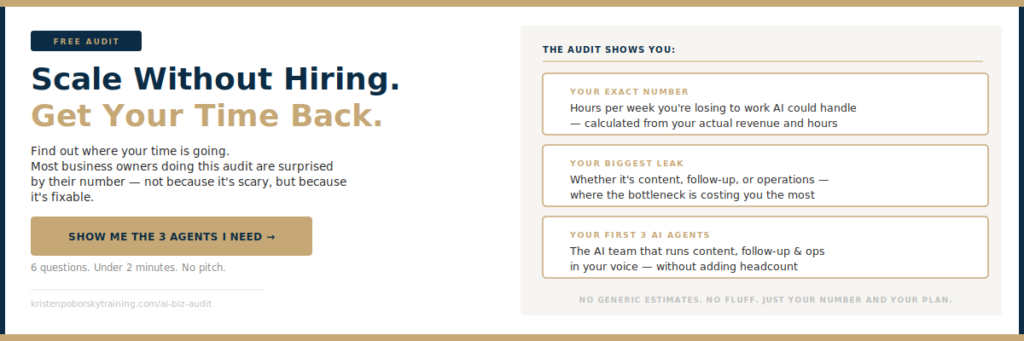
Want to know which AI agents your business needs first? Take the free 2-Minute AI Business Audit. It shows you the first three agents to build, what not having them is costing you, and what changes in your business once they’re running. Or steal my AI org chart and see which of the 7 AI seats your business still has empty.