The Short Version: Your VA isn’t forgetting. They’re not bad at their job.
They’re asking the same questions every week because they don’t have three things: your voice, your decision-making frameworks, and systems that run without you. Once those three things are in place, questions drop by 80–90%. Here’s how AI makes that happen.
A few things most people get wrong about this:
→ Giving your VA more detailed instructions won’t solve this. Instructions and systems are completely different things.
→ The problem usually isn’t the VA — it’s that you’ve accidentally made yourself the system.
→ AI doesn’t just create content for you. When it’s set up right, it answers your team’s questions so you don’t have to.
It’s Tuesday Morning, and Here We Go Again
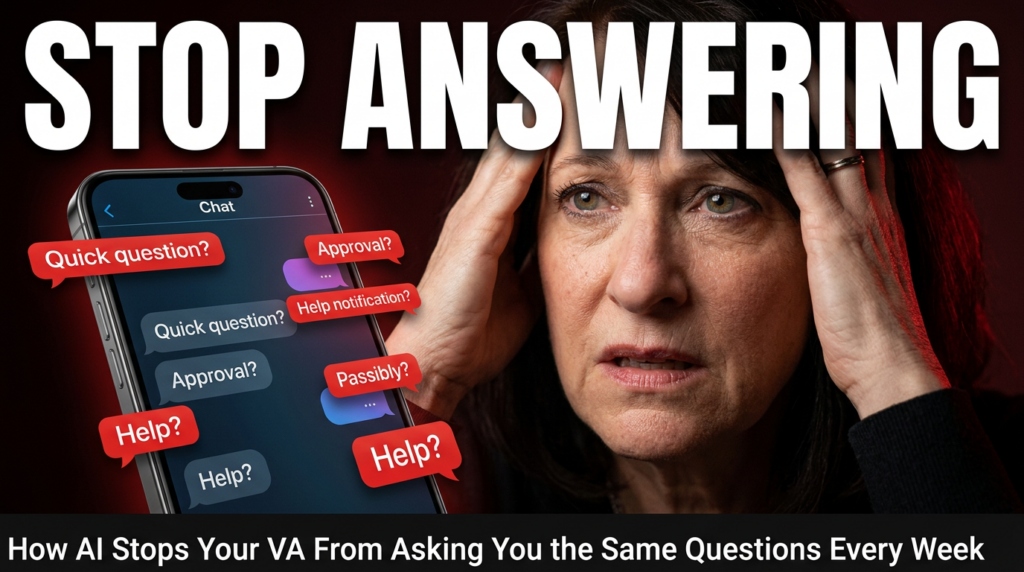
You wake up and check your phone. Seven messages from your VA. They need guidance, clarification, a decision, your approval. You answer while you’re making coffee. Twenty minutes gone.
Mid-morning, you finally get into a real flow state on something important. Ping. “Quick question.” It’s never quick. You switch gears, answer, try to get back into what you were doing. It’s harder this time.
By evening, you do the math. Four hours answering questions. Again. Same questions as last week. Same questions as the week before that.
One of my clients actually set a designated “question time” every day — 10am and 3pm. She thought batching her answers would protect her focus. What actually happened? Her VA saved up all the questions and dumped 15 at once. Each session took an hour. Ten hours a week just on questions.
“I hired someone to get time back,” she told me. “Instead I have a full-time job answering questions.”
Sound familiar?
Here’s What’s Actually Causing This
Most business owners blame themselves or their VA when this happens. They think: I need to be clearer. I need to train better. My VA needs to be more independent.
That’s not quite it.
I spent a week watching one client’s Slack. Her VA had been with her for three years — three years — and was still asking 30 questions a week. Here’s what I saw:
VA: “What should I post on Instagram today?”
Owner: “Something about the new program launch.”
VA: “What specifically?”
Owner: (writes the entire post herself)
Next week: same conversation. The VA wasn’t being difficult. She just didn’t have a content system with AI trained on the owner’s voice. So the owner became the system. That’s why nothing changed.
Your VA asks you questions because that’s the only way they can get the information they need. Not because they’re forgetful. Not because they’re bad at their job. Because they don’t have anything else to reference.
The 3 Things Your VA Actually Needs (And Where AI Comes In)
Here’s the fix. It’s not about better onboarding or more Loom videos. Your VA needs three specific things that most business owners have never actually built — and AI is what makes all three possible.
1. AI Trained on Your Voice
When your VA sits down to write a post, an email, a caption — and they don’t have AI trained on how you write — they have two options: ask you, or guess. Both of those create problems.
When AI is trained on your voice, something shifts. Your VA isn’t creating from scratch anymore. They’re reviewing, refining, and improving. That’s a completely different job.
Social posts?
AI writes them in your voice. Your VA reviews, tweaks, schedules. Emails? AI drafts using your tone and frameworks. VA personalizes and sends. Video scripts? AI creates the outline in your style. VA polishes. You record.
The questions don’t stop because your VA suddenly got smarter. They stop because your VA finally has something to work with.
2. AI-Powered Decision Frameworks
Right now, when something comes up that your VA hasn’t seen before — a refund request, a student who’s stuck, an email that doesn’t fit a template — they do the only logical thing: ask you.
What they need instead is a framework that captures how you think.
Not just what to do, but the logic behind it. And when that framework is built into an AI agent, your VA doesn’t even have to dig through a document — they just ask the AI.
For example:
→ When someone requests a refund within 30 days: approve it and send this response.
→ When a student is stuck on module three: direct them to this resource, or this AI agent.
→ When someone wants to reschedule: check the calendar, offer these three times.
That’s not a list of instructions. That’s a decision tree.
Your VA can follow it without you. They stop asking “how would she handle this” — because now they know.
3. AI-Powered Systems That Run Without Your Input
This is the big one, and it’s usually the last piece people build.
Every task your VA does right now probably has at least one spot where they need you. Content needs a review. Emails need approval. Scheduling needs your preferences. That’s not a VA problem. That’s a systems problem.
When AI is doing the heavy lifting inside those systems — drafting, responding, organizing — your team can manage everything without asking you how. They only come to you for true exceptions. The stuff that genuinely needs you.
Instructions vs. AI Systems: The Difference That Changes Everything
This is where most business owners get stuck. They’ve tried being clearer, more detailed, more patient. They’ve recorded Loom videos. They’ve written step-by-step guides. And the questions keep coming.
That’s because there’s a real difference between giving instructions and building AI-powered systems.
Instructions: “Post on Instagram three times a week.” Your VA comes back: What should I post? What’s the caption? What are the hashtags? You answer every week — or you end up doing it yourself.
AI System: An AI agent trained on your voice writes posts every Monday using your content calendar. VA reviews Tuesday, makes edits, schedules for the week. Brand guidelines are built into the AI. Escalate to you only for major announcements.
Now your VA has everything they need and questions only come up on real exceptions.
Instructions: “Answer customer emails.” Your VA asks: How do I handle refunds? What about complaints? What if they have questions about the program?
AI System: AI drafts responses for the 10 most common email types using your frameworks and voice. VA reviews, personalizes if needed, sends. Three specific situations get escalated to you.
See the difference? Instructions make you the answer key. AI systems make the answer key accessible to everyone who needs it — without you.
What Actually Changes When AI Is In Place
Here’s what happens when these three pieces are built — and it’s pretty consistent across the clients I’ve worked with.
Questions drop fast. One client went from 40 questions a week down to 5 in about a month. Week one: 25 questions. Week two: 12. Week three: 5. Week four, her VA sent her a message: “I finally feel like I know what I’m doing.” That’s not because the VA changed. It’s because she finally had AI doing the heavy lifting behind her.
Quality goes up, not down. This surprises people. When your VA is guessing, quality is inconsistent — sometimes great, sometimes off. When they’re working with AI trained on your voice and frameworks that match your thinking, the output is consistent. It sounds like you. Every time.
Your team actually feels good. Nobody talks about this part, but it matters. Your VA doesn’t want to keep interrupting you. They want to do good work and feel helpful. When they’re constantly asking questions, they feel like they’re creating more work than they’re solving. AI changes that dynamic completely.
You get real time back. One client tracked her hours obsessively. Before we built her AI business team, she was spending 15–20 hours a week answering team questions and fixing things. After? Two to three hours a week, only on exceptions and real decisions.
“I forgot what it felt like to work on my business instead of in it,” she told me.
That’s 12–17 hours every single week. Not a one-time win. Every week.
How to Start Building Your AI Business Team
You don’t need to overhaul everything overnight. Here’s a practical way to approach this:
Step 1: Audit the questions. For one week, write down every question your VA asks you. Group them by category: content, operations, client-facing, decisions. This shows you exactly where to build your AI systems first.
Step 2: Train AI on your voice. This is the foundation. Start with a voice guide that captures how you write, your common phrases, your tone, your brand. Then build it into the AI tools your VA will use for content.
Step 3: Document your top 10 decision types. Pick the 10 most common situations your VA asks you about and write out the logic: if this, then that. Don’t just describe what to do — explain the thinking behind it so the AI can handle variations too.
Step 4: Build one AI system at a time. Start with the area generating the most questions. Usually that’s content or client communication. Get that system running before adding the next.
Step 5: Set clear escalation criteria. Define what actually needs you. When your VA knows the exact situations where they should escalate — and the AI handles everything else — questions that reach you become real exceptions, not routine.
The realistic timeline: Most people see a noticeable drop in questions within the first two weeks of implementing even one AI system. Full implementation — voice training, decision frameworks, and AI-powered operations — typically takes 30–60 days. That timeline is worth it for 12–17 hours back every week, indefinitely.
The Bottom Line
Your VA is not the problem. The missing AI systems are.
When you give your team AI trained on your voice, decision frameworks for common situations, and systems with AI doing the heavy lifting — everything changes. Questions drop by 80–90%. Quality gets consistent. Your team stops feeling like they’re bothering you. And you get back to the work that actually needs you: strategy, relationships, growth.
The shift from being the answer key in your business to having AI hold those answers for your team? That’s what makes scaling actually feel like scaling.
If you’re ready to build this inside your business, book an AI Business Game Plan call with me — the link is in the description. We’ll map out exactly what your AI business team looks like for your setup.
And if you’re not sure whether you even need a VA yet, watch the next video. I’m breaking down the unicorn assistant myth and what most people actually need instead.
Kristen Poborsky helps coaches, consultants, and course creators build AI-powered content systems and business teams that run without them.