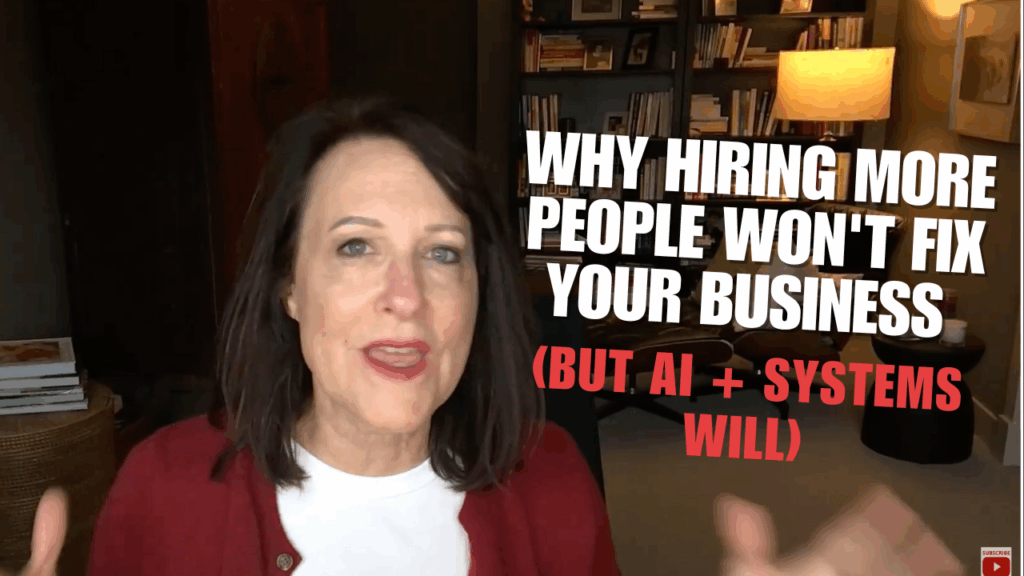
Why Hiring More People Won’t Fix Your Business (And What Actually Will)
Let me guess—you’re thinking if you could just find the right person, everything would finally run smoothly. One more VA who really gets it. A content manager who can take that off your plate. Someone to handle client questions so you don’t have to.
And you hire them. They start. You train them. And somehow, within a few weeks, you have more questions to answer than before. More things waiting on your approval. More Slack messages asking what to do next.
Here’s what nobody tells you until you’ve already burned through the time and money: you don’t have a people problem. You have a systems problem. And hiring more people into a broken system doesn’t fix it. It just multiplies the chaos.
TL;DR: Hiring fails when your workflows are broken, your execution standards are unclear, and your team has no AI support structure to help them succeed. Adding more people to this setup just means more people waiting on you. The solution isn’t finding better team members—it’s building systems that let your existing team actually function.
But here’s what most people miss:
Your team keeps asking you questions because the answers aren’t documented anywhere
→ They’re not incompetent—they literally don’t know what “done” looks like in your business
→ Without clear workflows, even AI becomes extra work instead of help
→ Every new hire increases communication overhead when systems are unclear
I learned this after hiring what felt like an entire army and still waking up to fires every morning.
The Hiring Trap That Keeps You Stuck
My business was growing. Clients were coming in. Revenue looked great on paper. Behind the scenes, I was doing absolutely everything.
So I hired a VA. Finally, I thought. Some breathing room.
Instead, I got more questions. “How should I handle this?” “What do you want me to say here?” “Should I prioritize this or that?” Every task I delegated came back to me as three decisions I had to make.
So I hired a second person. Surely two people could share the load, right?
Suddenly I had two people waiting on me. Double the Slack messages. Double the “quick checks.” Double the approvals and reviews. Everything still ran through me.
And I kept thinking—why am I still drowning? I hired help. I should have more time, not less.
But here’s the truth I didn’t want to admit at first: I wasn’t delegating tasks into a system. I was delegating tasks into more chaos.
And that’s exactly where most people get stuck. They think the problem is finding the right person. But the real problem is what you’re asking that person to step into.
Why Even Great People Fail in Broken Systems
Let me break down what actually happens when you hire someone into a business without clear systems. Your new team member is capable, willing, motivated. They want to do a good job.
But they’re immediately hit with:
No clear workflows. They don’t know the steps for getting content out the door. They don’t know how client onboarding actually works. They’re piecing together the process based on what they observe and what they can guess.
No execution standards. You’ve told them to “handle social media” but they don’t know what good social media looks like to you. What tone you prefer. What topics are off-limits. When to be professional vs. casual. What done actually means.
No documented processes. Everything lives in your head. When they ask how to do something, you explain it. Next time they need to do it, they’ve forgotten half the details and they ask again. Or they guess and get it wrong.
No AI support structure. Without predictable workflows, AI can’t step in to help. It becomes an extra tool they have to learn instead of the execution partner that makes their job easier.
The result? Your team member is constantly unsure. They send things to you hoping it’s right. You fix it. They feel incompetent. You feel exhausted. And nothing gets faster.
This is not a people problem. Your team member isn’t failing. Your system is failing them.
The Real Cost of Hiring Without Systems
One of my clients—let’s call her Rachel because I can’t use her real name—came to me in exactly this situation.
She had a VA. A part-time content person. A contractor handling delivery. Three people supposedly supporting her business.
And she was working 10-12 hour days.
She told me, “I’ve hired all these people and somehow my workload has increased. And the output? It’s really not that great.”
She wasn’t wrong. And she wasn’t alone.
When we audited her business, here’s what we found:
The team didn’t have clear workflows. Nobody knew the approved way content should look or sound. Delivery tasks were being done differently every single time—no consistency, no standard. And her VA was scared to make decisions because nothing was documented anywhere. She didn’t know what Rachel would want, so she asked about everything.
Rachel’s team wasn’t the problem. They were doing their best inside a system that set them up to fail.
Rachel didn’t need more people. She needed systems and AI assistance her existing people could use to actually succeed.
What Actually Fixes This (Systems + AI + Clear Standards)
Here’s what we did for Rachel, and what I do with every client who’s stuck in the “I hired people but I’m still doing everything” trap:
We rebuilt her execution systems from the ground up. Content workflow. Delivery process. Client experience touchpoints. Marketing tasks. Everything got a clean, simple structure with clear steps.
Not complicated. Not rigid. Just clear enough that someone could follow it without having to read Rachel’s mind.
We documented what “done” looks like. For every major task, we created examples of good work vs. work that needs revision. We captured Rachel’s feedback patterns—when she edits something, why is she making that change? That became reference material for her team.
We inserted AI into the repetitive tasks. AI drafted first versions of content based on Rachel’s voice guide and examples. AI checked work for accuracy against her standards. AI tracked progress through workflows. AI created the consistency her team was struggling to maintain manually.
We gave her team Rachel’s brain. Not literally. But through documented processes, clear examples, and AI trained on her decision patterns, her team now had access to the answers they used to have to ask her for.
Suddenly her VA knew what to do without guessing. The content person could draft something in Rachel’s voice without multiple revision rounds. The delivery contractor followed a consistent process every time.
Within 30 days, Rachel’s team was executing 80% of the business without her direct involvement. And Rachel told me, “I’m finally feeling like this business isn’t balancing on my shoulders anymore.”
Why Systems Have to Come Before (or With) Hiring or Adding AI Team Members
I need to be really clear about the order of operations here because most people get this backwards.
Broken sequence: Hire someone → realize they need more guidance → try to train them → get frustrated when they still can’t do it without you → hire someone else hoping they’ll “get it better”
Working sequence: Build clear systems → document standards → set up AI support → then hire someone who can plug into a structure that actually works
Or if you already have people: Audit where your system is breaking → rebuild workflows → add AI support → watch your existing team suddenly become way more capable
You don’t need different people. You need to give your people something they can actually succeed within.
Here’s what happens when you build systems first:
Your team knows what to do without asking. They have documented workflows, clear examples, AI tools that support their execution. They’re making decisions within a framework instead of guessing at what you’d want.
You hire less because your team can handle more. One person with good systems is more effective than three people in chaos.
You manage less because the system does the managing. Your team follows the process. AI catches inconsistencies. You only get involved when something genuinely needs your strategic input.
You correct less because standards are clear. Your team isn’t guessing at quality—they have examples and AI feedback loops that keep them on track.
When your systems are strong, you don’t need to find a unicorn assistant who magically understands everything. You need normal, capable people who can follow a clear structure.
The Three Elements Every System (Including AI) Needs to Actually Work
Based on setting this up dozens of times with clients, here’s what makes a system actually functional instead of just theoretical:
Element 1: Documented workflows that show decisions, not just steps
Most process documentation is too vague to be useful. “Create social content” isn’t a workflow. That’s a task description.
A workflow includes the decision points: When choosing topics, prioritize client questions over trending topics. When writing posts, lead with a problem statement, then provide the insight. When deciding on CTAs, use “comment below” for engagement posts and “link in bio” for conversion posts.
That’s the level of detail your team actually needs.
Element 2: Clear examples of quality standards
Don’t tell your team content should be “engaging” or “on-brand.” Show them five pieces you consider excellent and three that missed the mark. Explain specifically what made the difference.
This is what AI gets trained on too. You’re not just telling it to “write like me”—you’re showing it what “like me” actually looks like with concrete examples.
Element 3: AI support at the bottleneck points
Identify where your team gets stuck most often. That’s where AI needs to step in.
If they struggle with starting drafts, AI handles first-draft creation based on your templates. If they’re unsure about quality, AI checks against your standards before human review. If they’re bogged down in research, AI pulls relevant information so they can focus on application.
AI doesn’t replace your team. It makes your team capable of doing work at your standard without needing you for every micro-decision.
What This Actually Looks Like in Practice
Let me get specific about how this plays out day-to-day once you have systems in place.
Before systems: Your content person writes a social post. Sends it to you. You read it, realize the tone is off and the angle isn’t quite right. You rewrite half of it. Send it back. They publish it. Repeat this 6 times per week. You’re spending hours on content review.
After systems: Your content person checks the content calendar for the topic and strategic goal. They input the key points into your custom AI agent that’s trained on your voice and loaded with your examples. AI drafts the post in your style. Your team member reviews it, adds the specific client story or current timing reference that makes it relevant right now, checks it against your quality checklist, and publishes. You see it when it goes out. You’re not in the creation loop.
Before systems: Client emails come in with questions. Your VA doesn’t know the answer. Forwards it to you. You respond. They send your response to the client. Every question creates a back-and-forth that involves you. You’re interrupted constantly.
After systems: Client question comes in. Your VA checks the AI knowledge base you’ve set up with your FAQ, past responses, and decision framework. AI provides the answer you’d give. VA personalizes it with the client’s specific situation and name. Response goes out within an hour. You’re only pulled in for genuinely complex situations that need strategic judgment.
Before systems: You’re working 10-12 hour days despite having people on your team. Everything still needs your input, your approval, your revision.
After systems: You’re working 6-8 hour days. Your team handles 80% of execution. You focus on strategy, client delivery, and business development—the things only you can do.
That’s the shift that happens when you fix the system instead of just adding more people to a broken one.
The Mistakes That Keep This From Working
I’ve seen people try to implement systems and still end up stuck. Here are the patterns that sabotage this:
Mistake 1: Making systems too complicated
Your workflow document shouldn’t be 50 pages. Your team won’t read it and they definitely won’t follow it. Keep it simple. Clear steps. Key decision points. That’s it.
Mistake 2: Documenting the ideal process instead of the real one
Write down how work actually gets done in your business right now, not how you wish it worked. You can improve it later. But if you document a fantasy workflow that doesn’t match reality, your team won’t use it.
Mistake 3: Setting up AI without training it on your specifics
Generic AI doesn’t help your team. AI that’s been trained on your voice, your examples, your standards—that’s what makes the difference. Don’t skip the setup work.
Mistake 4: Expecting perfection immediately
Your first version of any system will need refinement. That’s normal. Build it, use it for two weeks, see where it breaks or where people get confused, and update it. Systems get better through use, not through overthinking before launch.
Mistake 5: Not involving your team in the process
Your team knows where they get stuck. Ask them. Build systems that solve their actual problems, not what you assume their problems are.
Why This Matters More Than Just Saving Time
I want to zoom out for a second because this is about more than just getting your time back.
When you keep hiring people into broken systems, here’s what happens to your business:
Your costs go up but your output doesn’t improve proportionally. You’re paying multiple people but still doing the bulk of the work yourself.
Your team feels incompetent even though they’re not. They can sense that things aren’t working, and they assume it’s their fault. Morale drops. Turnover increases.
You become the single point of failure. If you’re sick, on vacation, or just need a break—everything stops. Your business can’t function without you.
You can’t scale. You’re maxed out on how many people you can personally manage and guide. Adding more just creates more overhead without more output.
But when you build systems first, everything changes:
Your costs stay manageable because you’re not constantly hiring to solve problems that aren’t people problems.
Your team feels confident and capable because they have what they need to succeed. They stay longer. They perform better.
Your business can run without you in the day-to-day. You can take time off, focus on growth, step into CEO-level work instead of execution.
You can actually scale because your business isn’t dependent on your personal availability. Systems + AI + a small team can handle the work that used to require you plus five people.
That’s not just time savings. That’s business sustainability.
Where to Start If You’re Already Stuck in This
Maybe you’re reading this and thinking—okay, I already have people. I’m already in the chaos. How do I fix this now?
Start with an audit. Look at your business over the next week and track:
→ Every time someone asks you a question or needs your input
→ Every time you have to redo work because it wasn’t quite right
→ Every task that requires your approval before it can move forward
By the end of the week, you’ll see patterns. Those patterns show you where your systems are breaking.
Pick the biggest bottleneck—probably the place where you’re spending the most time approving, revising, or answering questions. That’s your first system to fix.
Document that one workflow. Write down the actual steps. Capture the decision points. Create examples of good vs. needs-work. Set up AI support for the repetitive parts.
Get that one workflow running smoothly. Then move to the next bottleneck.
You’re not trying to fix everything at once. You’re systematically eliminating the places where you’re the single point of failure.
And as you do this, you’ll notice something: your existing team becomes more capable. Not because they suddenly got better at their jobs, but because they finally have a structure that lets them succeed.
That’s when you realize—you never needed more people. You needed better systems.
About the Methodology Behind This Approach
This framework comes from three years of working directly with coaching and consulting businesses stuck in the “hired people but still doing everything” trap. The audit → rebuild → AI insertion → documentation sequence has been tested across 50+ implementations with teams ranging from 1 VA to 8 people.
The “80% of business running without founder in 30 days” outcome is based on actual client results, though timeline varies depending on how many workflows need rebuilding and how receptive teams are to new systems. Median timeline is 4-6 weeks for first major workflow, 8-12 weeks for comprehensive system overhaul.
Success metrics tracked: hours saved per week (average 10-15), reduction in team questions (average 60-70%), increase in team confidence self-ratings (average 40% improvement), and reduction in founder stress levels (measured subjectively but consistently reported).
What’s not covered: specific AI platform recommendations (they change too rapidly), team hiring best practices (that’s a different expertise), or detailed change management psychology (though basic implementation psychology is woven throughout). Focus is deliberately on practical system-building that non-technical business owners can implement without developers.
Case studies are real implementations with names changed for privacy. Results represent typical outcomes, not guaranteed results, as actual improvement depends on implementation quality and team engagement.
I Had a Huge Team and Was Still Working 12-Hour Days. Here's What Was Actually Wrong