
Key Takeaways
How AI Employees Let You Design Your Business Around Your Life
Using AI to work faster still leaves you in the middle of every task. AI employees hand the work off completely, and that’s the difference that gives you your time back.
Start with a list of every recurring task in your business this week, then ask one question about each: does this need a human judgment call?
Most businesses find 3 to 7 tasks on that list that don’t need a human at all. Those are your first AI employees.
One task, one AI employee, trained like a real hire, with your brand voice, offer details, standards, and edge cases baked in from the start.
On the other side is a schedule like my 10-2 life: deep work in the morning, laptop closed by 2, and the business still running.
Nobody talks about the real cost of building a business the hard way. Not the money. The other cost.
At the end of last summer, I sat down and did something I hadn’t done all season. I looked up. And I realized I had missed the whole thing. In Seattle, where I live, sunny days are rare, and I’d spent mine inside, working. The business was growing. Clients were happy. Revenue was up. And the summer was gone anyway.
I’ve had over 60 summers. I’m probably down to 20 more. That was the moment I decided I was done designing my life around my business.
Here’s how I flipped it, with AI employees running underneath a schedule I actually want to live.
Why Faster AI Doesn’t Give You Your Time Back
AI that makes you faster doesn’t make you free. That’s the trap almost every business owner falls into right now, and I fell into it too.
Alex Hormozi made a comment that stopped me in my tracks. He said AI will make the things you’re doing right now easier and faster, but it doesn’t mean you don’t still have to do them. And he’s exactly right. Content gets drafted quicker. Follow-ups go out faster. Call summaries happen in minutes. But you’re still in the middle of all of it. You’re still starting every task, still reviewing every output, still the one keeping the whole thing running, even when there’s a team involved.
Faster, but not free. That’s where most businesses get stuck.
Hormozi made another point that I keep coming back to. Almost every business today is on the internet, but that doesn’t make them internet businesses. They use the internet. AI works the same way. The businesses that figure this out early get disproportionate returns, and not because they turned themselves into tech companies. They used the technology to change how the business is built and run.
And here’s what most people miss when they hear that: speed feels like progress, so nobody questions it. You draft a week of content in an hour and feel productive. But if you check your calendar three months later, you’re working the same hours. The bottleneck was never the pace of the tasks. The bottleneck was that every task still needed you to start it.
Which brings me to the shift that actually changed my schedule.
AI Employees vs. AI Tools: What Actually Changes Your Schedule
A tool is something someone opens and prompts. An AI employee runs, whether or not someone starts it. That one distinction changes everything about how you use AI in your business.
Hiring AI employees looks like this. You take every recurring task in the business this week. Follow-ups. Content drafts. Call summaries. Client questions. Onboarding messages. Then you look at each one through a single lens: does this require a human judgment call, or can an AI employee handle it completely?
Most businesses find three to seven things on that list that don’t need a human at all. Those are your first AI employees.
Here’s the part people get wrong, though. They think one AI employee should do everything. It’s actually the opposite. One task, one AI employee, built with the right context, the right voice, the right decision rules, everything about your business baked in from the start. And not configured once and forgotten, either. You train an AI employee the way you’d train a real one. You feed it your brand voice, your offer details, your standards, your edge cases. Then you test and tweak until it sounds and decides like you.
There’s an idea Hormozi calls cloud to dirt knowledge, understanding your business from high-level strategy all the way down to the ground. That’s what hiring your first AI employee actually requires. Not tech skills. Business knowledge. Because you’re the only one who knows which tasks in your business are truly repeatable and which ones genuinely need a human in there.
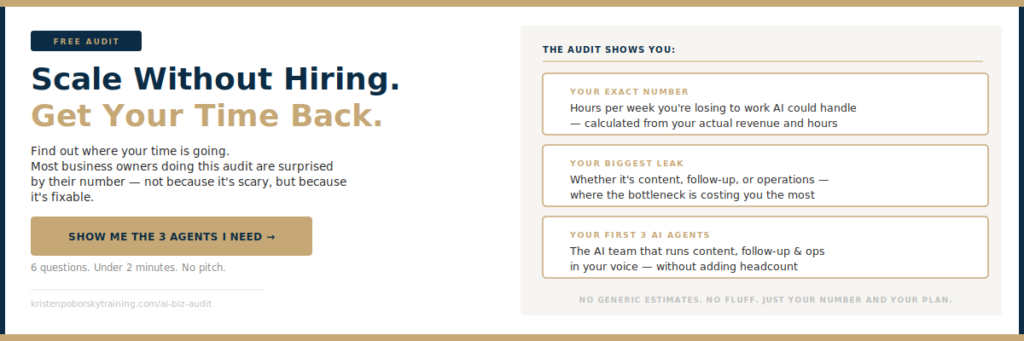
That’s also why I run my AI audit the way I do. It’s a conversation about your specific business, not a generic list of tools. What’s running on human energy that doesn’t have to? Which AI employee should you hire first? What’s it worth when it’s running? The audit has to start with the business, not the technology.
The 10-2 Life: What Happens When AI Employees Take Over the Work
When your AI employees run, capacity opens up. Not because the work got faster. Because it got handed off entirely. That’s the whole point, and it’s the piece nobody sold me on when I started using AI.
Here’s what my 10-2 life looks like on the other side of hiring that first AI employee. Work starts at ten. Deep work comes first, real thinking, real creating, real building. Calls and client work sit in the middle of the day. Admin comes last, and it stays tight. And at two, the laptop closes. Not because the to-do list is done. Because the AI employees are holding and running the rest of it.
My afternoons belong to the garden now. To the golf course. To long walks with my dogs on a sunny Seattle day. To sitting outside with a book and nowhere to be. To the summers I almost missed.
Now, a little honesty, because I want you going into this with clear eyes. This doesn’t happen in a weekend. Your first AI employee will get things wrong before it gets them right, the same way a new hire does in their first month. That’s normal, and it’s why the test-and-tweak part matters so much. And some tasks will always need your judgment. Client strategy, sensitive conversations, the calls only you can make. Those stay with you. That’s not a limitation of the system. That’s the system working, because the lens question already told you where you belong.
The business runs so the life can happen, not the other way around. AI employees are what make that design possible.
What To Do Next
You can hire your first AI employee today, and you don’t need any tech skills to do it.
Write down every recurring task in your business this week: follow-ups, content drafts, call summaries, client questions, onboarding messages.
Run each one through the lens question: does this need a human judgment call, or can an AI employee handle it completely?
Circle the 3 to 7 tasks that don’t need you. Pick one.
Build one AI employee for that one task, and feed it your brand voice, offer details, standards, and edge cases.
Test and tweak until it runs without you starting it. Then move to the next one.
Your first step today is the list. Fifteen minutes, pen and paper, every recurring task you touched this week.
And if you want help deciding which AI employee to hire first, that’s exactly what my free personalized AI audit does. It looks at your specific business and tells you where to start and what it’s worth when it’s running.
You started your business for freedom, and somewhere along the way it started running you. It doesn’t have to stay that way. The gap between where you are and a 10-2 life isn’t more hustle or more hours. It’s handing the repeatable work to AI employees that are trained to sound and decide like you.
Grab your free personalized AI audit and let’s figure out which AI employee to hire first. Your next summer is waiting, and this time you get to be outside for it.
Ready to build your AI business team?
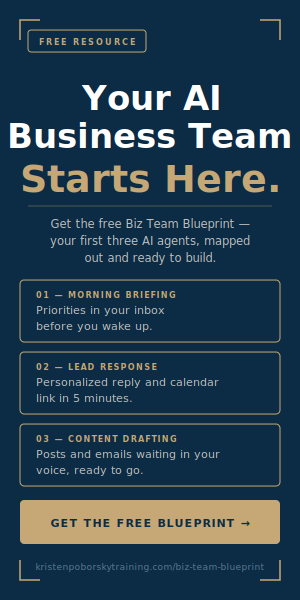
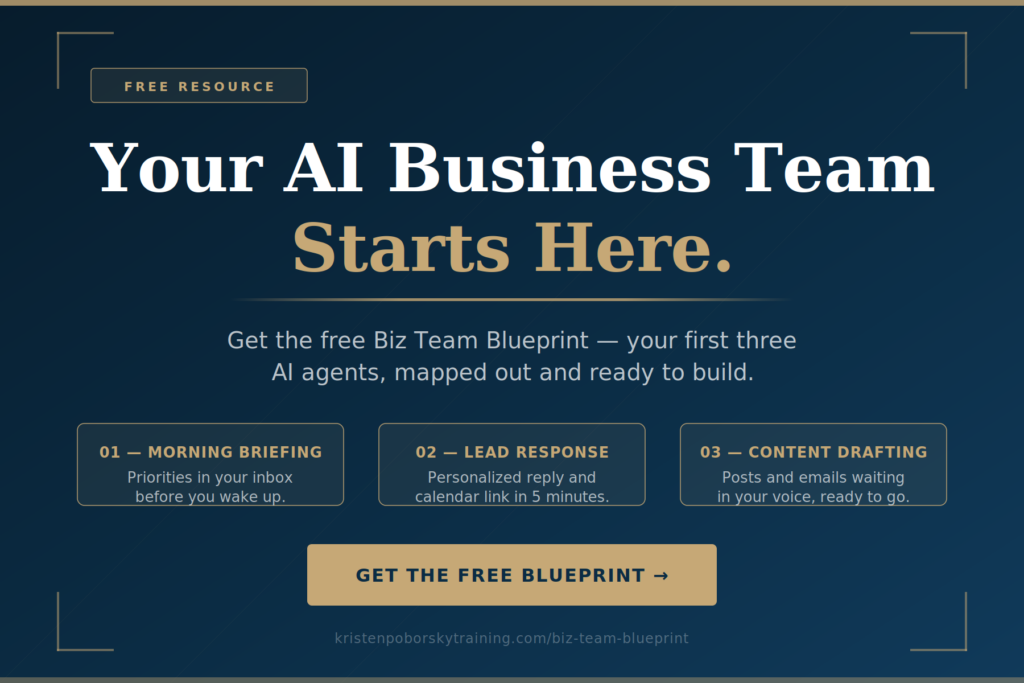
Get the free Biz Team Blueprint and see exactly what your first three agents should be — and how to set them up.
Get the Free Blueprint
Frequently Asked Questions About AI Empoyees
Q: What are AI employees?
A: AI employees are AI agents where each one owns a single recurring task in your business, like follow-ups, call summaries, or onboarding messages. Each one is trained with your brand voice, offer details, standards, and edge cases, so it runs the task completely rather than waiting for you to prompt it. It’s the difference between a tool you open and a hire that works.
Q: How are AI employees different from using ChatGPT?
A: ChatGPT is a tool: you open it, prompt it, review the output, and repeat, which makes you faster but keeps you in the middle of every task. An AI employee removes the task from your plate entirely. It has your context built in and handles the work whether or not you start it.
Q: Do I need tech skills to hire AI employees for my business?
A: No. What you need is business knowledge, because you’re the only one who knows which tasks in your business are truly repeatable and which ones need a human judgment call. The building part follows a repeatable process; the knowing-your-business part is the real requirement.
Q: Which tasks should I hand to my first AI employee?
A: List every recurring task in your business this week, then ask of each one: does this require a human judgment call? Most businesses find 3 to 7 tasks that don’t, and those are the first AI employees to hire. Start with one task and one AI employee, get it running well, then add the next.
Q: Will AI employees make my business feel impersonal to clients?
A: Not when they’re trained right. Each AI employee gets fed your brand voice, your standards, and your edge cases, then tested and tweaked until it sounds like you. And the tasks that genuinely need your judgment, like client strategy and sensitive conversations, stay with you.
That’s part of the design.