
Key Takeaways
- Anything that lives only in your head can’t be handed off, to a person or to AI. That’s the ceiling most small businesses hit.
- Getting it out is mostly talking. Record yourself answering the questions a smart new hire would ask, then let AI organize it.
- Once it’s captured, it goes into your Business Cortex and your SOPs, where your agents and your team can use it.
- It’s not a discipline problem. It’s a documentation problem.
This post is part of my complete guide to making AI sound like you — and work like you, too.
Read the full guide → How to Make AI Sound Like You
If you disappeared for two weeks, what would break?
Whatever just came to mind, that’s the part of your business that lives only in your head. Most owners I work with can name it in about three seconds. The client onboarding only they understand. The pricing call nobody else can make. The follow-up that happens because they remember, and doesn’t when they’re busy.
It’s also the reason AI hasn’t given them their time back. You can’t hand off work that isn’t written down, to AI or to anyone else.
Here’s why head-knowledge becomes your ceiling, the simple way I get it out, and where it goes once it’s out.
Why Is Head-Knowledge the Ceiling on Your Growth?
Knowledge that lives only in your head can’t be delegated, automated or passed to a new hire, so every task that depends on it keeps landing back on you.
I see this in almost every business audit I do. One client runs a 10-person sales team. When we audited his business, he was working 65 hours a week. Every morning from 10 to noon, he was answering his team’s questions. Two hours a day, every day, because the answers lived in his head and nowhere else.
His team wasn’t the problem. The problem was that nobody could find an answer without him.
It shows up in smaller businesses too. A VA who knows every workaround in your inbox. An assistant who knows which clients pay late and how to follow up. If they leave, that knowledge walks out with them, because none of it was ever written down.
I’m not immune to this. There are still pieces of my own business, like how I edit my videos, that only I can run because I haven’t documented them yet. That’s exactly the kind of thing that keeps an owner in the chair.
How Do You Get Your Business Out of Your Head?
You get your business out of your head by talking it out, not writing it out: record yourself answering the questions a smart new hire would ask, then let AI turn your answers into documents.
Writing it all down sounds like a huge project, and that’s why most people never start. Talking is different. You already explain these things to clients and team members every week. You only need to say them once more with a recorder running.
Start with questions like these:
- What do you do first every Monday, and why?
- When two clients need you at the same time, how do you decide who comes first?
- What does “done” look like for your most common deliverable?
- What would you never say or do with a client?
- What do people always get wrong the first time they do this?
Answer each one out loud using a voice tool. Don’t polish it. The stories and reasons that come out when you talk are the parts a checklist always misses.
Then hand the transcript to AI and ask it to organize what you said into steps, rules and examples. You review it once and fix what’s off. That’s it.
What Does This Look Like in a Real Business?
In a real business, a few recorded sessions become SOPs, a job description, a training plan and a knowledge base that people use instead of interrupting you.
For the sales team owner, we built a knowledge base his team could ask instead of him, a lead intelligence agent so warm leads stopped disappearing, and a retention agent so follow-up happened every time. His mornings became his own, and his team stopped waiting for him before they could move.
Another client runs operations for a multi-location retail business. When she suspected a key team member was about to leave, she had no idea what he actually did every day. Her AI HR assistant, which already knew her business, built a three-session interview guide for that person in about 30 minutes. Those three conversations became SOPs, a job description, a playbook for the next hire and a 30-60-90 day ramp-up plan.
Neither of them sat down and wrote a manual. They talked, or they had someone else talk, and AI did the organizing.
Where Should Your Business Knowledge Live Once It’s Out?
Once it’s out of your head, your business knowledge should live in two places: a Business Cortex that your AI agents read, and SOPs that your team follows.
The Cortex holds how you think. Your decisions, your standards, your priorities, what you’d never do. Every agent in your business reads it first, so it can work the way you would.
The SOPs hold how things get done. Step by step, for a specific task, written so someone else can do it without asking you.
Together they close the gap that keeps you in the chair. Your agents know your judgment. Your team knows the steps. And if someone leaves, gets sick or takes a week off, the knowledge stays.
The best time to do this is on an ordinary week, when nothing is on fire. The worst time is the day someone gives notice.
What To Do Next
Pick one thing only you know how to do, and get it out this week.
- Answer the two-week question. Write down the first thing that would break if you disappeared.
- Record one session. Use the five questions above and talk for 15 minutes about that one thing.
- Let AI organize it. Hand over the transcript and ask for steps, rules and examples.
- Put it where it gets used. Add the rules to your Business Cortex and the steps to an SOP your team can find.
If you want to see which parts of your business to get out of your head first, take the free 2-Minute AI Business Audit below. It shows you the first three agents to build, what not having them is costing you, and what changes once they’re running.
You’ve been carrying your whole business in your head because nobody gave you an easier way to get it out. Talking is the easier way. A few recorded conversations, organized by AI, can give your team and your agents what they need to run without you in the middle of everything. It’s not a discipline problem. It’s a documentation problem. Take the free 2-Minute AI Business Audit, or steal my AI org chart, and see what your team could be running without you.
Frequently Asked Questions
What does it mean to get your business out of your head?
It means capturing the knowledge, decisions and routines that only you carry, so your team and your AI agents can use them without asking you. In practice, that’s a Business Cortex for how you think and SOPs for how things get done.
What’s the fastest way to document how my business runs?
Talk instead of write. Record yourself answering the questions a new hire would ask, then have AI turn the transcript into steps, rules and examples. You review it once instead of writing it from scratch.
What is key-person risk in a small business?
It’s the risk that one person holds knowledge nobody else has, so the business stalls if they leave, get sick or take time off. That person is often the owner. Documenting what they know is how you reduce it.
Can AI really hold my business knowledge?
Yes, when you give it that knowledge in writing. AI agents that read your Business Cortex and SOPs can answer your team’s questions, follow your standards and make routine calls the way you would.
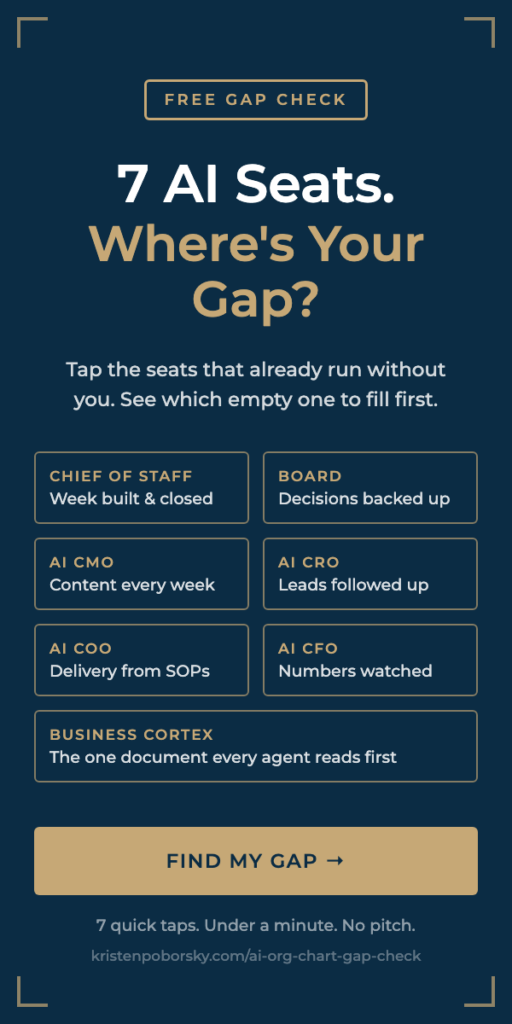
Want to know which AI agents your business needs first? Take the free 2-Minute AI Business Audit. It shows you the first three agents to build, what not having them is costing you, and what changes in your business once they’re running. Or steal my AI org chart and see which of the 7 AI seats your business still has empty.