
Key Takeaways
- AI sounds generic because it has never learned you — generic in, generic out. It was never your prompts.
- Voice capture has three layers: your voice, your audience, and your offers. Most people only capture the first — and that’s why their AI content still misses.
- The fastest shortcut is the record-first method: start from your spoken words instead of AI’s.
- Sounding like you is half the job. Working like you requires your decisions, your standards, and your systems — captured in a Business Cortex™.
- You can’t run a business on a voice file.
To make AI sound like you, stop prompting harder and train it once — on your voice, your audience, and your offers — in a playbook it references every time it writes. And if you want AI that doesn’t just write like you but WORKS like you — makes your calls, holds your standards, runs your systems — that takes a second, deeper document. I run my own business on both, and this page walks you through the whole thing.
Why Does AI Content Sound Generic?
Because AI doesn’t know you. When you open a chat and ask for an Instagram post, the AI has never learned your voice, your phrases, who your audience is, or what you offer — so it fills every gap with everyone else’s content. You get something that reads like it was written by a corporate intern who’s never met you.
If you’ve tried AI for content and rewrote everything it gave you, you’re not imagining it — and it wasn’t your prompts failing. Better prompts can’t fix missing knowledge. The fix isn’t asking differently; it’s teaching AI who it’s writing for and as, before it writes a word. Related: Is AI-generated content original?
How Do You Train AI to Sound Like You?
Voice training has three layers, and this is where most advice stops short — the internet is full of “feed AI your writing samples” tips that only capture layer one:
Your voice — your words, your phrasing, how you actually talk. This is what writing samples capture, and it’s necessary but not sufficient.
Your audience — who they are and what they’re struggling with, so every piece speaks to a real person instead of a feed.
Your offers — paid and free, so your content always knows where it’s leading. Voice without offers is a diary; voice with offers is marketing.
I capture all three in a single document — the AI Voice Authority™ Playbook — built through my 5-phase AI Voice Replication Framework™. Once it exists, using it is one line at the top of any AI chat: “Use my attached AI Voice Authority Playbook for voice, audience, and offers.” Every draft after that starts from you instead of from everyone.
The shortcut that accelerates everything: record first. Instead of asking AI to write and then fixing its voice, talk your ideas out — a 10-minute video, a voice memo — and have AI multiply your transcript. Your words go in, so your words come out. Stop Typing AI Prompts — Talk Instead Related: Can AI Create a Natural and Engaging Video Script?
What does trained-on-you output look like? One of my clients, a podcast producer, put it best after running her content through her playbook-trained system: “I just read through it, and I don’t have to change anything on it. And usually I edited everything.” Not “it was close.” Not “a good starting point.” She didn’t change a word.
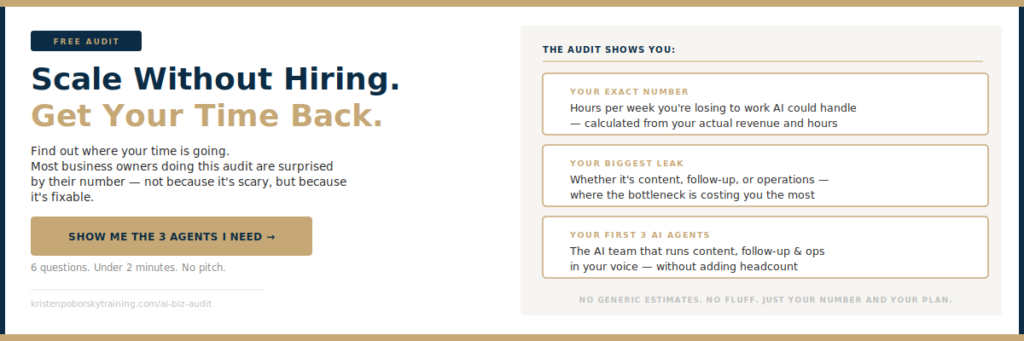
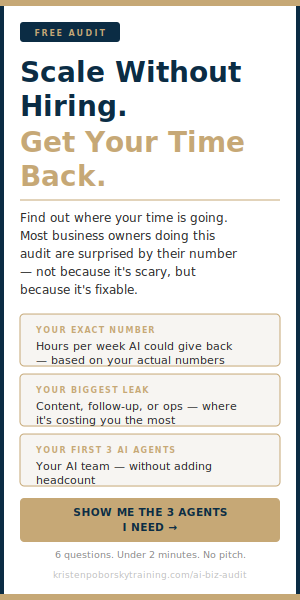
Not sure where your business should start? The free 2-Minute AI Business Audit shows you the first three agents to build, what not having them is costing you, and what changes once they’re running.
Is Sounding Like You Enough?
Here’s the honest answer nobody selling voice tricks will give you: no.
Voice capture is having a moment — everyone from AI gurus to video tools is teaching some version of “put yourself in a file.” And it works, for content. But watch what happens the moment you ask that same AI to do actual business work: answer an upset client’s email, decide which lead to follow up first, plan a launch, brief a contractor. It writes like you — and works like nobody. It doesn’t know how you make decisions, what your standards are, what you’d never say to a client, or how work moves through your company.
Voice cloning is the easy half. A voice file makes AI a good ghostwriter. It does not make AI a good employee. Related: Why Training AI on Your Voice Isn’t Enough
How Do You Make AI Work Like You?
You go one document deeper. Alongside the voice playbook, I build every client a Business Cortex™ — the master document that captures how you actually run your company: your decision-making, your standards, your frameworks, how you think. Not just how you sound — how you operate. Related: What Is a Business Cortex?
Getting there means getting the business out of your head — the judgment calls you make on autopilot, the things “everyone just knows,” the way you’d handle the tricky email. It sounds like a big job; it’s mostly talking, captured and structured. Related: How to Get Your Business Out of Your Head
Once the Cortex exists, every AI agent in your business runs on it — and that’s when the shift happens. Your content agent doesn’t just write in your voice; it knows which offer this week’s post should point to. Your operations agent doesn’t just draft the client email; it answers it the way you would, holding your standards. That’s the difference between AI that knows your voice… and a team that knows your business. The AI Business Team: How to Grow Without Hiring
How Do You Start?
Two free ways to find your starting point:
Take the audit: the free 2-Minute AI Business Audit shows you the first three agents your business needs, what not having them is costing you, and what changes once they’re running.
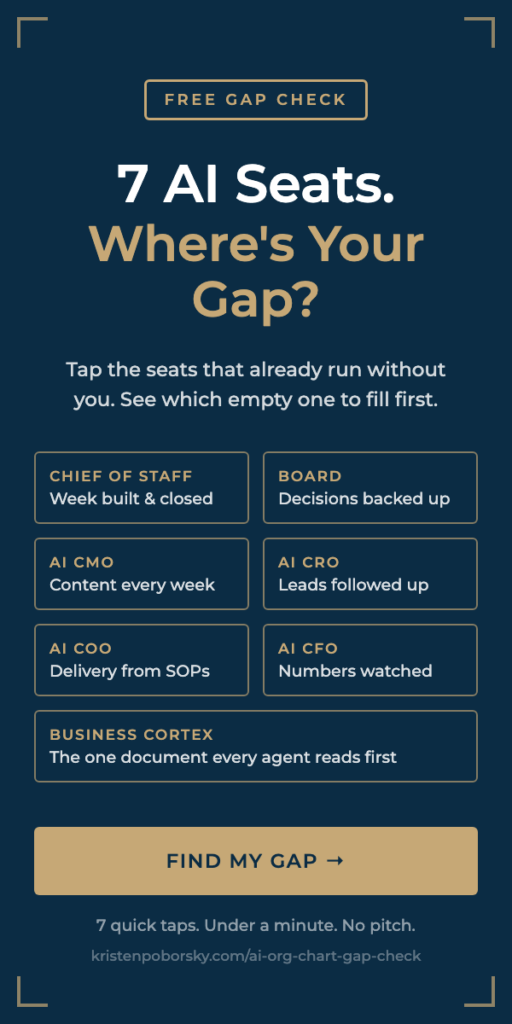
Steal my org chart: see the 7 AI seats every $100K+ business should have filled, and find out which ones are still empty in yours.
FAQ: Making AI Sound (and Work) Like You
Can’t I just feed ChatGPT or Claude my writing samples?
Samples capture layer one — your phrasing. They don’t capture your audience or your offers, which is why sample-trained AI sounds like you but writes to no one and sells nothing. Capture all three layers and the difference is immediate.
What is a voice playbook?
A single document that captures your voice (words, phrasing, tone), your audience (who they are, what they’re struggling with), and your offers (paid and free) — so AI references you before it writes. Mine is the AI Voice Authority™ Playbook, built through a 5-phase framework.
What’s the difference between a voice playbook and a Business Cortex™?
The playbook makes AI sound like you — it’s the marketing layer. The Cortex makes AI work like you — decisions, standards, frameworks, systems. For content, the playbook is all you need. For a team of agents running your business, you need the Cortex.
How long does training AI on my voice take?
Done for you: about 30 minutes — you answer questions, my agents build the playbook. DIY from samples: expect days of trial and error, and you’ll still be missing the audience and offer layers.
Will AI trained on me still need editing?
Light review, yes — you’re the publisher. Rewriting, no. The goal is the zero-edits experience my clients describe: read it, approve it, ship it.
I’ve tried this before and it still sounded robotic. Why would this work?
Because “this” was probably layer one — samples or a style prompt. Robotic output is a missing-knowledge problem: no audience, no offers, no stories. Fix the inputs and the output changes. That’s the entire reason the playbook exists.
The Bottom Line
AI that sounds like you gets your content done in your voice. AI that works like you gets your business done to your standards. They’re two floors of the same house. You can’t run a business on a voice file. But you can absolutely run one on a voice file plus a Cortex — I do it every day. Not sure which floor to build first? Take the free 2-Minute AI Business Audit, or steal my AI org chart.
Last updated: September 2026 · By Kristen Poborsky — creator of the AI Voice Authority™ methodology and builder of custom AI business teams for coaches, consultants, and course creators. 16+ years helping experts turn content into clients, on top of a 40-year business career including a $300M retail division and Microsoft. Everything on this page, I run in my own business first.