
Last updated: September 2026
Key Takeaways
- AI can write a natural, engaging video script, but only when it starts from your own words, stories and way of explaining things.
- Scripts sound stiff because AI writes for the page, not for your mouth, and it has never heard you teach.
- Start from something that’s already yours, like a transcript, a voice memo or a brain dump, and give AI your audience and offers so it knows where the video leads.
- Read the draft out loud and speak back how you’d really say it. By the time you film, it feels like you’ve already rehearsed.
This post is part of my complete guide to making AI sound like you — and work like you, too.
Read the full guide → How to Make AI Sound Like You
Ask generic AI to “write a video script” and you’ll get something you would never say out loud. It’s tidy, it’s structured, and it sounds like a stranger reading your notes.
Back in 2024, I asked whether AI could create a natural and engaging video script, and my answer was “not on its own.” That’s still true. What’s changed is how I work with it. Every lesson, training and weekly video I record now starts with an AI draft, and I’m happy to get on camera with it.
Here’s why AI scripts sound stiff, how I script with AI today, and what to do with the draft once you have it.
Can AI Write a Natural, Engaging Video Script?
AI can write a natural, engaging video script when the script is built from your own words, stories and way of explaining things, and it can’t when you ask it to start from nothing. A script from a blank prompt gives you the average of every script on the internet. A script built from you gives you something you can say without flinching.
What AI does well is structure. Give it your ideas and it will find the hook, put your points in order and keep you from wandering. That’s the part most of us struggle with when we sit down to record.
What it can’t do on its own is know your stories. It doesn’t know the client moment that made you change your whole approach, or the phrase you use every time you explain your framework. Those are the parts your audience remembers, and they only get into a script if you put them there.
So the question isn’t whether AI can write your script. It’s what you give it to write from.
Why Do AI Video Scripts Sound So Stiff?
AI video scripts sound stiff because AI writes for someone reading, not for someone speaking, and it has never heard how you talk.
Written language and spoken language are different. On the page, long sentences and neat transitions work fine. Out loud, they sound like a press release. When you try to deliver them, you end up stumbling, going back, or reading in a flat voice because the words aren’t yours.
There’s a second reason, and it’s the one most people miss. When you type your request into AI, your conscious mind filters it before it ever reaches the screen. You shorten the story. You leave out the detail that made it land. You write a tidy summary of what you want to say. AI takes that polished input and hands you polished output, and polished is exactly what sounds stiff on camera.
I noticed this in my own content. The scripts I got from typed briefs were fine. The scripts I got after talking to AI about what I wanted to say sounded like me.
How Do You Write a Video Script With AI That Sounds Like You?
You write a video script with AI that sounds like you by starting from something that’s already yours, then giving AI the context it needs to shape it.
Start with your own words. That can be the transcript of an older video on the same topic, a voice memo you recorded in the car, or a brain dump you spoke into Wispr Flow. I still use transcripts for this every week. They’re the fastest way to get your real phrasing in front of AI.
Then give it the rest of you. In my business, that’s my AI Voice Authority Playbook and my Business Cortex. The playbook tells AI who I’m talking to, what they’re struggling with and which offer the video should lead to. The Cortex holds how I think and what I’d never say. With both attached, AI isn’t guessing at my audience or my call to action.
Then let it draft. Ask for a hook, your main points and a close that leads somewhere. Don’t ask it to sound like you. It already has what it needs.
This is exactly how I built the lessons for my Heart-Centered Download Method. I worked with my AI to get each lesson script done, let it write, then went back through it and gave it my version.
Should You Read an AI Script Word for Word?
You shouldn’t read an AI script word for word. Read it out loud once before you film, speak back how you would really say each part, and leave room to riff while you record.
Here’s the loop I use. When the draft comes back, I read it out loud. Anything that feels awkward in my mouth, I don’t fix by typing. I pick up my voice tool and say, “That’s not how I’d say it. Here’s how I’d say it,” and let the words come out. AI takes that and rewrites the script closer to how I talk.
Something happens when you work this way. By the time you sit down to film, it’s like you’ve already rehearsed it. You’ve said the ideas out loud once already, in your own words, so the camera doesn’t feel like a test.
And when I’m actually delivering it, I add more. A story comes up that wasn’t in the script. A client question pops into my head. That’s the part your audience connects with, and it only happens when the script is a guide instead of a teleprompter you have to read line by line.
One caution. Give the script one voice pass, maybe two. If you keep reworking it, you drift away from your first, most honest version, and that’s usually the one worth filming.
What To Do Next
Pick your next video and try this once.
- Find something that’s already yours. An old transcript, a voice memo or a spoken brain dump on the topic.
- Attach your context. Whatever document holds your voice, audience and offers. If you don’t have one yet, write three short paragraphs covering those three things.
- Let AI draft the hook, points and close. Then read it out loud and speak back your version once.
- Film with the script as a guide. Leave space for the story that shows up on the day.
If you want to see where AI can take more off your plate than scripting, take the free 2-Minute AI Business Audit below. It shows you the first three agents to build, what not having them is costing you, and what changes once they’re running.
AI was never going to hand you a script that sounds like you from a blank prompt. It can hand you one built from your own words, shaped around your audience, and read back until it fits how you talk. That’s a script you can film without stumbling, and one your audience hears as you. Take the free 2-Minute AI Business Audit, or steal my AI org chart, and see what else your AI team could be handling.
Frequently Asked Questions
Can AI write a video script that sounds human?
Yes, when it starts from your words instead of a blank prompt. Give it a transcript, voice memo or spoken brain dump, plus who you’re talking to and what you offer. Then read the draft out loud and speak back your changes so it matches how you talk.
Should I read an AI-written script word for word?
No. Use it as a guide. Read it out loud once before filming, speak back how you’d really say each part, and leave room for the stories and examples that come up while you’re recording. That’s usually the part your audience connects with most.
How do I keep my stories in an AI-written script?
Put them in before AI writes anything. Stories live in your transcripts and voice memos, not in a typed prompt. When you talk through the topic first, AI has your real examples to work with and keeps them in the draft.
Which AI tool should I use to write video scripts?
The tool matters less than what you give it. I work in Claude with my voice playbook and Business Cortex attached, and I use Wispr Flow to talk to it instead of typing. Any AI that lets you attach your own documents and speak your input will work.
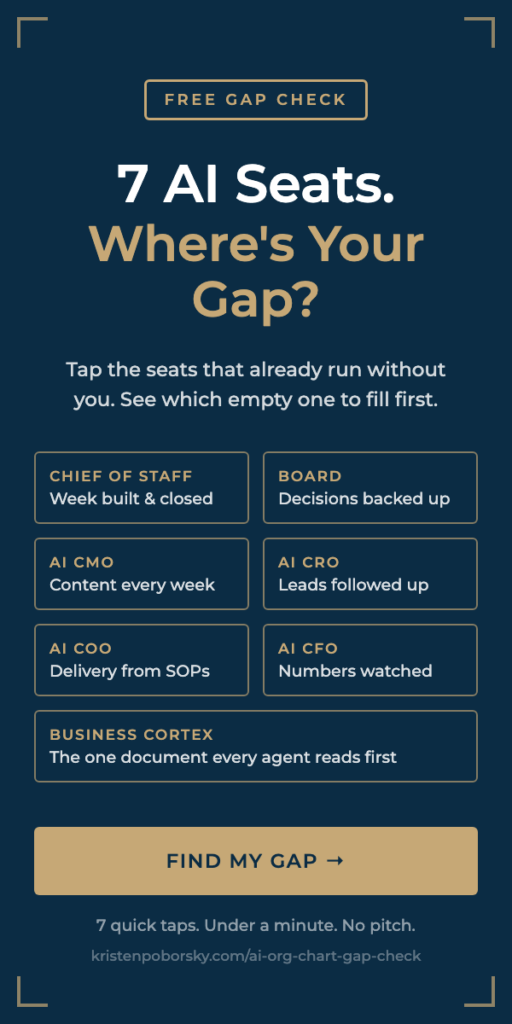
Want to know which AI agents your business needs first? Take the free 2-Minute AI Business Audit. It shows you the first three agents to build, what not having them is costing you, and what changes in your business once they’re running. Or steal my AI org chart and see which of the 7 AI seats your business still has empty.