
Key Takeaways
How to Make AI Sound Like You (Better Prompts Won’t)
AI writes the average of everyone it learned from, so without your real words it fills every gap with generic copy.
Describing your voice with adjectives like warm, friendly and professional gives AI nothing to copy. Your competitors use the same three words.
To make AI sound like you, give it evidence. That means real phrases you use, how you open and sign off, and the words you would never say.
Put that evidence in one document your AI reads first, every time, and your editing drops to a few small changes.
You’ve written better prompts. You’ve typed “make it sound like me,” pasted in your old prompts and asked for something warm and professional. The draft still comes back flat, like a stranger wearing your name tag. So you fix it. You change the opening, cut the words you would never say and put your own phrases back in. By the time it sounds like you, you’re thinking you might as well have started from scratch.
I build AI systems for coaches and consultants, and this is the pattern I see more than any other. It’s also the first thing I fix. If you want to make AI sound like you, the answer isn’t a better prompt. This article covers why AI goes generic every time, what it actually needs from you, and an exercise you can do today.
Why Does AI Make Everything Sound Generic?
AI sounds generic because it learned to write by reading millions of people, and when you ask it for a post, it writes the most likely post. AI writing sounds generic because, without samples of your real words, a language model fills every gap with the most statistically likely phrasing, which is the average of everyone it learned from.
That average is the opposite of what you want. Your clients hired you because you don’t sound like everyone else.
I know this from my own work. When I let AI write without my voice in front of it, the draft comes back sounding like a high school paper, or too business-y. Neither is how I write or how I talk.
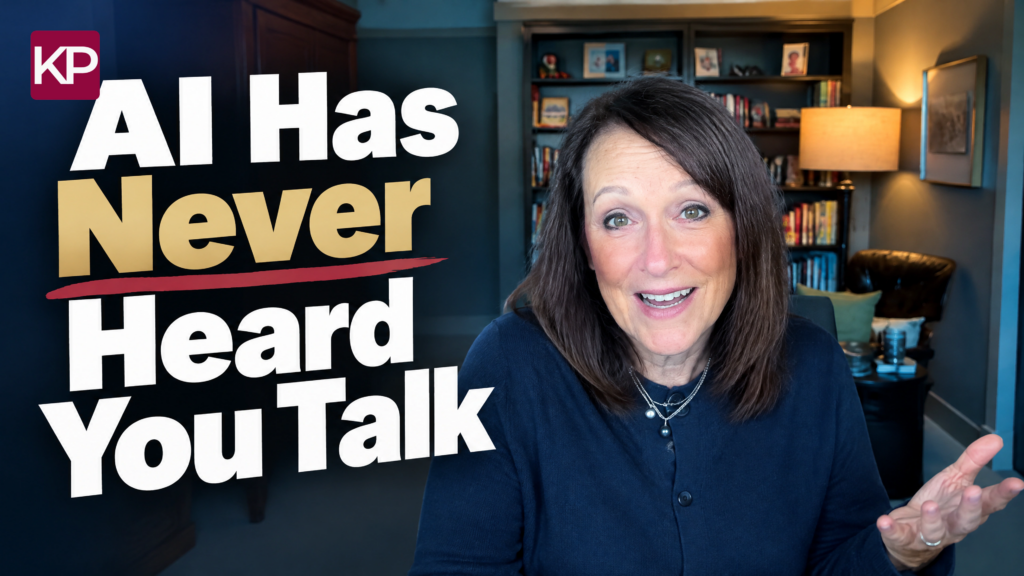
So most people tell it, “Make it sound like me.” AI has never heard you talk. It doesn’t know the phrase your clients quote back to you. It doesn’t know there are words you wouldn’t say in a million years. So it guesses, and the guess sounds like everybody else.
This is why switching tools rarely helps. ChatGPT, Claude and every AI content tool learned the same way, so every one of them defaults to the same middle. A new tool gives you a different flavour of average.
Better prompts hit the same wall. A prompt can tell AI what to write and how long to make it. It can’t hand over a voice the AI has never seen. Until you give it real samples of how you sound, every prompt is asking it to imitate a person it has never met.
Why “Warm, Friendly and Professional” Won’t Make AI Sound Like You
When the first drafts come back generic, most people try to fix it with adjectives. They type in words like warm, friendly and professional and expect a different result.
Try this test. Describe your voice in three words. Now ask yourself if your biggest competitor would use those same three words.
They probably would. Nearly every coach on the planet thinks of themselves as warm, friendly and professional. Those words feel personal when you write them, and they’re still generic. They describe a category of voice, not your voice.
That’s the problem with adjectives. AI can’t copy an adjective. “Warm” could mean a dozen different things, so AI picks the most common version of warm, and you’re back to average. It still fills in the blanks, and it fills them with whatever most people would write.
I see the same thing when people write long voice instructions. They add more descriptions, more tone words, more rules about being conversational. The drafts improve a little and then stall, because every one of those instructions is still a description. None of them is a sample.
If your voice instructions are mostly adjectives, that’s where the problem sits. If you already have real writing samples in front of your AI and it still sounds off, the gap is usually in what’s missing from those samples, especially the words you’d never use. That part comes next.
What AI Needs to Sound Like You Is Evidence
AI doesn’t need adjectives. It needs evidence, and evidence is your actual words.
When I build a voice for a client, I don’t ask them how they describe themselves. I look at what they’ve actually said and written. An email they sent their list. A post that landed. A video transcript. The pieces they’re proudest of, the ones that sound most like them at their best.
From those, I pull out the things AI can copy and use:
Rhythm. Do you talk in punchy, short lines or long, flowing ones?
Openings and sign-offs. How you start and how you close.
Your phrases. The ones you say all the time, and the ones your clients repeat back to you.
The words you’d never use.
Your stance. What you stand for, what you promise and what you’d never promise.
Your reader, in their words. Who you’re talking to, described the way they describe themselves.
What you sell. So the content you create leads somewhere.
Of everything on that list, the words you’d never use matter most, more than people think. Take out the wrong words and you’re halfway there. Most of what makes a draft feel off is a handful of words you would never say. Remove those and the draft starts sounding like you before anything else changes.
A quote is something AI can copy. An adjective is something it has to guess at. Give it the quote every time.
Put Your Voice in One Place Your AI Reads First
Once that evidence is pulled together, it goes into one document. I call it the AI Voice Authority Playbook. It’s your voice, written down.
Every time I work with my AI team, it reads that playbook before I ask it for anything. Same for my clients. That’s the difference between AI guessing and AI working from something real.
This is how I think about every system I build. Systems first. AI serves the system. Without a foundation underneath it, AI produces slop. With your voice written down, AI has something real to work from. The playbook is the system underneath your content. And it isn’t a few words sprinkled here and there. It’s a real document about your business and how you sound.
Here’s what that looks like in practice. One of my clients has a weekly podcast and was editing everything, every description, every post, every single week. We uploaded their transcript, put their voice in a central place and gave their AI agents access to it. After that, we changed very little. The client told me they used to edit everything, and they called the new output a thousand times better than anything they’d done before.
Same AI. Slightly different input.
The full playbook used to take my clients a few sessions to build, so I built a shorter version. It’s a conversation of about 20 minutes. You share one thing you’ve said or written and answer a handful of questions. If you don’t have a recording or anything written, you can answer out loud with voice-to-text, and your answers become the sample. If your AI results feel inconsistent across the board, not only in voice, the same principle applies to your whole business. I wrote about that in Why Your AI Results Are Inconsistent (It’s Not the Prompts).
What To Do Next
You can start making AI sound like you today with a pen and one piece of your own writing.
Find one thing you wrote recently that sounds like you. An email to your list is perfect. A blog post works too.
Write down five phrases you always use. Read the piece and pull out the lines that are unmistakably yours.
Write down five words you’d never use. If you don’t want to write the lists yourself, feed the piece into your AI and ask it to find them.
Paste both lists at the top of your next AI request with one line, “Write like this, never use these words.”
That’s the first step, and it’s the one to do today. It isn’t the full playbook, but you’ll see a difference on your next AI draft. Once you’ve seen it work, build out the rest, covering your openings, sign-offs, client language and what you stand for, and keep it in one place your AI reads before every request.
If your AI still sounds generic, stop blaming your prompts. Give it your voice written down, and give it that first, every single time. To see the whole system working, I’m hosting a free live Open House on Thursday, November 12 at 11am Pacific. I’ll take one video I’ve already filmed and turn it into a week of content in my voice, live. Register for the free Open House.
Frequently Asked Questions
Q: Why does AI writing sound generic?
A: AI learned to write by reading millions of people, so when it has nothing of yours to work from, it writes the most likely version, the average of everyone. Without samples of your real words, it guesses, and the guess sounds like everybody else.
Q: Can better prompts make AI sound like me?
A: Prompts help with structure and task, but they can’t hand AI a voice it has never seen. Typing “make it sound like me” or adding tone adjectives still leaves AI guessing. What changes the output is giving it real samples of your writing and a list of words you’d never use.
Q: How do I train ChatGPT or Claude to write like me?
A: Start with one piece of writing that sounds like you. Pull out five phrases you always use and five words you’d never use, and paste both lists at the top of your next request with the line “Write like this, never use these words.” For lasting results, keep a full voice document your AI reads before every request.
Q: What is an AI Voice Authority Playbook?
A: The AI Voice Authority Playbook is Kristen Poborsky’s name for a single document that captures how you sound, drawn from your own words. It covers your rhythm, openings and sign-offs, the phrases you use, the words you never use, what you stand for, who you’re talking to and what you sell. Your AI reads it first before writing anything.
Q: Why do the words I’d never use matter so much?
A: Most of what makes an AI draft feel wrong is a small set of words you would never say. Removing them gets you about halfway to sounding like yourself, which is why a “never use” list is often the fastest improvement you can make.
Not sure where AI fits in your business yet? Take the free 2-Minute AI Business Audit and find out where your time and money are leaking before you build anything.