
Last updated: September 2026
Key Takeaways
- Inconsistent AI results are almost never a prompting problem. They’re an access problem.
- Your standards, decisions and judgment calls live in your head, which is the one place AI can never reach.
- A longer prompt or a better writing sample won’t fix it. One central source of truth that every agent pulls from will.
- More agents on top of scattered knowledge just means more places guessing wrong, faster.
This post is part of my complete guide to getting your business ready for AI.
Read the full guide → Systems Before Agents
You’re already using AI. So why are the results still inconsistent?
Not “should I try AI.” You’re past that. The real question is why the output still misses half the time, why you’re still rewriting it, and why it still doesn’t quite think the way your business thinks.
I spent 40 years building operational systems, including running a $300 million retail division, before I ever built an AI agent. What I see now is the same pattern I saw then, just wearing a new outfit. The AI you’re already using is only ever as good as what it can actually reach.
Why Are Your AI Results Inconsistent?
Your AI results are inconsistent because the AI is guessing at things it was never given. Your standards, your decisions and your way of running things aren’t centralized anywhere it can pull from.
Every time you open a chat and get something almost right, that’s not a prompting problem. It’s an access problem.
You’re good at a lot of things. That’s not the issue. The issue is where all of that lives. Your standards live in your head. Your decision-making lives in your head. The way you’d handle the tricky client, the thing you’d never say in an email, the judgment call you make in two seconds without thinking about it. None of that is written down anywhere.
It’s not disorganized. You’re clearly running a real business. It’s just centralized in exactly one place an AI agent can never reach: you.
Why Don’t Better Prompts Fix It?
Because the prompt was never the constraint.
When the output keeps missing, the instinct is to try a different model, a different platform or a better prompt library. That fixes nothing, because every new tool is guessing at the same things it was never given access to.
I’ve had clients who were already sophisticated AI users. Folders of prompts, a few agents already built. And their output still felt like it was written by someone smart who’d never actually worked at their company.
Their IP wasn’t missing. It just wasn’t centralized anywhere their team or their AI could get to it.
What Does Centralized Actually Look Like?
It looks like one central document that holds your actual standards, your decisions and your way of running things. I call it a Business Cortex.
Not a longer prompt. Not a better writing sample. One source of truth for the stuff that’s currently only in your head.
Once that exists, every agent you build pulls from the same source. Your content agent, your operations agent, your sales agent, all reading from the same page instead of each one guessing on its own.
That’s the difference between AI that occasionally gets it right and AI that consistently thinks the way you do. I explain exactly what goes into one in What Is a Business Cortex?
Why Does Adding More Agents Make It Worse?
Because more agents on top of scattered knowledge just means more places guessing wrong, faster.
The businesses winning with AI right now aren’t the ones with the most tools. They’re the ones whose knowledge got centralized before they scaled the number of agents pulling from it.
It’s the same sequence I teach in Systems Before Agents: document first, then build. Skip it, and every new agent you add inherits the same gap.
What To Do Next
Before you build another agent, give your AI something consistent to pull from.
- List what your AI keeps getting wrong. The tone, the decision, the detail you always fix. That’s the knowledge it doesn’t have.
- Talk it out. Record yourself explaining how you’d handle it and why. Documenting is mostly talking.
- Put it in one place. One central document every agent reads from, not scattered across chats and prompts.
- Point every agent at it. Then watch how much less you rewrite.
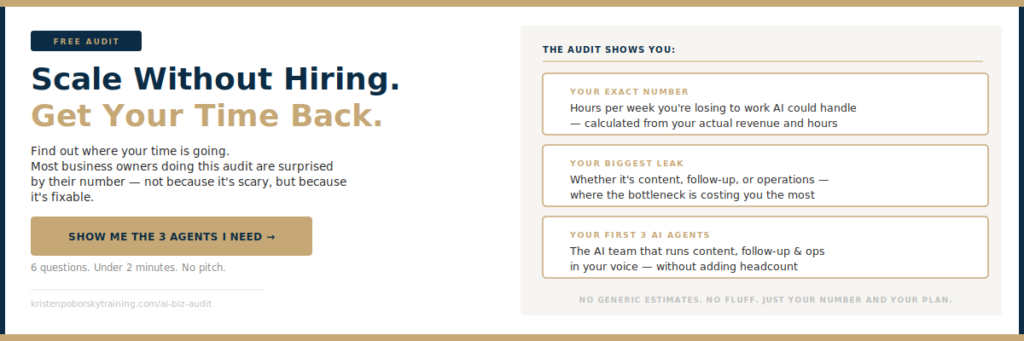
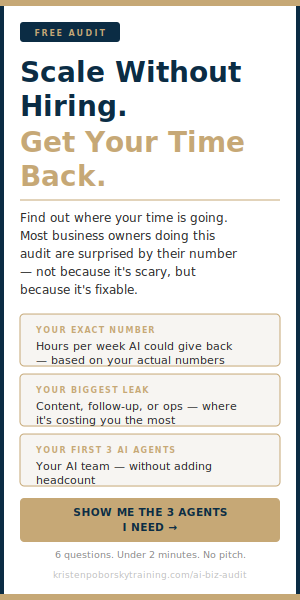
If you’d like to see which agents should be pulling from that source first, take the free 2-Minute AI Business Audit below. It shows you the first three agents to build, what not having them is costing you, and what changes once they’re running.
You’re not behind on AI. Your knowledge is just still living in your head instead of one place your team and your AI can both reach. More tools won’t fix inconsistent output. A central source of truth will. Take the free 2-Minute AI Business Audit, or steal my AI org chart, and see which seats your AI team still has empty.
Related: Why AI Isn’t Working in Your Business: The 4 Real Reasons • How to Get Your Business Out of Your Head (With AI)
Frequently Asked Questions
Why are my AI results inconsistent?
Because the AI is guessing at things it was never given. Your standards, decisions and judgment calls live in your head, so every chat starts without them. It’s an access problem, not a prompting problem.
Will better prompts fix inconsistent AI output?
Not on their own. A better prompt helps one chat. The fix that lasts is putting your standards in one central document that every agent pulls from.
What is a Business Cortex?
It’s one central document that holds your standards, your decisions and how you run your business. Every AI agent you build reads from it, so they all work from the same source instead of guessing.
Should I build more AI agents to get better results?
Not until your knowledge is centralized. More agents on top of scattered knowledge just means more places guessing wrong, faster.
Want to know which AI agents your business needs first? Take the free 2-Minute AI Business Audit. It shows you the first three agents to build, what not having them is costing you, and what changes in your business once they’re running. Or steal my AI org chart and see which of the 7 AI seats your business still has empty.