
Key Takeaways
- Most failed AI implementations are strategy failures disguised as technical problems. Agents know nothing about your business on day one.
- You can’t hand off work that isn’t documented. That rule predates AI, and it governs AI.
- The sequence: document, audit, then agents. Never the reverse.
- Documenting is mostly talking. The knowledge is already in your head; it just needs capturing and structuring.
- You can’t see what you can’t see, which is why the audit comes before the build.
Getting your business ready for AI has almost nothing to do with technology. It’s one principle: you can’t hand off work that isn’t documented, not to a new hire and not to an AI agent. The sequence that works is systems first, agents second. Get the business out of your head, audit where the time and money leak, and then build agents on top of documented systems. Skip the first two steps and AI makes you more overwhelmed, not less. I’ve spent 40 years building operational systems. Here’s the whole sequence.
Why Do Most AI Implementations Fail?
Talk to any business owner who “tried AI and it didn’t stick” and you’ll hear the same story. They bought the tools, collected the prompts, maybe even built an agent, and ended up with more work, not less. Reviewing generic output. Re-explaining the business in every chat. Fixing things that would’ve been faster to do themselves.
Here’s what actually happened: the AI was asked to run a process that didn’t exist anywhere except the owner’s head. An agent on day one knows nothing about your business: your clients, your standards, your way of deciding. Hand it undocumented work and it fills every gap with guesses. The failure was never the technology. It was the missing system underneath it. Related: Why AI Isn’t Working in Your Business: The 4 Real Reasons
What Does “Systems Before Agents” Mean?
It means the order of operations is the strategy. Before I built a single AI agent, for myself or any client, I spent 40 years building operational systems, including running a $300 million retail division. The lesson from all of it is the same one that governs AI today: growth doesn’t come from working harder or hiring more people. It comes from systems that make the right things happen without you in the middle of every decision.
Agents are simply the newest, and best, way to run those systems. But an agent without a system is a very fast way to do the wrong thing. The businesses winning with AI right now aren’t the ones with the fanciest tools. They’re the ones whose processes were documented enough to hand off. Systems first. Agents second. Related: How I Went From 60-Hour Weeks to Half That Using AI
Where Is Your Business Leaking Time and Money?
You can’t see what you can’t see. When you’re inside the business every day, the leaks look normal. The follow-ups that quietly never go out. The leads sitting untouched. The task only one person knows how to do. The hour a week that’s been “just how we do it” for three years. In my client work, every leak falls into one of five categories, and knowing which category is yours tells you exactly what to document and automate first. Here are all five: The Five Places Your Business Leaks Time and Money. Related: AI Business Team: Stop Losing Revenue to Blind Spots
The most expensive leak of all is the invisible one: the business that lives in someone’s head. If a key person left tomorrow, or if you stepped away for two weeks, what would break? Whatever came to mind is undocumented, unprotected and impossible to hand off. Related: AI Business Continuity: What Happens When They Leave?
What Should You Document Before Building AI?
Three layers, and none of them require you to become a documentation person:
- Your processes: how work actually moves. Onboarding, delivery, follow-up, the weekly rhythm. The stuff “everyone just knows.”
- Your decisions and standards: how you’d answer the tricky email, what “good enough to publish” means, how you prioritize when everything’s urgent.
- Your voice: how you talk to clients and your audience. It’s the layer most people start with, and the easiest.
The good news: documenting is mostly talking. Record yourself answering the questions a smart new hire would ask, and let AI structure the answers. Related: How to Get Your Business Out of Your Head (With AI) • Why Your AI Results Are Inconsistent (It’s Not the Prompts)
Captured and organized, those three layers become the master document my clients’ entire AI teams run on: the Business Cortex™. Related: What Is a Business Cortex? The full method is in How to Make AI Sound Like You, and Work Like You, Too.
What Is an AI Business Audit?
It’s the diagnosis that comes before any build: a structured look at your entire business. Where the time is leaking, where the money is stuck, which systems exist only in heads. It produces a prioritized map of what to document and automate first, sequenced for maximum relief. Not a vague strategy doc. A build order.
Why a diagnosis instead of just starting? Because owners reliably automate the wrong thing first: the annoying task instead of the expensive one. The audit finds the leak that’s actually costing you, which is rarely the one that’s bothering you. Related: What Is an AI Business Audit?
Then, and Only Then, the Agents
With systems documented and the audit done, agents stop being a gamble and start being an install. Each one gets a defined job, runs on your documented process and holds your standards, because those standards finally exist somewhere an agent can read. That’s when you get the results people buy AI hoping for: work handled to your standards without you in the middle. The full picture of what that team looks like is here: The AI Business Team: How to Grow Without Hiring. To see how you hire each one, read AI Employees: How to Hire Your First AI Team Member.
How Do You Start?
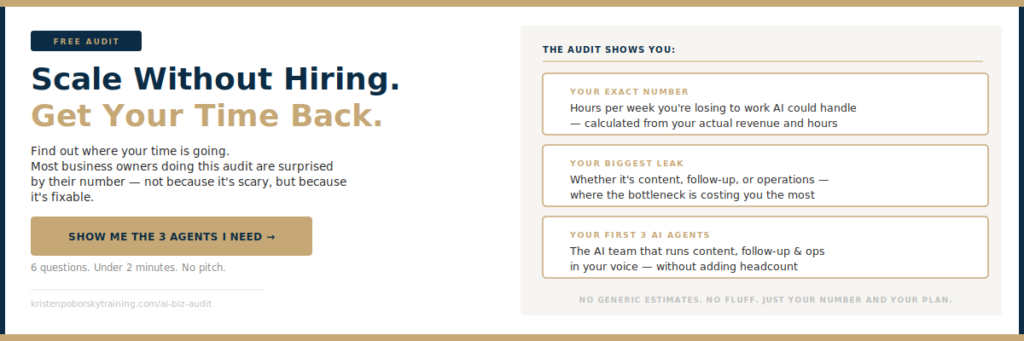
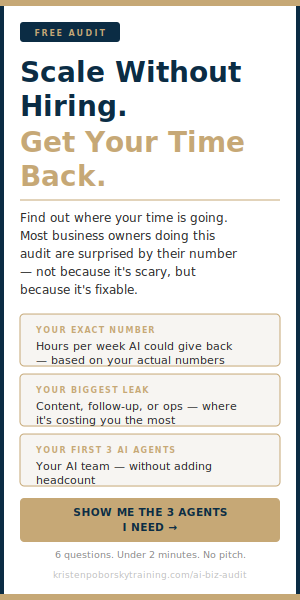
Start by seeing where your business leaks. The free 2-Minute AI Business Audit shows you the first three agents to build, what not having them is costing you, and what changes once they’re running.
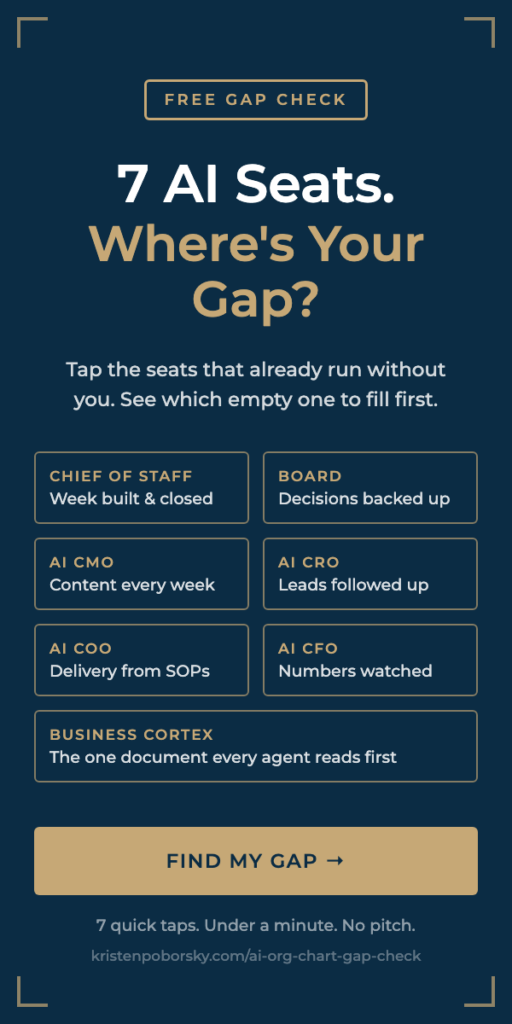
Want to see the whole structure first? Steal my AI org chart and see which of the 7 AI seats your business still has empty.
The Bottom Line
AI isn’t a shortcut around building a real business. It’s the payoff for having one. Document what’s in your head, find the leaks, and then let agents run what you’ve built. That’s the sequence that makes AI actually hold. Take the free 2-Minute AI Business Audit, or steal my AI org chart. Systems first. Agents second. Growth without more of you.
Last updated: September 2026 · By Kristen Poborsky, builder of custom AI business teams for coaches, consultants and course creators. 16+ years helping experts turn content into clients, on top of a 40-year business career including a $300M retail division and Microsoft. Everything on this page, I run in my own business first.
FAQ: Getting Your Business Ready for AI
Do I really need systems before using AI?
For content, you can start light; a voice foundation is enough. For agents running real business functions, yes. An agent executing an undocumented process executes guesses. Systems first is the difference between AI that holds and AI that adds work.
What if nothing in my business is documented?
You’re the norm, not the exception. Most established businesses run on head-knowledge. Start with the one process that would hurt most if the person who knows it disappeared. It’s not a discipline problem. It’s a documentation problem, and it’s fixable by talking.
How long does documenting take?
Less than you fear. Because the method is recording yourself (or your team) answering structured questions, most core processes can be captured in one focused session each, and AI does the organizing. The audit tells you which handful actually matter.
Can AI help me do the documenting?
Yes. It’s the best use of AI most owners never try. Talk, and let AI structure your answers, ask follow-up questions and turn them into SOPs and standards. You supply the knowledge; AI supplies the format.
What’s the first system I should document?
Whichever one runs through you the most. If every week includes you personally doing or approving it, it’s costing you the most hours and it’s the first candidate. For most coaches and course creators, that’s content, follow-up or client onboarding.
Isn’t this just “write SOPs,” which nobody ever does?
The old version was, because writing SOPs by hand is miserable and they went stale in a drawer. The new version is different in both directions: capture is talking, and the documents don’t sit in a drawer. Agents run on them every day, which keeps them alive.