
Key Takeaways
- An AI business team is different from AI tools — tools wait for prompts; a team has agents with defined jobs that produce finished work.
- The three jobs agents cover: content, sales conversion, and operations — the three engines every business runs on.
- Custom beats generic: an agent trained on YOUR business outperforms any template team, because it works like you, not like everyone.
- The math: most of my clients were spending $8K–$15K a month on team members and contractors. The tools behind an AI team run about $20 a month — the value is in the build.
- You can’t hand off work that isn’t documented — systems come first, agents second.
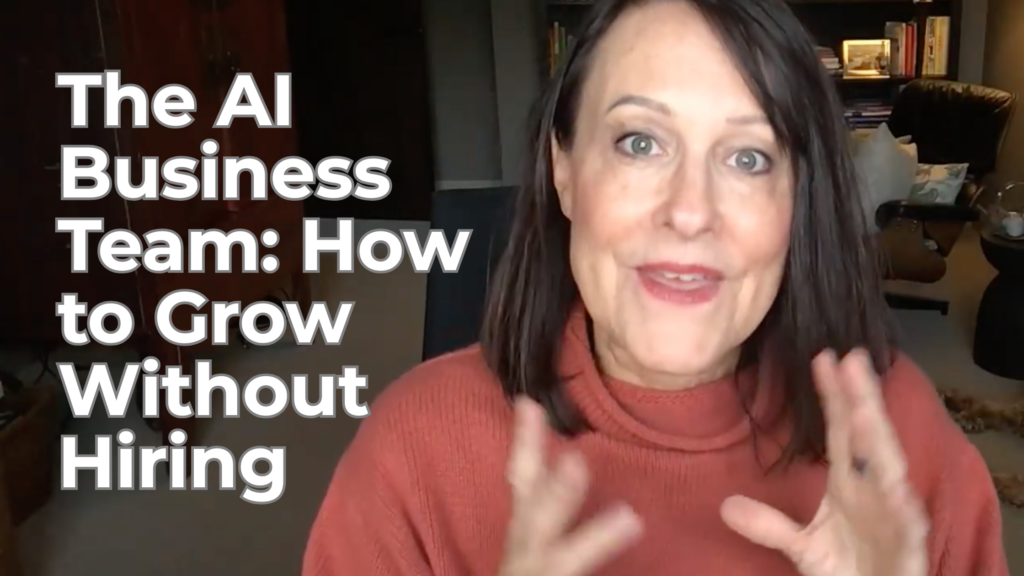
The AI Business Team: How to Grow Without Hiring
An AI business team is a set of custom AI agents — each with a specific job — trained on your voice, your offers, and how your business actually runs.
Instead of hiring people to handle content, follow-up, and operations, the work gets done by agents that cost about $20 a month to run and never call in sick. I run my own business on one, and this page covers everything I get asked about them: what they are, what they cost, and how to start.
What Is an AI Business Team — and How Is It Different From AI Tools?
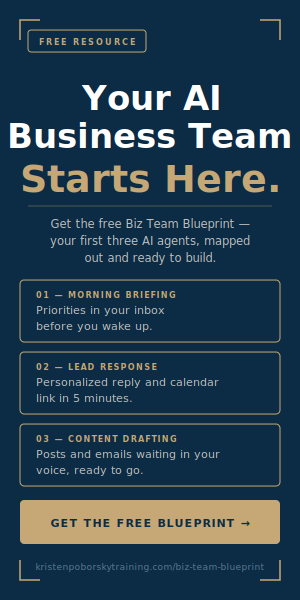
An AI business team is a group of AI agents, each built to do one job in your business the way you would do it — your content agent writes in your voice, your follow-up agent knows your offers, your operations agent knows your processes.
Here’s the difference that matters. When you open ChatGPT or Claude and type a prompt, you’re using AI in task mode: you ask, it answers, and it forgets you the moment the chat ends. Every session starts from zero. That’s a tool.
A team is different. Each agent is set up once with everything it needs to know — who you serve, what you sell, how you talk, how you decide — and then it does its job on demand, without you re-explaining your business every time. You stop being the prompt-writer and become the reviewer.
That shift is the whole game.
I watched this play out with my client Sheila, who runs a training program for wellness professionals. Her members were stuck — her coaching team was personally opening AI tools on Zoom calls and plugging in their work, one member at a time.
We found that was the bottleneck in ger own program. We built custom agents for her members’ specific tasks and deployed them right into her school platform. Now her members complete the work independently, and Shelia and her coaching team are out of the loop.
Same AI technology. Completely different result — because agents with jobs beat tools with prompts.
What Jobs Can AI Agents Actually Do?
Three engines run every business: content gets you visible, sales converts that attention into revenue, and operations keeps the whole thing running without you in the middle. AI agents can carry real weight in all three.
Content agents
This is where most people start. I record one 10-minute video a week. My content team turns it into the blog post, the YouTube description, the podcast description, my weekly email, and the social posts — in about 30 minutes, in my voice. What used to take me 5–6 hours takes about 30 minutes, and the output is better, because the system is trained on my best-performing content.
Sales agents
Agents that diagnose your offer, analyze your sales page against proven frameworks, write pages and launch emails in your voice, and recover buyers who dropped off at checkout. One of my favorite examples: a coach thought she needed better email copy. The real diagnosis — her emails were selling when her audience wanted to be seen. One rebuilt sequence, five sales. The problem was never the copy; it was the diagnosis.
Operations agents
The invisible engine. Delegation packages so your team executes without coming back for clarification. Client onboarding that runs itself. Meeting notes that capture every decision and follow-up. I built this for my own business first — I replaced my project manager with AI. What used to take over an hour takes five minutes. And operations agents solve a problem that nobody talks about until it hurts: what happens when the person who knows everything leaves.
Why Does Custom Beat Generic?
Here’s the uncomfortable truth about most “AI team” offers on the market: every member gets the same team, running on someone else’s frameworks. That’s renting a generic team — and generic in means generic out.
A custom team starts from you. Before my agents write a word, they’re built on a foundation document that captures how you actually run your company — your voice, your offers, your standards, your decision-making.
That’s why the work coming out of your business still sounds and thinks like it came from you.
It’s the difference between AI that knows your voice… and a team that knows your business.
My client Todd is what this looks like over time. We built his content system from scratch — the same approach I use with every client. Today his practice generates $450K annually with a waitlist, and half of his new clients come directly from the content his system produces.
His phone rings with qualified prospects. That doesn’t happen with template output.
What Does an AI Business Team Cost Compared to Hiring?
Let’s do the honest math, because this is the question everyone actually wants answered.
For the full breakdown, read What Does an AI Business Team Cost? The Real Math.
Most of my clients were spending $8,000–$15,000 a month on team members and contractors before we built their AI systems — that’s $100K to $180K a year in payroll, plus the hiring, training, and managing that comes with it.
The tools behind an AI business team run about $20 a month. That’s not a typo — but read it carefully, because the value was never in the tools. It’s in the build: the architecture, the documentation, the training on your business.
You can rent a done-for-you content team by the month, build and own your own marketing system for under $1,000, or have a complete custom team built with you as a partnership.
The right entry point depends on where you are — the whole ladder is on my Work With Me page.
What you’re really buying, at any level, is the same thing: growth without more of you.
Do You Need Systems Before You Build Agents?
Yes — and this is where most AI implementations quietly die. You can’t hand off work that isn’t documented. If your processes live in your head, an agent has nothing to run on, and you’ll end up more frustrated than before you started.
This is why I don’t start by building. I start by going deep: an audit of where your business is leaking time and money, and a master document that captures how you actually operate — not just how you sound.
I spent 40 years building operational systems, including running a $300 million retail division, and the lesson from all of it is the same: growth doesn’t come from working harder or hiring more people.
It comes from systems that make the right things happen without you in the middle of every decision. Agents are just the newest — and best — way to run those systems.
How Do You Start Building an AI Business Team?
Two free ways to find your starting point:
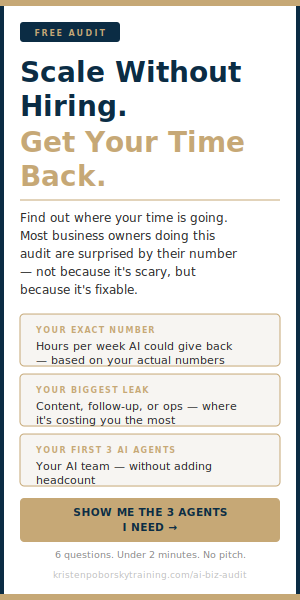
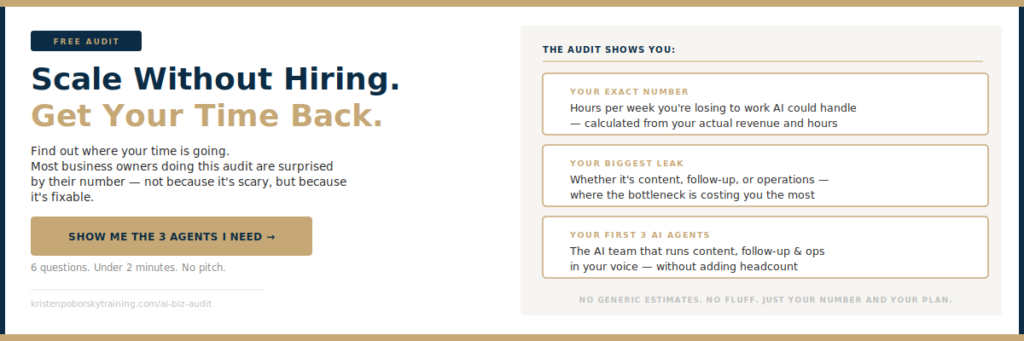
Take the audit: the free 2-Minute AI Business Audit shows you the first three agents your business needs, what not having them is costing you, and what changes once they’re running.
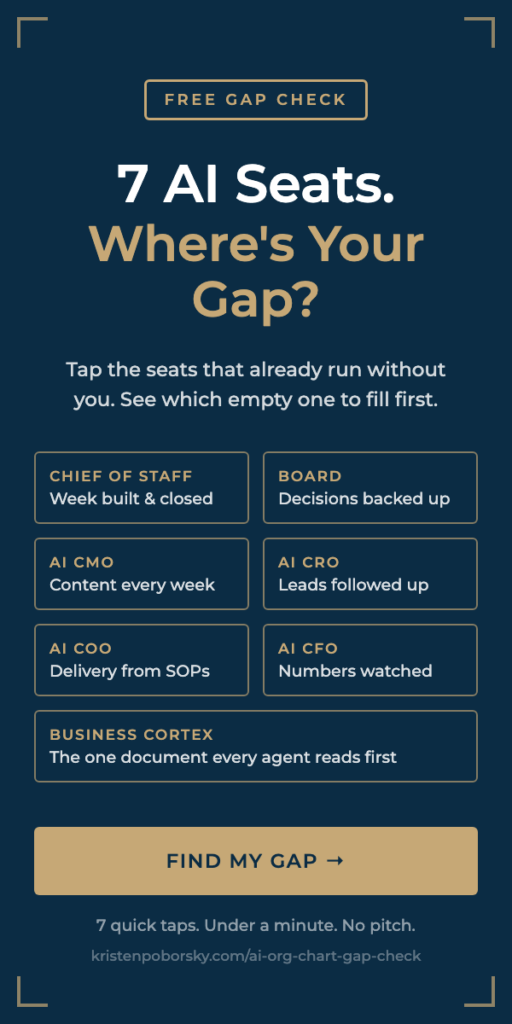
Steal my org chart: see the 7 AI seats every $100K+ business should have filled, and find out which ones are still empty in yours.
FAQ: AI Business Teams
Will an AI business team replace me?
No — and be suspicious of anyone who promises that. The system amplifies you; it doesn’t replace you. You still show up, you still record, you still decide. The team handles everything downstream of your genius.
I’m not technical. Can I actually run this?
If you can record a video and paste into a chat window, you can run an AI content team. The building is the technical part — which is exactly the part you can have done for you or built with you.
What tools does an AI business team run on?
Mine runs on two: Claude (the $20/month Pro plan is where the team lives) and Descript for recording and transcripts. That’s the entire stack.
How is this different from hiring a VA or an agency?
A VA needs training, management, and review — and takes the knowledge with them when they leave. An agency puts you in their template. Agents are trained once on YOUR business, work 24/7, never quit, and everything they know stays documented and owned by you.
How long does it take to see results?
For content, the first week — one recording becomes a week of content the first time you run the system. A full business team is a build measured in months, but it pays rent from week one.
I tried AI before and everything sounded generic. Why would this be different?
Because generic AI has never learned your voice, your audience, or your offers — so all it can give back is everyone else’s content. A team built on your voice foundation produces work you’d actually publish. One client told me: “I just read through it, and I don’t have to change anything on it. And usually I edited everything.”
The Bottom Line
You don’t need more willpower, more hours, or a bigger payroll. You need a team — and for the first time, a team doesn’t have to mean headcount. Start with the free 2-Minute AI Business Audit to see the first three agents your business needs and what not having them is costing you, or steal my AI org chart.
Last updated: October 2026 · By Kristen Poborsky — builder of custom AI business teams for coaches, consultants, and course creators. 16+ years helping experts turn content into clients, on top of a 40-year business career that includes running a $300M retail division and working with Microsoft. Everything on this page, I run in my own business first.