
Last updated: September 2026
I cut my work week roughly in half — not with more discipline, but with structure: an AI business team that handles the work that used to eat my evenings. Here’s exactly what changed, and how to start building the same structure in your business.
Key Takeaways
Working long hours and staying behind on content isn’t a discipline problem — it’s a structure problem. Most coaches and course creators are using AI as a tool when they need it as a team.
The shift from “AI as a tool” to “AI as a team” means building actual agents with defined jobs, trained on your voice and your business, running in the background while you focus on what only you can do.
With the right AI agents in place: work week cut in half, revenue up, clients getting better service — not because of more hours, but because the right things are finally running consistently.
This post is part of my complete guide to AI business teams — what they are, what they cost compared to hiring, and how to build one.
Read the full guide → The AI Business Team
Not long ago, I was where you might be finding yourself now…
Business I loved. Clients I was proud of. Calendar that was completely eating me alive.
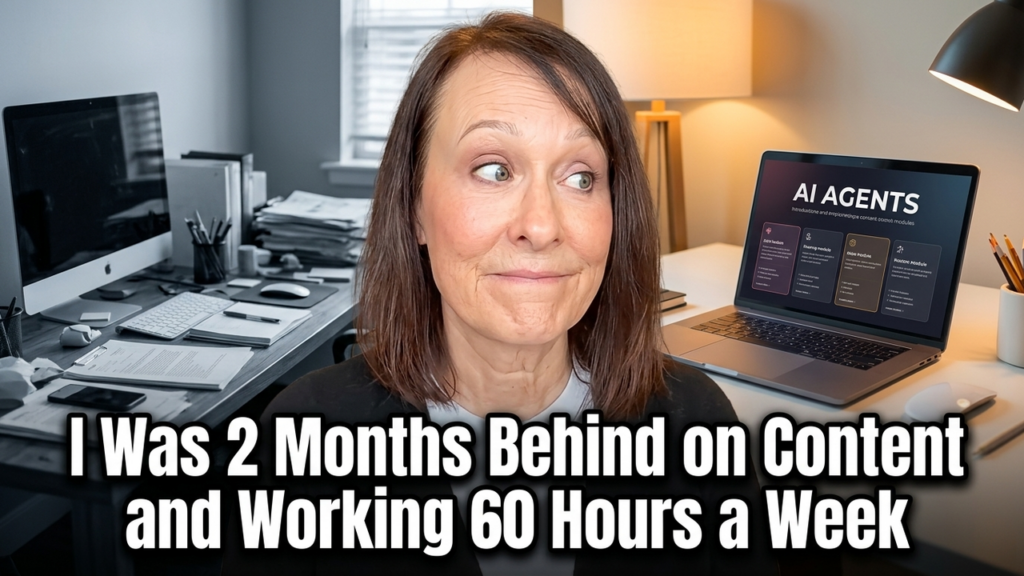
Sixty hours a week. Inbox that owned me. Two months behind on content — honestly, longer than that. And every time someone asked how I was doing, I’d say “great, just busy.” The truth was I was drowning.
I’m telling you this because if any of that sounds familiar — if you’re working way too many hours, if you keep promising yourself you’ll get caught up, if you’re tired of being the bottleneck in your own business — I know exactly how that feels. And I know what changed it.
Why Using AI as a Tool Keeps You Stuck
When I first started using AI, I did what everyone does.
Open a tab. Ask a question. Copy the answer. Close the tab. Open another tab.
ChatGPT first, then Claude. And it helped — a little. Enough to feel like something was different. But I was still drowning, still behind, still the one holding every single piece of the business together. Because I was using AI wrong.
I was treating it like a smarter Google search. A place to get answers faster. And AI is genuinely useful that way — but it’s not what changes your week.
The problem with using AI as a tool is that a tool only works when you pick it up. It doesn’t do anything when you’re with clients. It doesn’t run while you’re recording. It doesn’t watch your business while you sleep. You still have to show up for it, prompt it, guide it, and paste the output somewhere useful.
That’s not a team. That’s still you doing the work, just with a slightly faster assistant.
The shift that actually changed things wasn’t a new tool. It wasn’t a better prompt. It was stopping treating AI like a tool at all.
What It Looks Like to Treat AI as a Team
When I stopped using AI as a tool and started building AI as a team, everything changed.
Not chatbots. Actual agents. Team members trained on my voice, trained on my business, trained on my standards — each one with a specific job, each one running in the background while I focused on what only I could do.
My morning briefing is an agent. It shows up in my inbox every single morning before I start my day. I don’t pull data. I don’t dig through dashboards. The briefing comes to me.
Lead response is an agent. Content drafts are an agent. Client follow-up is an agent.
Each one knows how I communicate. Each one knows my business well enough that I’m not re-explaining context every time or cleaning up outputs that don’t sound like me. They run. I work.
My work week now is about half of what it used to be. Revenue is up. My clients get better service from me — not worse, better — because I’m not stretched across every function of my own operation. And I sleep better at night. That part still surprises me a little.
The difference between “AI as a tool” and “AI as a team” sounds small when you say it out loud. In practice, it’s the difference between being the bottleneck in your business and having something actually running it with you.
The One Mindset Shift That Makes It Work
Here’s what most people miss when they start exploring AI automation: they go looking for tools to add to their workflow. Better tools, faster tools, more integrated tools.
But adding more tools to a one-person operation still leaves one person running everything. You just have more tabs open.
The shift is asking a different question. Not “what tool can help me with this?” but “who on my team should own this?” When you start thinking in terms of team roles — who handles morning briefings, who handles lead response, who handles content, who handles client follow-up — and then build AI agents to fill those roles, the whole structure of your week changes.
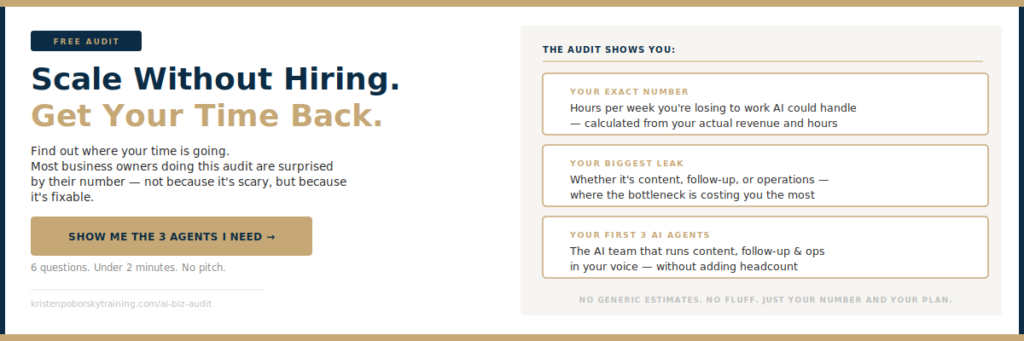
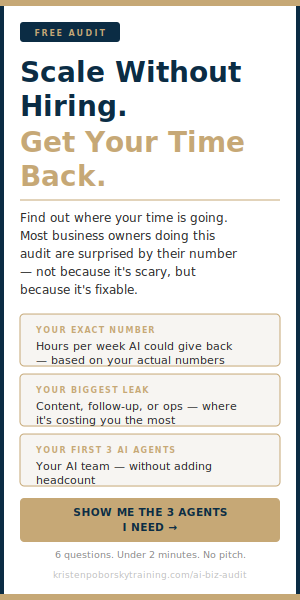
This is what an AI business audit actually surfaces. Not just where you’re spending time, but which of that time doesn’t actually require you. Which functions in your business need a person watching them — just not necessarily you, personally, every time.
Most coaches and course creators doing this work alone are spending hours every week on functions that an agent trained on their voice and standards could handle consistently and well. Not to replace the human work. To cover the operational work so the human work actually happens.
That’s the shift. It’s not about AI doing more. It’s about you doing what only you can do — because something else is covering what doesn’t require you personally.
What To Do With This
If you’re sitting at 50 or 60 hours a week and can feel the bottleneck, here’s exactly what to do next:
Stop adding tools. Start thinking in roles. What functions in your business need consistent attention — and which of those need to be done by you specifically versus just done well?
Identify your first agent. Morning briefings and lead follow-up are where most people see the fastest relief. Pick the one that’s costing you the most time or the most money when it slips.
Build it trained on your actual business. Voice, standards, methodology, the specific way you operate — not a generic agent, not a template someone else built.
Let it run. That’s the part that’s hardest to trust at first. But when Monday morning starts with a briefing already waiting and leads aren’t going cold while you’re with clients, the trust builds fast.
If you’ve already done an AI business audit, you know which agents you need first. If you haven’t, that’s the place to start — seeing clearly where the hours are going and what structure would actually change it.
The two-months-behind-and-drowning version of your business doesn’t have to be the permanent version. The structure that changes it isn’t more discipline or more tools. It’s a team.
Related: Systems Before Agents: How to Get Your Business Ready for AI
Frequently Asked Questions
Q: What’s the difference between using ChatGPT and having AI agents for your business?
A: ChatGPT is a tool — it responds when you prompt it and does nothing when you don’t. AI agents are built to run specific functions in your business consistently, trained on your voice and your standards, without you needing to show up and direct them every time. One keeps you in the loop. The other runs in the background whether you’re working or not.
Q: What AI agents do coaches and course creators actually need first?
A: The highest-impact starting points are almost always a morning briefing agent (so you start each day knowing what needs attention) and a lead response agent (so leads don’t go cold while you’re with clients). Those two alone tend to recover the most hours and the most money in the shortest time.
Q: Will AI agents actually sound like me, or will my audience be able to tell?
A: When they’re built correctly — trained on your voice, your communication style, your specific way of explaining things — your audience won’t clock it. The key word is “trained.” A generic agent sounds generic. One built on your actual voice and content sounds like you.
Q: How long does it take to set up AI agents for an online business?
A: The setup time depends on how many agents you’re building and how clearly you’ve documented your business voice and standards. A single well-built agent can be up and running in a few hours. The foundation work — getting your voice, methodology, and standards documented — is what takes the most time upfront and is also what makes every agent that follows faster to build.
Q: What is an AI business audit and do I need one?
A: An AI business audit maps where your time is actually going, which functions in your business aren’t getting consistent attention, and which of those could be handled by a well-trained AI agent. If you’re working 40+ hours a week and still feeling behind, an audit is usually the fastest way to see what’s actually driving that — and what a team structure would change.
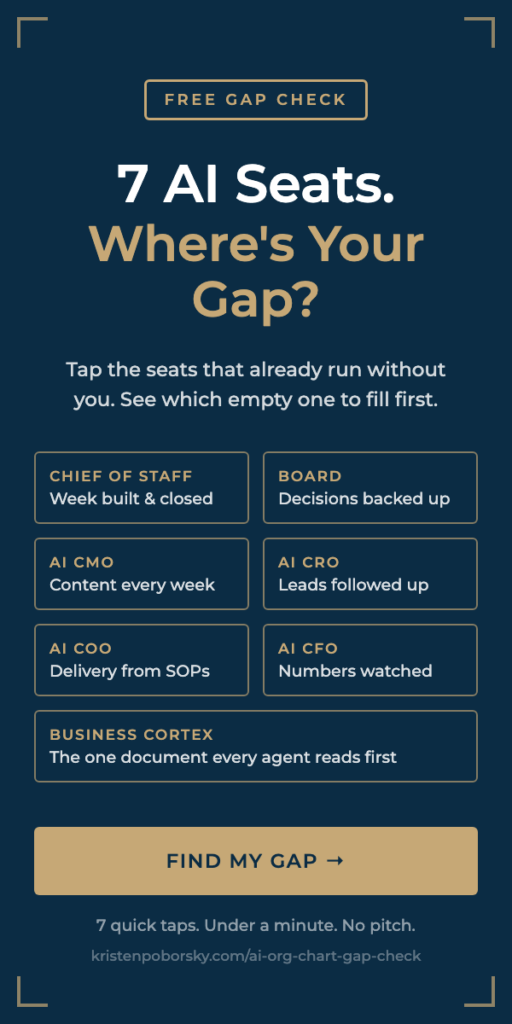
Want to know which AI agents your business needs first? Take the free 2-Minute AI Business Audit. It shows you the first three agents to build, what not having them is costing you, and what changes in your business once they’re running. Or steal my AI org chart and see which of the 7 AI seats your business still has empty.