
Key Takeaways
- Training AI on your voice works for content. It makes AI sound like you, and that’s worth doing.
- A voice file can’t make business decisions for you. It doesn’t know your standards, your priorities or how work moves through your company.
- AI that knows your business needs a second document: a Business Cortex that holds how you decide, what you won’t tolerate and how you run things.
- A voice file makes AI a good ghostwriter. It does not make AI a good employee.
This post is part of my complete guide to making AI sound like you — and work like you, too.
Read the full guide → How to Make AI Sound Like You
Everyone is teaching you to put your voice in a file and hand it to AI. I build these for a living, and I’m going to tell you why that’s only half the job.
Voice capture is having a moment. AI gurus teach it, video tools teach it, and I teach it too. It works. Your content starts sounding like you instead of like everyone else.
Then you ask that same AI to do real business work, and something breaks. It writes like you, and it works like nobody.
Here’s what a voice file gets right, where it hits a ceiling, and what the other half looks like in my business and my clients’ businesses.
What Does Training AI on Your Voice Actually Do?
Training AI on your voice gives it your words, your phrasing, who you’re talking to and what you offer, so the content it writes sounds like you instead of like the average of the internet.
That matters. Most coaches and course creators I talk to have spent months rewriting AI drafts that didn’t sound like them. A good voice file ends that. I capture three layers in what I call the AI Voice Authority Playbook: your voice, your audience and your offers. With those in place, the drafts start from you.
One of my clients, a podcast producer, ran her content through her playbook-trained system and told me, “I just read through it, and I don’t have to change anything on it. And usually I edited everything.” That’s what a voice file is for, and it does it well.
So I’m not telling you to skip it. I’m telling you where it stops.
Where Does a Voice File Hit Its Ceiling?
A voice file hits its ceiling the moment you ask AI to make a decision instead of write a sentence, because your voice doesn’t hold your judgment.
Try it with a few real tasks. Ask your voice-trained AI to answer an upset client’s email. It will sound like you. It won’t know that you always offer a call before a refund, or that this client has been with you for three years. Ask it which lead to follow up with first. It doesn’t know how you prioritize. Ask it to plan your next launch or brief a contractor. It doesn’t know your standards, your calendar, or what “done” means to you.
It writes like you, and it works like nobody.
That’s not a flaw in the voice file. It was never built to hold that. Your voice is how you sound. How you run your business lives somewhere else, mostly in your head, and AI can’t read your head.
This is the gap I see most when I audit a business that’s already “using AI.” The content side is humming. Everything else still runs through the owner, because the AI knows how they talk and nothing about how they decide.
A voice file makes AI a good ghostwriter. It does not make AI a good employee.
What Is the Other Half?
The other half is a Business Cortex: one core document that captures how you run your company, including your decisions, your standards, your frameworks and what you’d never do.
If the voice playbook is the marketing layer, the Cortex is the operating layer. It holds things like how you evaluate an opportunity, what you’ll say yes and no to, how you prioritize when everything feels urgent, and the deal-breakers your team should never cross. It’s written for AI to read, so it’s specific and it uses your own words.
I run my own business on one. Every agent I build for myself starts from it, and so does every agent I build for my AI Business Team clients.
Here’s what that looks like in practice. One of my clients runs operations for a multi-location retail business. When she suspected a key team member was about to leave, she opened the AI HR assistant we’d already built for her business. Because it knew her team structure, her industry and her operations, it didn’t hand her a generic checklist. It built a three-session interview guide for that specific person and role in about 30 minutes. A voice file could never have done that. Only something that knew her business could.
What Changes When AI Knows Your Business?
When AI knows your business, your agents stop drafting and start doing the work the way you would.
Your content agent doesn’t just write in your voice. It knows which offer this week’s post should point to. Your follow-up agent doesn’t just draft the email. It answers the way you would, holding your standards. Your planning agent doesn’t just list tasks. It sorts them the way you’d sort them.
And you stop being the bottleneck. When every decision needs you, nothing moves while you’re with clients, sick or on vacation. When your judgment lives in a document your agents can read, the work keeps moving without you in the middle of it.
You can’t run a business on a voice file. You can run one on a voice file plus a Cortex. I do it every day.
What To Do Next
Start by finding where your AI stops being useful.
- Test your AI on a decision, not a draft. Hand it a real client email or a priority call and see what it gets wrong.
- Write down three decisions you make every week. How you’d handle a refund request, which lead gets your time first, what “good enough to publish” means to you.
- Keep your voice playbook. It’s the right tool for content. Add the decisions document next to it.
- Speak it instead of typing it. Your judgment comes out more completely when you talk it through.
If you want to see which parts of your business your AI should be running, take the free 2-Minute AI Business Audit below. It shows you the first three agents to build, what not having them is costing you, and what changes once they’re running.
Getting AI to sound like you was the easy half. Getting it to work like you is where your time comes back. Keep your voice file, and give your AI the rest of you: your standards, your priorities and how you decide. That’s the difference between a ghostwriter and a team. Take the free 2-Minute AI Business Audit, or steal my AI org chart, and see what your AI team should be doing first.
Frequently Asked Questions
What is AI voice training for content?
It’s giving AI a document that captures how you write and talk, who your audience is and what you offer, so its drafts sound like you. It’s the right tool for content, and it’s usually the first thing I build with a client.
Why isn’t a voice file enough for AI to run my business?
Because a voice file holds how you sound, not how you decide. It doesn’t know your priorities, your standards or how you’d handle a tricky client, so AI trained only on your voice still needs you for every judgment call.
What’s the difference between a voice playbook and a Business Cortex?
The voice playbook makes AI sound like you. It’s the marketing layer. The Business Cortex makes AI work like you, with your decisions, standards and frameworks. For content, the playbook is enough. For agents that run parts of your business, you need both.
How do I start building a Business Cortex?
Start with the decisions you make every week and talk them through out loud: how you’d answer a refund request, how you choose what to work on first, what you’d never say to a client. Record it, then organize it into one document your agents can read.
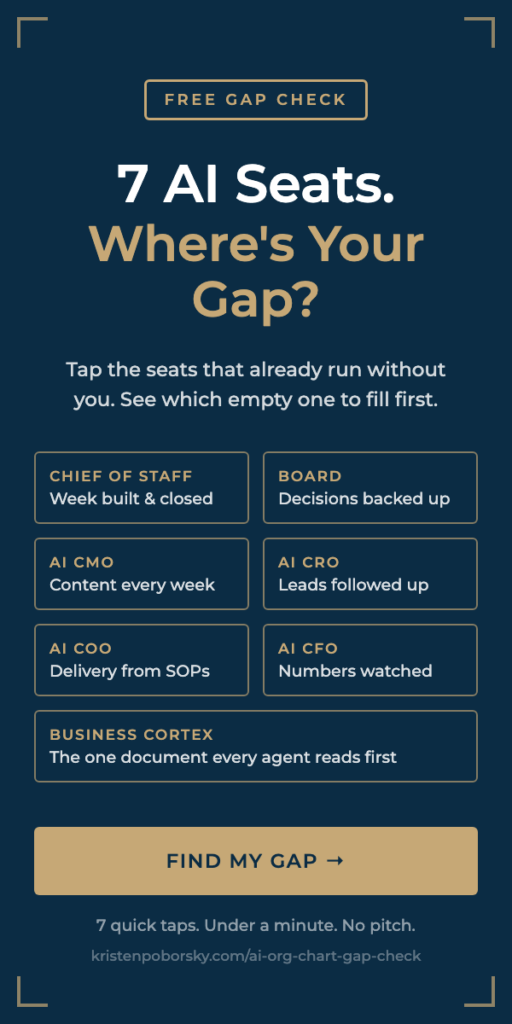
Want to know which AI agents your business needs first? Take the free 2-Minute AI Business Audit. It shows you the first three agents to build, what not having them is costing you, and what changes in your business once they’re running. Or steal my AI org chart and see which of the 7 AI seats your business still has empty.