
Last updated: September 2026
Key Takeaways
- AI-generated content is only as original as what you give it. With nothing to work from, it produces the average of what’s already out there.
- Everyone asking the same tools the same questions is why so many feeds sound alike right now.
- Your point of view, your stories and your client moments are what make content original, and AI can’t make those up for you.
- Originality isn’t an AI setting. It’s an input.
This post is part of my complete guide to making AI sound like you — and work like you, too.
Read the full guide → How to Make AI Sound Like You
When I first made a video about making AI content original back in 2023, most people were asking whether AI could write at all. Now the question has flipped. AI writes all day long, and the problem is that everyone’s content sounds like everyone else’s.
Scroll any feed for five minutes and you’ll see it. Same hooks, same structure, same “here are 5 tips” energy. Plenty of it is technically fine. Almost none of it sounds like a real person with real experience.
Here’s what makes AI content original, why most of it isn’t, and what I do in my own business so what comes out could only have come from me.
Is AI-Generated Content Original?
AI-generated content is only as original as what you feed it: trained on nothing, AI gives you the average of the internet, and trained on your voice, stories and point of view, it gives you content only you could have published.
That’s how these tools work. When you ask a general AI tool for a post with no context, it draws on patterns from everything it has already seen. It gives you the most likely answer. The most likely answer is, by definition, the one everyone else is getting too.
So it’s not copied, in most cases. It’s worse than copied for a business owner. It’s anonymous. It could be about anyone, and your audience can feel that even if they can’t say why.
I see this with almost every coach and course creator I start working with. They’ve tried ChatGPT, Claude and a content tool or two, and they tell me the same thing: it sounds fine, but it doesn’t sound like me. That’s not a tool problem. Nothing original went in, so nothing original came out.
Why Does So Much AI Content Sound the Same?
So much AI content sounds the same because people are asking the same tools the same questions, with no information about who they are.
Think about what a typical request looks like. “Write me an Instagram post about burnout for coaches.” Thousands of coaches type some version of that every week. The tool has no idea who’s asking, who they serve, what they’ve seen in their own client sessions, or what they believe that others in their field don’t.
So it fills the gaps with what’s common. Common advice, common phrasing, common structure. Then everyone posts it, and the feed turns into one long echo.
The fix people reach for is a better prompt. Add “make it engaging.” Add “use a conversational tone.” That changes the wording a little. It doesn’t change the substance, because the substance was never in the prompt. It’s in you.
What Makes AI Content Original?
What makes AI content original is the part of you that nobody else has: your point of view, your stories, your client moments and the way you explain things.
There’s a way I think about this in my business. There’s the brain side, which is your methodology, your frameworks and your processes. And there’s the heart side, which is your stories, your conviction and the way you make people feel. Most AI training focuses on the brain side. Both are yours, and both have to go in for the content to be yours.
In practice, that means your AI needs real source material before it writes. I start from my own transcripts, because the words in them are mine. I give it my voice playbook, which holds my voice, my audience and my offers. For client work, I give it their Business Cortex, which holds how they make decisions and what they’d never say.
With that in place, the content changes. One of my clients, a podcast producer, ran her content through her playbook-trained system and told me, “I just read through it, and I don’t have to change anything on it. And usually I edited everything.” Nothing in that draft was generic, because nothing generic went in.
How Do You Make AI Content Original?
You make AI content original by giving it something only you have before it writes, then speaking back your own version after it drafts.
Before it writes, give it your raw material. Record yourself talking through the topic, or pull the transcript from a video you’ve already made. Talk about the client situation that made you believe what you believe. That story is the most original thing in the whole piece, and AI can’t make it up.
After it drafts, read it once and notice what sounds like anyone. Then don’t type your fix. Speak it. Say “that’s not how I’d say it, here’s how I’d say it,” and let your real opinion come out. I built my Heart-Centered Download Method around this step, because your keyboard filters out the very parts that make content yours.
And keep your own experience in charge. AI can organize your ideas, find the hook and tighten the wording. It shouldn’t be the one deciding what you think. When you disagree with something common in your field, say so. That disagreement is where originality lives.
What To Do Next
Pick one piece of content you’re making this week and try this.
- Start with a story. Before you open AI, write or record one real moment from your own work that relates to the topic.
- Give AI your source material. A transcript, a voice memo or your voice playbook, not a one-line request.
- Read the draft for anything that sounds like anyone. Circle it.
- Speak your version of those lines. Use a voice tool, say what you really think, and let AI rework it once.
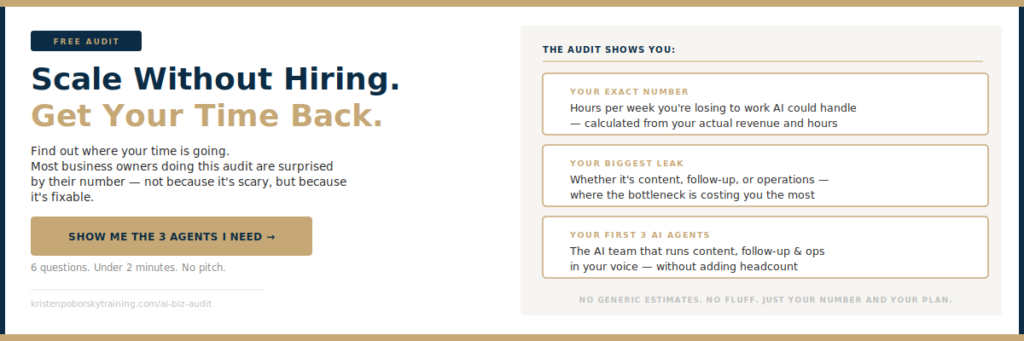
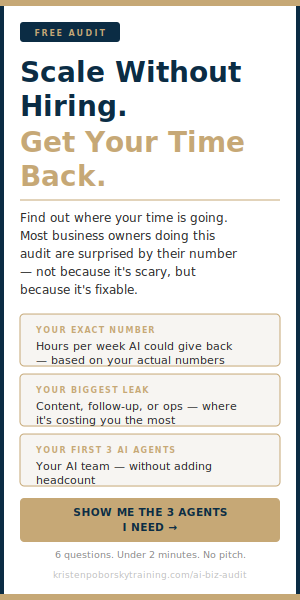
If you want to see where AI fits in the rest of your business, take the free 2-Minute AI Business Audit below. It shows you the first three agents to build, what not having them is costing you, and what changes once they’re running.
AI isn’t the reason content sounds the same. Empty input is. When you bring your stories, your opinions and your way of explaining things, AI becomes a way to get more of you out into the world, not less. Originality isn’t an AI setting. It’s an input, and you’re the only one who has it. Take the free 2-Minute AI Business Audit, or steal my AI org chart, and see what your AI team could be doing with it.
Frequently Asked Questions
Is AI-generated content plagiarism?
Usually not. General AI tools write new text from patterns rather than copying a single source. The bigger risk for a business is sameness: content built from no personal input tends to say what everyone else is saying, which makes it forgettable even when it isn’t copied.
Will Google penalize AI-generated content?
Google’s published guidance says it looks at whether content is helpful and high quality, not at whether AI was used to make it. Using AI to mass-produce pages that add little value can run into its spam policies. Content built on your own experience and point of view is the safer path and the more useful one.
How do I make AI content original?
Give AI something only you have before it writes: your stories, your transcripts, your point of view and details about who you serve. Then read the draft and speak back your own version of anything that sounds generic. Originality comes from the input, not the tool.
Can AI content still sound like me?
Yes, when it’s trained on your voice, your audience and your offers, and when you speak your corrections instead of typing them. That combination gets your real phrasing and your stories into the draft, which is what makes it sound like you.
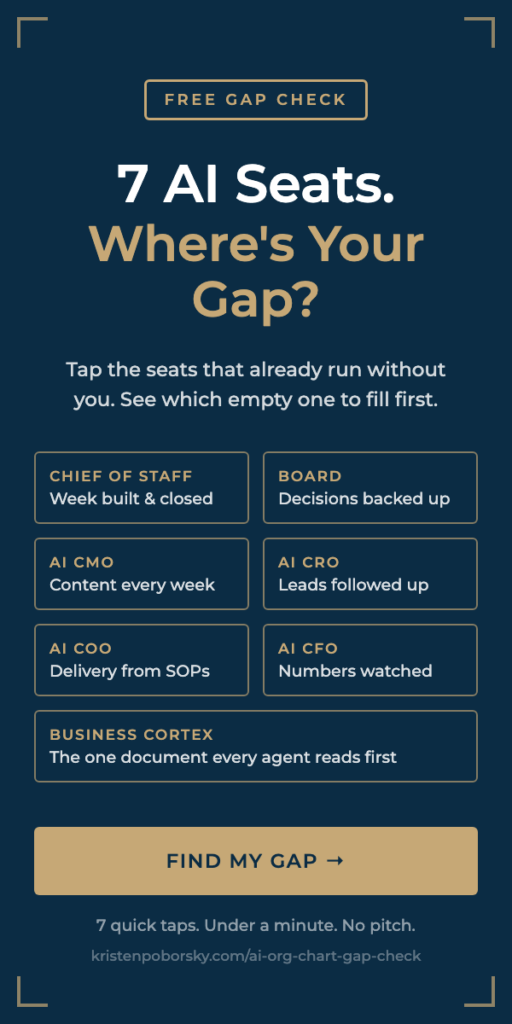
Want to know which AI agents your business needs first? Take the free 2-Minute AI Business Audit. It shows you the first three agents to build, what not having them is costing you, and what changes in your business once they’re running. Or steal my AI org chart and see which of the 7 AI seats your business still has empty.