
Key Takeaways
You Don’t Need an AI Agent for Every Task
Not every task in your business needs an AI agent or a built system. Some of them are a fine fit for a plain prompt, and that’s the right call.
The AI agent vs. prompt decision comes down to a two-part test: how often the task happens, and whether it has to match your voice and format every time.
If a task happens randomly or only a few times a year, a prompt handles it on its own.
Build only when a task repeats close to weekly and has to sound and look like you every single time.
A free AI business audit can show you which of your tasks are actually worth building and which ones are fine staying a prompt.
There’s a whole side of the AI world telling you to automate everything, and the AI agent vs. prompt question gets lost in the noise. Build the agent. Build the system. Build a team of AI employees. Some of that is right, and I do this for a living, so I’m not going to tell you agents don’t work. I’ve built hundreds of them, for myself and for clients. But there’s a quieter category of work that almost nobody talks about, because there’s no product to sell around it: the tasks where the correct answer is a chat window, one prompt, and about four minutes of your attention. If you’ve been feeling behind because you haven’t turned every part of your business into a system, here’s the test that tells you when a prompt is genuinely enough, and when it’s actually worth building something bigger.
AI Agent vs. Prompt: What Actually Separates Them
An AI prompt is a single instruction you type into a chat window to get one answer right now, with nothing saved and nothing left running once you close the tab. An AI agent is a system built around that same kind of task so it handles the work the same way every time, without you re-explaining yourself in a fresh chat.
Here’s what that looks like in practice. A few times a year, I get handed a contract and I need to know what I’m actually agreeing to before I sign it. That’s a prompt. I paste it in, ask it to walk me through the terms, go back and forth a couple of times, and close the tab. No system, nothing to maintain, nothing I’ll be staring at in six months wondering how I set it up. Same thing when I need ten title options for a video. I read them, pick one, and move on. There’s no version of that worth turning into a prompt library, a project, or a skill, because it happens too randomly to earn the setup.
Nobody makes money telling you that a prompt is still a perfectly good way to get work done, so almost nobody says it out loud. Every email, every ad, every piece of content out there is pointing the same direction: automate it, build it, systemize it. And for a real chunk of the work you do, that direction is correct. But for another chunk, treating a random, occasional task like it needs a system is where people burn hours they didn’t need to spend.
The Tasks That Never Needed to Be Automated
A prompt is the right tool any time a task is one-off or shows up too irregularly to justify a build. Writing a one-off email to someone I met at an event is a prompt. Getting a second opinion on how I priced something is a prompt. So is writing something to a client when I’m delivering a piece of work and I want a second set of eyes on the tone before it goes out. None of it needs a big structure wrapped around it. It needs a conversation and about four minutes of my attention to land on the answer I’m after, and then I close the tab and move on with my day.
I talk to a lot of people who feel behind, and when I actually get in there and look at what they’re doing, a good chunk of the work they feel guilty about not automating should never be automated at all. They’ve been handed a standard, usually from watching someone else’s content, that doesn’t fit every part of their own business, and they’re measuring themselves against it anyway. That’s not a knowledge gap. It’s a mismatched standard.
So if you run something through the test below and land on prompt, you didn’t fail. You saved yourself an entire day of building something you’d have to maintain for a task that shows up three or four times a year. That’s a genuinely good outcome, not a consolation prize, and it still works in your business exactly as it is. It’s allowed to stay that simple, and staying simple there frees up your attention for the parts of your business that actually need the bigger build.
The Two-Part Test That Tells You When to Build
The line moves from prompt to build when two things are true at the same time. First, you’re doing the task often, close to every week, not a handful of times a year. Second, the output has to match your standard every time: your voice, your formatting, the way you structure something, the way you think through it. That second condition is the one a plain prompt can’t hold for you, no matter how good the prompt itself is.
With a plain prompt, you’re re-explaining yourself from scratch each time. Fresh chat window, same context typed out again, same instructions rebuilt from memory. I’ve watched this happen in my own work: for a while it’s fine, then it gets old, and you stop bothering to add the one detail that made the output sound like you instead of like anyone. Once that detail stops making it into the prompt, the output starts reading like something generic wearing your name, and that’s the actual cost of staying on prompts for the wrong kind of task.
If a task is recurring but doesn’t need to match your specific voice or format each time, a prompt can often carry it indefinitely, even weekly. Getting a second opinion on pricing might happen every month and still be fine as a prompt, because the answer doesn’t need to carry your voice, it only needs to be correct. But if a task is recurring and it has to sound and look like you every single time, that’s the one worth building. Run both questions honestly before you decide, because the frequency question alone will send you down the wrong path more often than not.
Turning This Into a Habit, Not a One-Time Check
I run this myself, more than once, and it’s changed what I actually build versus what I leave alone. Go through what you’re doing right now with AI and separate the tasks that repeat on a real schedule from the ones that show up here and there without much pattern to them. Then, for each recurring one, ask yourself if it needs your specific voice or formatting every time, or if a solid generic answer would hold up fine on its own.
Most people skip straight to building, because that’s the message they’ve absorbed from watching everyone else’s content. But a task that happens three times a year doesn’t get less annoying because you built a system around it. It gets more annoying, because now you have a system to maintain sitting on top of the original task, and six months from now you’re the one staring at your own setup like a stranger built it.
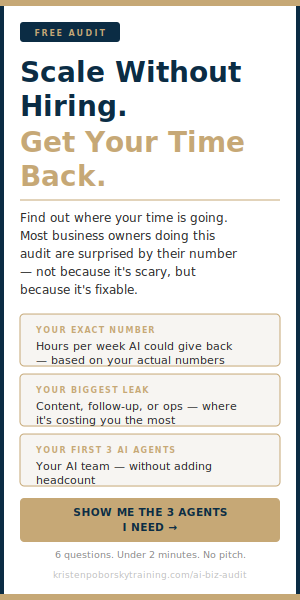
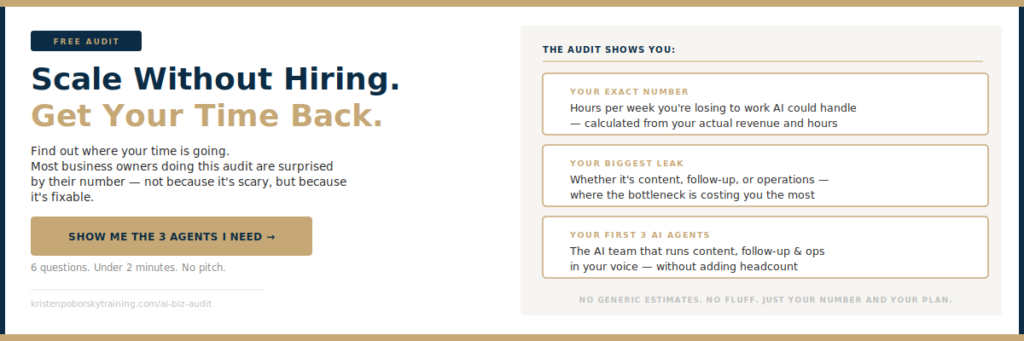
If you want a faster way to run this test across your whole business rather than task by task, I built a free AI business audit that does exactly that. It takes about two minutes, and it’s going to tell you honestly which two or three things are actually worth building and which ones are meant to stay a prompt. It won’t tell you that you need an agent for every single thing you do, because most people don’t, and treating every task the same way is how the overwhelm starts in the first place.
What To Do Next
Start with a plain list of everything you currently do with AI, one task per line, including the small stuff you’d normally skip past. Next to each one, write down how often it actually happens: weekly, monthly, or a handful of times a year, based on what’s really happened, not what you think it should be.
For every task that repeats weekly or close to it, ask one honest question: does this have to sound and look like you every time, or would a solid generic answer be fine? That single question sorts your list into two piles.
Anything random or infrequent stays a prompt. Stop feeling behind about it and move on.
Anything weekly that has to match your voice and format goes on your shortlist to build.
Take the free AI business audit if you’d rather have that shortlist built for you in about two minutes.
Pick one item from the build pile and start there instead of trying to build everything at once.
The AI agent vs. prompt question comes down to how often the work shows up and whether it has to sound like you every time. You don’t need an agent for every task, and you’re not behind for leaving some things as a prompt. Some of it stays a prompt, and that’s a good outcome, not a shortcut. Build less, keep the prompts that are already working, and only build where the frequency and the voice both genuinely demand it.
Ready to build your AI business team?
Get the free Biz Team Blueprint and see exactly what your first three agents should be — and how to set them up.
Get the Free Blueprint
Frequently Asked Questions
Q: What’s the difference between an AI prompt and an AI agent?
A: A prompt is a single instruction you type into a chat window to get one answer, right now, with nothing saved once you close the tab. An AI agent is a system built to handle that same kind of task automatically and consistently, every time it comes up, without you re-explaining the context.
Q: How do I know if a task needs an AI agent or a prompt?
A: Ask two questions: how often the task happens, and whether the result has to match your specific voice, formatting, or thinking every time. If it’s occasional, a prompt is fine. If it happens close to weekly and has to sound like you every time, it’s worth building.
Q: Is it a bad habit to keep using prompts instead of building agents?
A: No. If a task only comes up a few times a year, building a system around it costs you more time than it saves, and you’re left maintaining something you barely use. Staying on a prompt for that kind of task is the smarter call, not a shortcut.
Q: How often does a task need to happen before it’s worth building an agent for it?
A: There’s no fixed number, but the practical line is close to weekly. A task that happens three or four times a year almost never clears that bar, no matter how tempting it is to build something around it.
Q: What does the AI business audit actually tell me?
A: It looks at your recurring work and tells you which two or three tasks are genuinely worth turning into an agent or skill, and which ones should stay a prompt. It takes about two minutes and won’t tell you to build something for every task you do.