
Key Takeaways
AI Agents for Small Business and the 10-to-2 Workday
A 10-to-2 workday only holds when your business stops depending on you for every task.
A team of AI agents for small business, each trained on one specific job, carries content, email, social scheduling, client materials and follow-up outside that window.
Protect the order of your work rather than a fixed schedule, and treat a growing pile of work as a signal to diagnose, never a reason to stay at your desk longer.
This past summer, at 2 p.m. on a Tuesday, you’ll find me in my garden or at the golf course. My content still goes out. Client work still gets done. And I’m not the one doing it.
My team of AI Agents does the heavy lifting for me.
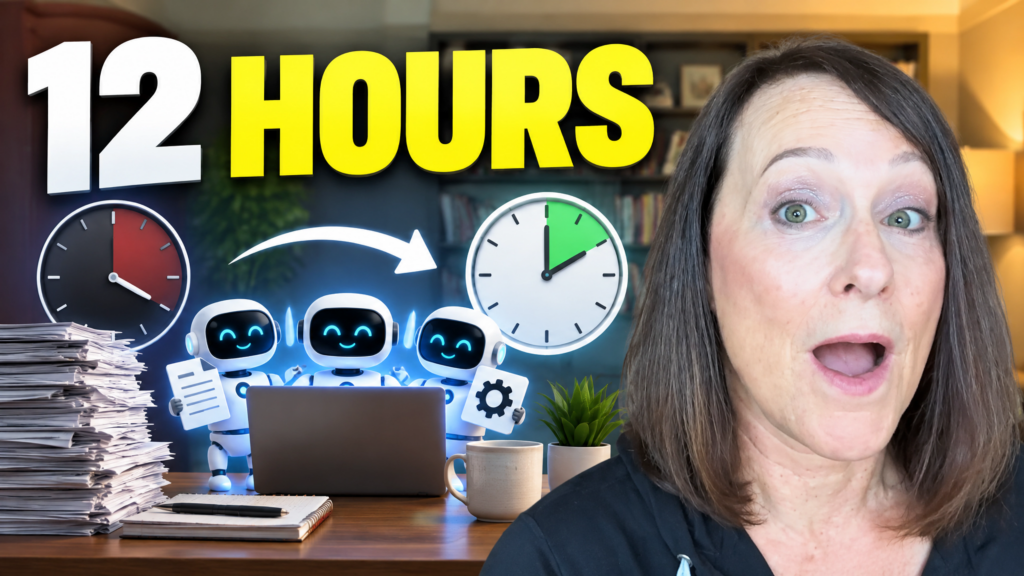
Last summer looked nothing like that. I was at my desk well past 2, sometimes for 12 hours, watching beautiful weather through the window.
What changed it is a team of AI agents for small business that runs in the background while I’m away.
In this post I’m walking you through the exact setup I built last summer and run every day now: what my workday looks like, why the window only works because of those agents, and how you can build the same thing even if you’re running solo right now.
What AI Agents for Small Business Actually Do
An AI business team is a group of AI agents, each trained to handle one specific job in a small business, that keeps the daily work moving in the background while the owner is away from the desk. It’s a different thing from a chatbot you type questions into. A chatbot waits for you. An agent has a job.
Think about what has to happen in your business every day. Content needs writing. Emails go out. Social posts get scheduled. Client materials get organized. Follow-up happens. Each of those can belong to an agent while you’re walking the dog, playing with your kids, at the beach or making dinner.
For me, the biggest shift was what happened to my ideas. I’m a creative person, and summer is when my ideas catch fire. Before I built my AI business team, every good idea meant more work on my plate. My creativity was a liability. Now when I have an idea, I hand it to the agent and it moves forward without me staying up until midnight to push it through.
That shift took me from bottleneck to visionary. I don’t feel guilty when I step away anymore. I’m not thinking about work on a hike or reading a book in my backyard, because the business is still moving and my clients are still being served.
Most people try AI and stop at the chatbot stage, typing prompts one at a time. That still leaves you as the engine behind every task. An agent trained to run your business the way you already run it is what takes you out of the loop.
Why Working Longer Hours Never Buys Your Time Back
The real cost of a business that depends on you is that you miss your life while you’re building it. Being tired is the smaller part.
I love creating. That was never my problem. My problem was that I had no system to hold what my creativity produced. Every summer I’d come up with ideas, write the content, write the emails, post on social media, build a new program and run the launch. All of it landed on me. The more I created, the more there was to manage, and it kept stacking up.
By August I wasn’t enjoying summer. I was barely surviving it. My golf game, which I work hard on every summer, was flat. My garden was dusty and tired. And I wasn’t there to enjoy any of it.
Here’s the part that stung. I couldn’t blame the business. It was doing exactly what I had built it to do. I just hadn’t built it to run without me. The workload was the symptom, and my business depending on me for everything was the cause.
So at the end of last summer I made a decision. My life sets the terms now, and the business fits inside it.
If your busiest season is also your most creative one, pay attention to that. It’s one of the clearest signs your business depends on you. More ideas should mean more momentum for the business, and they shouldn’t cost you more hours at the desk.
How the 10-to-2 Life Works Day to Day
The 10-to-2 life is a deliberate structure built from four parts: a morning ritual, a work window from 10 a.m. to 2 p.m., a 30-minute flex at the end, and the same order of work every single day. I want to be specific here, because this is a real structure and it works because it’s intentional.
Before 10, I do my morning ritual. It’s non-negotiable, and no work happens until it’s done. It sets my head, and I walk into whatever the day holds feeling good.
My window opens when the ritual ends and closes at 2. Some days it runs a little later or wraps a little earlier. At the very end I allow a 30-minute flex, so if I’m in flow and something genuinely needs finishing, I finish it.
No two days on my calendar are blocked the same. What never changes is the sequence. Deep work comes first, client calls sit in the middle, and admin and quick wins go at the end. My brain is sharpest in the morning, so following that order means I’m never spending my best thinking on shallow work.
Fridays are mine. They start my transition into the weekend, and I protect them. Saturdays and Sundays are for living, not for catching up. That holds all year, not only in summer.
Most people try to fix their time with a rigid calendar and abandon it the first week it breaks. A fixed schedule falls apart the moment a client reschedules. A sequence survives it. If your sharpest hours come in the afternoon, flip the order. Keep the rule that your best thinking goes to your most important work.
What to Do When the Work Piles Up
When work piles up inside a 10-to-2 schedule, stop and diagnose what’s broken instead of adding hours. The pile is information.
It does happen to me. When I see it, I stop. Sometimes for a moment, sometimes for half a day. I figure out what’s broken, because the pile is telling me something and I listen to it. That’s how a business stays sustainable, and it has nothing to do with laziness.
I watch the 30-minute flex the same way. Using it now and then is fine. When the flex starts becoming the rule, I know something is off, and that’s my cue to go looking for the cause.
The instinct for most business owners is to push through. Stay late, catch up on the weekend, tell yourself it’s temporary. That treats the symptom and trains your business to keep depending on you.
If the pile keeps showing up around the same job, that job is a strong candidate for an agent. If it shows up everywhere at once, check whether you’ve been adding new work before finishing what’s already in motion. Fix the biggest leak first, then build.
What To Do Next
List every task you did this week that someone else, or an agent, could have done. Content, emails, social scheduling, client materials, follow-up. This is your first step, and you can do it in 20 minutes today.
Circle the one task that repeats most often and pulls you out of your best thinking. That’s your first agent. One agent doing one job well beats five half-built ones.
Set your sequence for next week: deep work first, calls in the middle, admin and quick wins last. Keep it even when the calendar shifts.
Pick your flex rule and your protected day. Decide how much overtime you’ll allow at the end of the window, and notice how often you use it. If the flex becomes the rule, stop and diagnose.
Your business should work for your life, not the other way around.
The 10-to-2 life is real, and it holds when your business stops needing you for every piece of it. AI agents for small business are what make that possible. They carry the content, the email and the follow-up, so your best ideas move forward while you’re out living. When you go from “I have to be there for everything” to “my business runs,” your life runs too.
If you want to see the agents I use and how I set them up, the free guide below walks you through it.
Go build that.
Frequently Asked Questions
Q: What is an AI business team?
A: An AI business team is a set of AI agents, each trained to do one specific job in a business, such as writing content, sending emails, scheduling social posts, organizing client materials or handling follow-up. Unlike a chatbot, which waits for you to type a question, each agent owns its task and keeps it moving in the background. The owner hands off the work instead of doing every piece of it.
Q: Do I need a big team or a tech background to use AI agents in my small business?
A: No. You don’t need a large team or a big budget. You need the right agents, set up the right way and trained to run your business the way you already run it on your own. Solo business owners can start with one agent for the task that repeats most often.
Q: How do you run a business in a 10 a.m. to 2 p.m. workday?
A: Protect a morning ritual before 10, work inside the window, and allow a short flex of about 30 minutes at the end for work that genuinely needs finishing. Follow the same order every day: deep work first, client calls in the middle, admin last. AI agents handle the recurring work outside those hours.
Q: What should I do when my shorter workday starts falling behind?
A: Stop and diagnose what’s broken rather than working longer hours. A pile of work is a signal that a task still depends on you or that new work is being added before existing work is finished. If the pile keeps forming around the same job, that job is a good candidate to hand to an agent.
Want to see exactly how to build your own AI business team? My free guide walks you through the agents I use, how I set them up, and how to get your own version running without a tech background or a big team. Get the free guide here.