
Key Takeaways
Why Smart Business Owners Are Building AI Teams — Not Just Using AI Tools
Using AI as a tool means starting from zero every single time — no memory, no context, no momentum.
An AI business team runs in the background: drafting content, responding to leads, summarizing calls — without you asking.
The shift from AI tool to AI business team isn’t about technology. It’s about structure.
Your first three AI team members come directly from a work audit — they handle the tasks you keep putting off.
This post is part of my complete guide to AI employees.
Read the full guide → AI Employees: How to Hire Your First AI Team Member
Most business owners are using AI wrong.
Not because they’re not smart. Not because they’re not trying. But because they’re treating AI like a hammer — something you pick up, use, and put down. And when you treat AI like a tool, you hit a ceiling fast. You save a little time. You still feel exhausted. And you wonder why everyone else seems to be getting more out of it than you are.
Here’s what’s actually going on — and what to do instead.
The Tool Trap: Why Tab-by-Tab AI Will Burn You Out
Every time you open ChatGPT or Claude to solve a problem, you’re doing three things you probably don’t even notice anymore. You’re remembering how to prompt it. You’re rebuilding the context from scratch. And you’re doing this on repeat, all day, for every task that comes up.
That’s not efficiency. That’s a different kind of exhaustion.
When AI is a tool, your day looks like this: something comes up, you open the tab, you explain who you are and what you need and what voice you write in — again — you get something back, you tweak it, you use it, you close the tab. Two hours later, repeat.
It works. Barely. And it costs you more mental energy than most people realize, because you’re the one holding all the context. You’re the connective tissue between every single task. The AI doesn’t know you finished a client call. It doesn’t know a lead just came in. It doesn’t know you have a launch coming up and your content calendar is empty. You have to tell it every time.
That’s the ceiling. And for coaches, consultants, and course creators who are already stretched thin, that ceiling shows up fast.
What an AI Business Team Actually Looks Like
Here’s the version most people haven’t seen yet — and once you see it, you can’t unsee it.
You wake up and your morning briefing is already in your inbox. Your priorities for the day, the leads that came in overnight, the follow-ups that are due, a draft of the content you need to review. You didn’t ask for any of it. An agent ran while you were sleeping and put it together.
A new lead fills out your contact form. Within five minutes, they get a personalized response, a calendar link, and they’re added to your follow-up sequence. You didn’t touch it. An agent handled it.
You finish a client call. Notes are summarized. Action items are pulled out. A follow-up email is drafted. All you do is review and hit send.
You sit down to work on content and find three social posts and an email already waiting — written in your voice, ready to go.
That’s not a tool. That’s a team. And the difference is structural, not technological.
When you build an AI team instead of using AI tools, the work doesn’t depend on you remembering to do it. The agents have your context, your voice, your standards. They run whether or not you’re paying attention. You stop being the one who holds everything together and start being the one who makes the decisions.
That’s the actual shift.
Why Structure Is the Missing Piece
Most people think the problem is the tools. They try a new AI platform, they buy a new prompt pack, they watch another tutorial. And nothing really changes because the tools aren’t the issue.
The issue is that there’s no structure underneath them.
A team — any team — has roles. It has defined responsibilities. It knows what to do without being told every time. When you have a content manager on your team, you don’t explain what content is every Monday morning. They know. They have context, standards, and a process.
AI agents work exactly the same way when you set them up right. They have your business context baked in. They know your voice. They know your workflows. And they execute consistently, without you babysitting.
The business owners who are getting the most out of AI aren’t the ones with the most tools. They’re the ones who took the time to build the structure. They identified the work that keeps happening — the tasks they keep putting off because they’re too busy doing the work only they can do — and they built agents to handle it.
That’s where the audit comes in. When you map out what’s actually eating your time, three roles show up almost immediately across every business. Those become your first three AI team members. Not because someone assigned them. Because the work told you.
What To Do Next
If you’ve been using AI tab by tab and wondering why it still feels like so much work, here’s where to start:
Stop prompting from scratch. Every time you rebuild context from zero, you’re losing time and quality. Start building agents that hold your context permanently.
Map your repeating tasks. What comes up every single week that you’re still doing manually? Those are your first agent candidates.
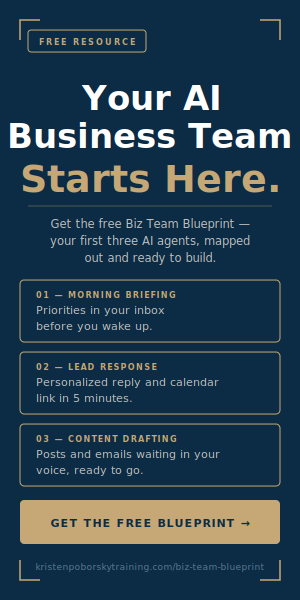
Identify your first three roles. Morning briefing. Lead response. Content drafting. These are the most common starting points — and they’re where the biggest time savings live.
Build for your voice first. An AI business team that doesn’t sound like you isn’t saving you anything — it’s creating more editing work. Get your voice documented before you build agents around it.
The first step isn’t picking a platform or signing up for another tool. It’s getting clear on what your team actually needs to do.
You started your business to do the work you’re good at — not to spend half your day managing tasks that could run without you. The AI business team model makes that possible. Not someday. Not when you finally have the time to figure it out. Right now, with the tools that already exist.
The question is whether you’re going to keep using AI like a tab you open and close — or build something that actually works for you.
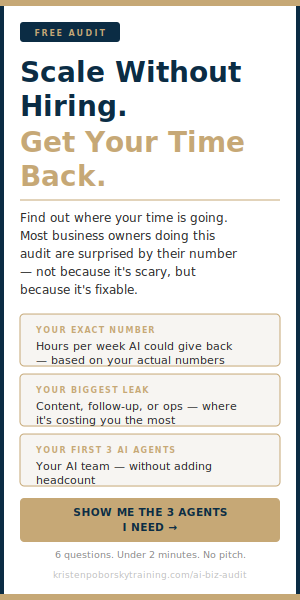
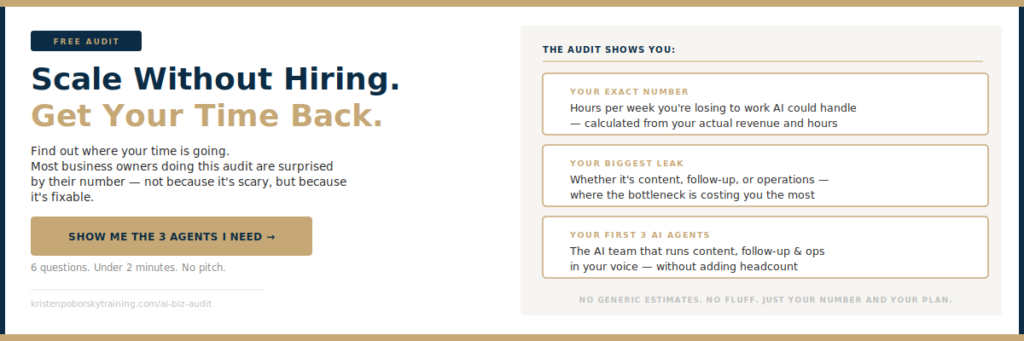
If you want to see exactly what your AI team could look like, take the free 2-Minute AI Business Audit below. It shows you the first three agents to build, what not having them is costing you, and what changes once they’re running.
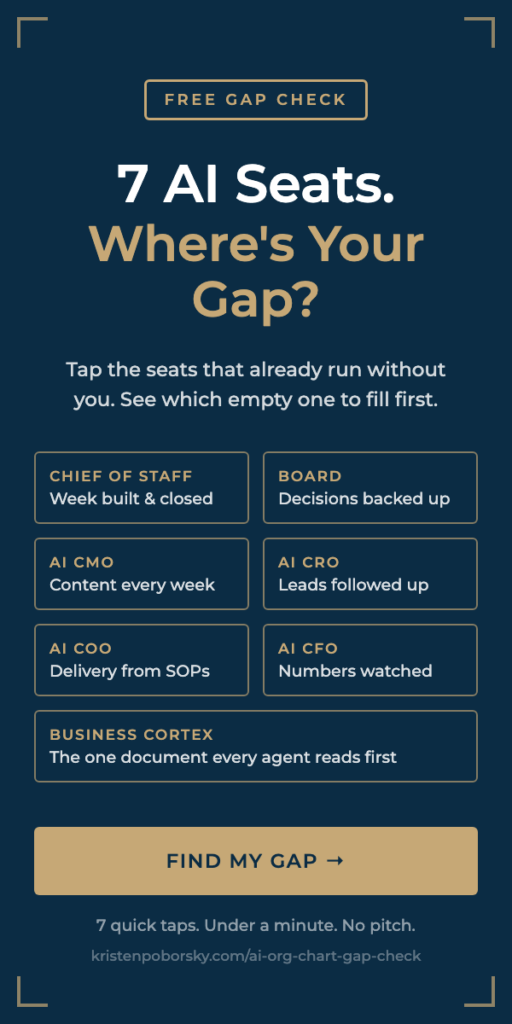
Take the free 2-Minute AI Business Audit, or steal my AI org chart, and see which seats your AI team still has empty.
Frequently Asked Questions
What’s the difference between using AI as a tool vs. building an AI business team?
When you use AI as a tool, you’re manually prompting it every time you need something — rebuilding context from scratch on every task. An AI business team means setting up agents that run automatically, hold your context, and complete recurring work without you initiating it each time. The work happens whether or not you remember to ask for it.
What are AI agents for business and how do they work?
AI agents are configured automations that handle specific recurring tasks — like summarizing client calls, responding to new leads, or drafting your weekly content — based on rules and context you set up once. Unlike a standard AI prompt, agents run in the background and don’t require you to start from zero every time.
How do I know which AI agents to build first?
Start with a simple audit of your repeating tasks — specifically the ones you keep putting off because you’re too busy. The most common starting points are a morning briefing agent, a lead response agent, and a content drafting agent. These three alone can reclaim several hours a week for most coaches and consultants.
Do I need to be technical to build an AI business team?
No. The setup requires clear thinking about your processes, not coding. Most agents are built using no-code platforms and work best when you’ve documented your voice, standards, and workflows — which is the foundational step regardless of which tools you use.
Can AI agents really write content that sounds like me?
Yes — when they’re trained correctly. The key is giving your agents a documented voice guide, sample content, and clear guidelines before you ask them to produce anything. An agent writing from scratch with no context will sound generic. An agent trained on your voice guide, your messaging, and your content examples will sound like you.
Want to know which AI agents your business needs first? Take the free 2-Minute AI Business Audit. It shows you the first three agents to build, what not having them is costing you, and what changes in your business once they’re running. Or steal my AI org chart and see which of the 7 AI seats your business still has empty.