Most coaches and course creators I talk to have hired the same way two, three, maybe four times in a row: write a quick post, do a gut-feel interview, cross their fingers, and repeat.
It works until it doesn’t — and when it doesn’t, they blame the person. What they don’t realize is that they never had a hiring system to begin with. They had a hope and a job post. AI changes that completely — and faster than you’d think.
The short version:
→ Most coaches and course creators are one bad hire away from realizing they have no real hiring system at all—just instinct and hope.
→ An AI agent can build your entire hiring infrastructure in a single conversation: job description, interview guide, test project with grading rubric, onboarding plan, performance reviews, and a daily playbook.
→ The output isn’t a template. It’s a connected system where every document feeds the next one—and it runs without you.
What most people don’t realize going in:
→ The quality of what your AI agent produces is directly tied to how specific your input is. Generic prompt in, generic documents out.
→ Building these documents with AI doesn’t just save time—it forces clarity you didn’t know you were missing.
→ This isn’t about replacing people with AI. It’s about using AI to build the infrastructure that lets the right people actually do their best work.
I built an AI HR agent for my clients. Months of work went into it. And then I looked at my own business and realized I was exactly the client I built it for.
I had just let go of a VA I’d worked with for five years. Not because she wasn’t good at her job—she was. But my business had shifted completely. I’m not running a coaching practice anymore. I’m building AI business teams for clients. The work requires judgment, technical thinking, and the ability to learn new tools fast. My VA was a copy-and-paste specialist, and that used to be enough.
The hard part wasn’t the conversation. The hard part was realizing I had never updated the role. I’d been trying to fit someone hired for one version of my business into a role that didn’t exist anymore—and I didn’t have a single document that reflected what I actually needed now.
So I did what I tell my clients to do. I used the AI agent on myself.
What an AI HR Agent Actually Does
Let’s be clear about what we’re talking about here, because “AI agent” gets used to describe a lot of things.
An AI HR agent isn’t a chatbot that spits out a generic job description when you type “write me a job posting for a VA.” That’s a prompt. That’s not an agent.
An agent is a Claude-powered system that’s been given specific context about your business, your role, your past hiring experience, and what success looks like—and then uses that context to build a connected set of documents that work together as a hiring system. It asks follow-up questions. It pushes you to get specific. It catches the gaps you didn’t know you had.
The difference in output between a basic prompt and an agent with real context is significant. With a prompt, you get a task list dressed up as a job description. With an agent that knows your business, you get a document that actually tells a candidate what good looks like six months in—and tells you how to measure it.
That specificity is what makes the rest of the system work.
The Seven Gaps My AI Agent Found in My Own Hiring Process
Before building anything, I did something a lot of business owners skip: I documented what I actually had. I grabbed my voice recorder, talked through the role I needed to fill, what had worked before, what hadn’t, and what was different now. Then I dropped all of it into a conversation with my Claude agent.
What came back was a list of gaps that explained everything.
→ No current job description. The one on paper reflected a version of my business from years ago.
→ No structured interview process. I improvised questions every single time.
→ An outdated test project. I had one, but it tested skills I no longer needed.
→ No onboarding plan. New hires learned by diving into Asana and figuring it out.
→ No performance review framework. Nothing to measure against at 30, 60, or 90 days.
→ No daily playbook. Tasks lived in Asana but weren’t tied to a role description anyone could reference.
→ No meeting structure. Check-ins were reactive, not rhythmic.
Seven gaps. I had been running my team like that for three years.
This is not a people problem. When structures don’t exist, even a strong hire will struggle—because they’re reading your mind instead of following a system. And when it doesn’t work, we blame the person when the actual issue is that the role was never built or updated.
The agent surfaced all of that in one conversation, before I’d even started writing a single document.
The Eight Documents That Came Out of One Claude Conversation
Here’s where it gets concrete. Starting from that voice note, my AI HR agent built eight connected documents in a single conversation with Claude.
1. A job description with real success metrics. Not a task list. Actual definitions of what good looks like—specific, measurable, and tied to the work I actually need done. Social content batched and delivered every Tuesday by noon, 100% of the time, without me as the bottleneck. That kind of specific.
2. A job posting in two formats. A full LinkedIn version with built-in screening questions, and a shorter social version for posting elsewhere. Both built from the job description, so the messaging stays consistent from the first touchpoint.
3. An interview question guide. 17 questions across five categories, each one specific to this role and this business. Not generic “tell me about yourself” questions—questions that surface exactly the judgment, process-following, and technical capability the role requires. Each question came with what to listen for, green flags, and red flags.
4. A paid test project with a grading rubric. A 100-point scoring system with instant-fail criteria and four deliberate errors built in to catch. The decision gets made before emotions enter the picture. Before you’ve talked yourself into liking someone who can’t actually do the work.
5. A 30/60/90-day onboarding plan. Week by week, from day one to fully independent in the role. Not “here are the SOPs, good luck”—an actual plan with milestones and checkpoints.
6. Three milestone review templates. A manager review and a self-assessment for the team member at day 30, 60, and 90. Both sides know what’s being measured and when.
7. A team member playbook. The permanent daily operations manual for the role. Not buried in a project management tool—a document that lives somewhere both of us can actually find and reference.
8. A weekly check-in agenda and quarterly review template. The ongoing rhythm that starts day one and continues forward, so communication is built into the structure rather than happening only when something goes wrong.
Eight documents. One conversation.
Why the Documents Have to Connect
This is the part most people miss when they hear about a hiring system—they picture five separate documents sitting in a Google Drive folder that nobody looks at.
That’s not what this is.
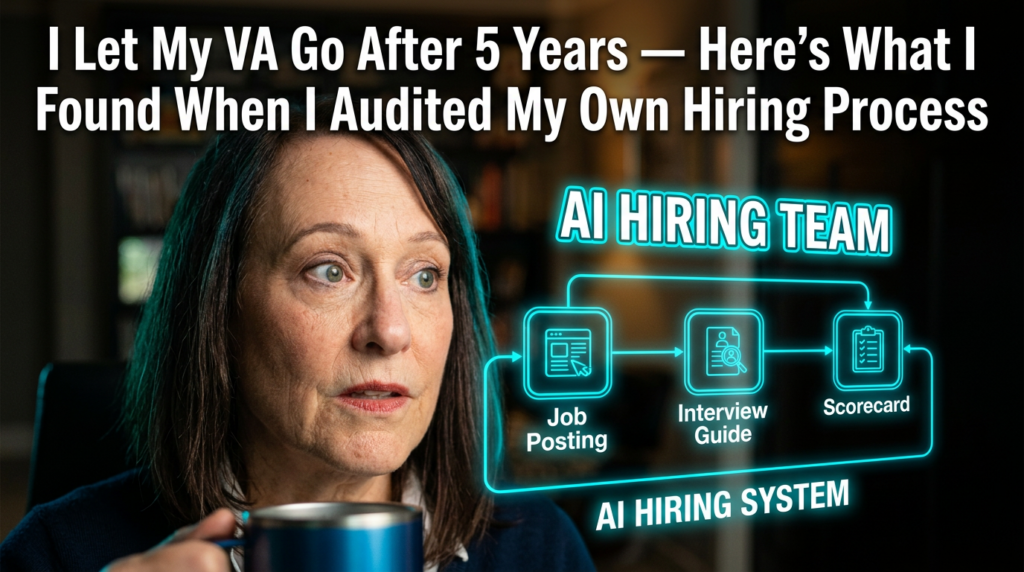
The job description feeds the posting. The posting feeds the interview questions. The interview questions feed the test project. The test project feeds the onboarding plan. Each document was built using the one before it as context, which means they’re actually aligned—the criteria you’re evaluating in the interview are the same criteria reflected in the grading rubric, which are the same milestones the 30/60/90 plan is tracking toward.
That alignment is what most hiring processes are missing. When the documents are built in silos—or improvised at each stage—there’s no through-line. You’re interviewing for one thing, testing for another, and onboarding toward something else entirely. And six weeks in, you’re wondering why the hire doesn’t feel right.
When Claude builds them together in a single conversation, the connection is built in. The system holds together because it was designed that way from the start.
What Makes AI Agent Output Different From a Generic Prompt
The difference comes down to context.
A generic prompt tells Claude what you want. An agent conversation tells Claude what your business actually looks like—your offers, your past hires, the specific kind of judgment the role requires, what failure looked like last time, what you need to be true six months from now.
Here’s what that looks like in practice. When I prompted Claude with the raw voice note about my situation—including that I needed someone who could think when the process didn’t cover a situation, learn new tools fast, and execute with precision—the interview questions it built weren’t generic. They were specific to what I’d described. They asked about exactly the kind of judgment call I’d need this person to make.
A generic “write me interview questions for a VA” prompt would never surface those. Because it doesn’t know the role is different now. It doesn’t know what failed before. It doesn’t know what I’m actually building.
That specificity is the whole game with AI agents. The more real context you give, the more useful the output. And the voice note approach works because it bypasses the instinct to sound polished and just captures what’s actually true about the situation.
What Happened When I Used It on Myself
Here’s what I didn’t expect: the process of building those eight documents clarified my own business in a way that surprised me.
Writing a job description with real success metrics forced me to decide what “good” actually looked like. Not “reliable.” Not “proactive.” Specific, measurable outcomes tied to real deliverables. That’s not a document exercise—that’s a business clarity exercise.
Building the grading rubric before applications came in meant the hiring decision was made before I had a face to put to it. Before I’d convinced myself someone was a fit because they were nice in the interview. The decision criteria existed independently of any candidate.
And building the onboarding plan forced me to map out what full independence in this role actually looked like—which made me realize I’d never actually thought about that before. I’d hired people and hoped they’d get there. I’d never built a path.
That’s the work that stops a bad hire before it starts. Not better instincts. A better system.
Is This Actually Right for You?
Not every business is at the stage where an AI HR agent makes sense. Here’s a rough way to think about it.
This is worth doing now if:
→ You’re actively hiring or about to be.
→ You’ve had at least one hire that didn’t work out and you’re not sure why.
→ Your business model has shifted in the last 12–18 months and your team structure hasn’t caught up.
→ You’re spending time managing people issues that feel like they should be running themselves.
It’s probably not the right first move if:
→ You’re a solo operator with no immediate plans to hire.
→ You have a stable, well-documented team infrastructure already.
→ You haven’t yet built your core AI content or automation workflows—those usually come first.
If you’re in the first category and any of the seven gaps I listed sound familiar, you’re not running a people problem. You’re running a systems problem. And that’s actually good news, because systems can be built.
Where to Go From Here
If this landed somewhere real for you—if you counted those gaps and realized you’ve got more than two—here’s what I’d suggest as a first step.
Spend five minutes with your voice recorder. Talk through the role you’re hiring for as it exists today. Not two years ago—today. What does the work actually look like? What does a great hire do differently than a mediocre one? What went wrong last time? What would need to be true six months in for you to feel like it was the right hire?
That voice note is all the input the agent needs to get started.
If you want to talk through where your operation is right now—whether it’s hiring, AI systems, automation, or the full picture of what an AI business team could look like for you—book an AI Business Game Plan call. It’s a short call, no pressure, and by the end of it you’ll know exactly what your next move is.
Your business has an AI layer now. Your hiring process should too.
Kristen Poborsky helps coaches, consultants, and course creators build AI business teams that actually run their operations—including the hiring systems that hold them together.