
Last updated: September 2026
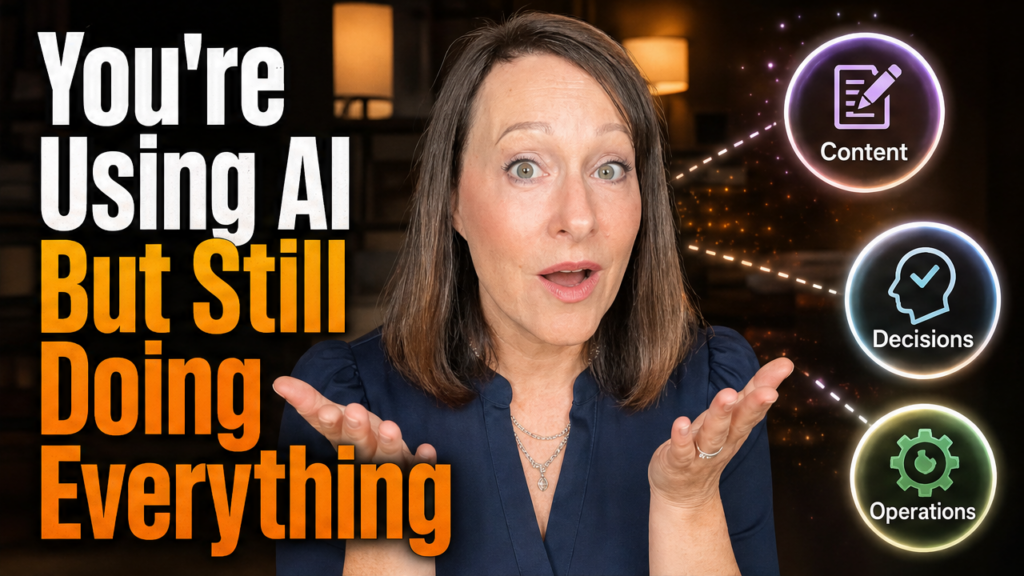
Most businesses use AI as a tool — you prompt it, it answers, and nothing happens until you show up again. The businesses scaling without hiring use AI as a team: agents with defined jobs. Here are the three agent jobs most coaches and course creators are missing — content, decision support and operations — and what each one replaces.
Key Takeaways
- Most businesses use AI as a tool — meaning you have to show up every time — instead of building an AI team that runs without you
- A content agent turns one recording into a full week of emails, social posts, carousels, and a blog post without you touching it again
- A decision support agent surfaces what you’re missing before a bad decision costs you — it’s the qualified second opinion most solopreneurs never have
- An ops agent handles follow-up, lead engagement, and onboarding so your business keeps running whether or not you’re in the room
- You don’t need a bigger team. You need AI agents with actual jobs to do.
This post is part of my complete guide to AI business teams — what they are, what they cost compared to hiring, and how to build one.
Read the full guide → The AI Business Team
Here’s something I see all the time. Someone tells me they’re using AI every single day. And then I ask one question: “Is your AI running anything without you right now?”
The answer is almost always no.
That’s the difference between a tool and a team. A tool waits for you to show up. A team keeps things moving while you’re coaching, sleeping, or just living your life.
I build AI agent teams for coaches, consultants, and course creators. And the gap I see most often — even with people who are fully committed to AI — is that they haven’t given their AI actual jobs to do.
There are three AI agent jobs your business should be running right now. Let’s get into each one.
Job 1: The AI Content Agent That Protects Your Time
One recording. One hour of your expertise on camera. And a content agent that turns it into a full week of content — email, LinkedIn posts, Instagram carousel, short-form clip scripts, blog post — all done before you’ve moved on to your next call.
That’s the whole point of a content agent: you record once, and the agent handles everything after that.
Most of the coaches I work with are spending ten to twenty hours a week on content. Not because they’re slow. Because they’re doing it manually, every single time, from scratch. The recording gets made. And then it sits there, or gets turned into one thing, and everything else just… dies.
I used to call it my content grave. A drawer full of ideas that never made it out into the world because I ran out of time or energy before they got there.
Here’s what changed when I set up a content agent: I recorded a 60-minute training. By the time I finished my coffee, my agent had turned it into a two-week content calendar, an email sequence, three LinkedIn posts, a carousel, and a short-form hook video script. Everything done. Nothing left to touch.
That’s not just a time win. That’s your ideas actually reaching your audience instead of staying stuck in your head where no one can benefit from them.
Here’s what most people miss about this: a content agent doesn’t just save you time, it changes what’s possible. When turning an idea into content is a five-hour process, you get selective — maybe too selective. When it’s handled automatically, you start sharing more freely. And that’s when your audience actually starts seeing you consistently.
Job 2: The Decision Support Agent That Covers Your Blind Spots
A decision support agent isn’t about making decisions faster. It’s about making better ones — because it catches what you can’t see when you’re too close to a situation.
When you’re running things solo, every decision lands on you. Pricing, positioning, what to say in a tricky client email, what to do when something goes sideways. And the real problem isn’t that you’re bad at decisions — it’s that you have blind spots. We all do.
Running solo means your blind spots go completely unchecked. There’s no one to ask the question you forgot to ask yourself. No one to push back before you pull the trigger.
Here’s a real example from my own business. I had a sticky situation with a client. When I described it to my decision support agent, it came back with a completely different angle — questions I hadn’t thought to ask, a perspective I couldn’t see because I was too emotional and too close to it.
The way I handled that situation was so much better than what my in-the-moment brain would have done on its own.
That’s the job. Not faster. Better. Catching the thing you almost said. The decision you almost made. The email you almost sent.
For most solopreneurs, the honest answer to “when did someone qualified push back on a big business decision before you acted?” is never. Or not recently enough. That’s exactly what this agent is there for.
Job 3: The Ops Agent That Runs What Shouldn’t Touch Your Desk
Follow-up emails. Lead engagement. Onboarding sequences. Retention check-ins. These are the things that absolutely have to happen in your business — but don’t need your brain to make them happen.
Right now, you’re probably doing this manually, which means it’s eating your week. Or it’s not getting done at all, which means you’re losing leads and clients you already worked hard to win.
I worked with a client who manages a 10-person sales team. When we did his business audit, he was working 65 hours a week. His team had produced $400,000 in revenue the year before — the target was a million dollars.
His problem wasn’t effort. He was working too much on the wrong things.
Every morning from 10 to noon, he was manually answering his team’s questions. Two hours, every single day, just gone. Warm leads that didn’t close got marked “no sale” and disappeared — no follow-up, no re-engagement, nothing. When anyone had a question, the whole operation stopped and waited for him.
We built nine agents: a knowledge base so his team could answer their own questions, a lead intelligence agent so warm leads stopped disappearing, and a retention agent so follow-up happened automatically, every time, without him.
Now his mornings are his own. His team runs without waiting for him. The path to a million dollars is finally a math problem instead of a prayer.
That’s what job three does. It keeps your business running whether or not you’re in the room.
Which AI Agent Does Your Coaching Business Need First?
Three jobs. One question: which one is your business missing most right now?
Here’s a quick way to figure it out:
If your ideas keep dying before they reach your audience, start with a content agent
If you’re making big business decisions alone with no qualified pushback, start with a decision support agent
If follow-up isn’t happening, leads are disappearing, or you’re the bottleneck on your own operations, start with an ops agent
Your fastest move right now is identifying which of these three your business needs first — and then building that one before anything else.
You don’t need a bigger team. You need the right one.
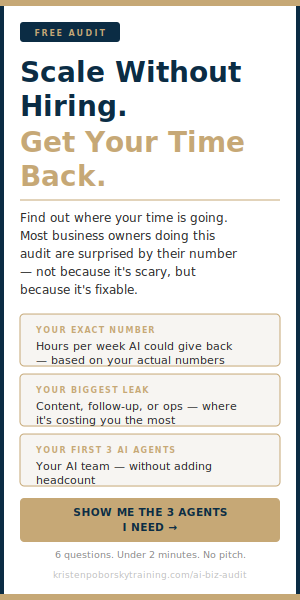
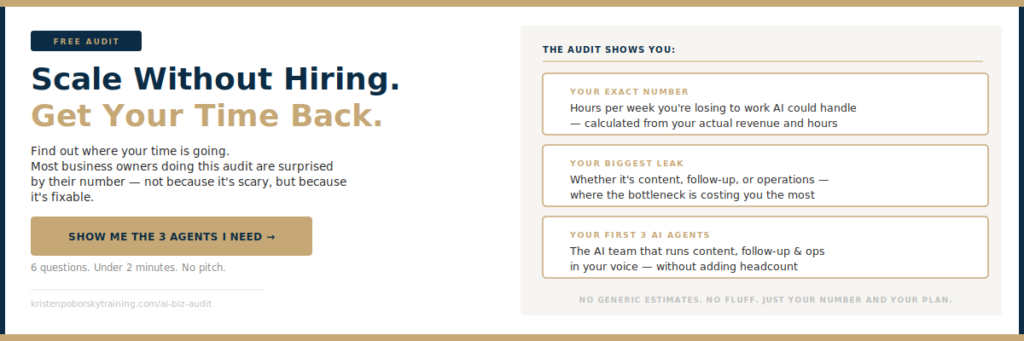
If you want to know exactly where your business is losing time and money, I built a free two-minute audit that does that calculation for you. Six questions. It shows you how many hours a week you’re losing based on your actual revenue and hours — and which agents would give them back.
Grab the link below. It takes less than two minutes, and it’ll show you exactly where to start.
Most coaches are one content agent, one decision support agent, and one ops agent away from a business that actually runs like a team.
The work you’re carrying every week? A lot of it doesn’t need to land on your plate. And setting up AI agents for your coaching business doesn’t need to be complicated — they just need actual jobs to do.
Start with the one your business is missing most. Take the two-minute audit below. Then build the one thing that buys you back the most.
Frequently Asked Questions
Q: What AI agents do coaches actually need in their business?
A: Most coaching businesses need three core AI agents: a content agent that turns recordings into a week of content, a decision support agent that catches your blind spots before they cost you, and an ops agent that handles follow-up, lead engagement, and onboarding automatically. These three jobs cover time, decisions, and operations — the areas where solopreneurs lose the most without realizing it.
Q: What’s the difference between using AI as a tool versus building an AI agent team?
A: Using AI as a tool means you have to show up every time — you prompt it, it responds, you move on. Building an AI agent team means specific jobs in your business are running without you initiating each step. A tool adds to your to-do list. A team reduces it.
Q: How does a content agent actually work for coaches?
A: You record a video, training, or podcast episode. The content agent processes that recording and produces multiple content formats — emails, social posts, carousels, video scripts, blog posts. One input, multiple outputs. You don’t have to touch it again after the recording is done.
Q: What kinds of decisions can an AI decision support agent help with?
A: Client situations, pricing decisions, sticky emails, positioning questions, and any high-stakes moment where you’d normally be the only voice in the room. The agent doesn’t decide for you — it asks the questions you forgot to ask yourself and surfaces perspectives you may have missed.
Q: How quickly do coaches see results after setting up AI agents?
A: A content agent produces results the same day — your first recording becomes your first batch of repurposed content immediately. The decision support and ops agents take more setup time to configure correctly, but most coaches start seeing hours returned to them within the first week of running an ops agent.
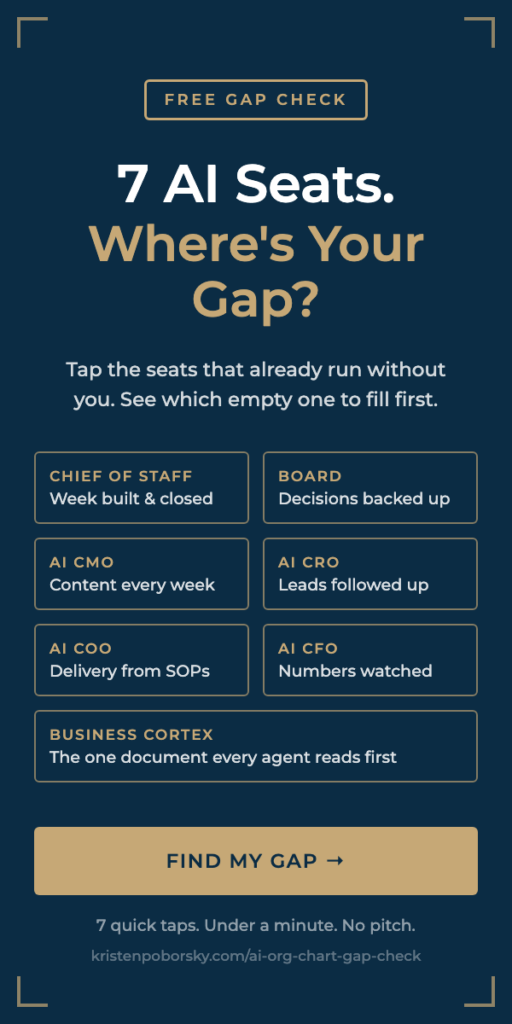
Want to know which AI agents your business needs first? Take the free 2-Minute AI Business Audit. It shows you the first three agents to build, what not having them is costing you, and what changes in your business once they’re running. Or steal my AI org chart and see which of the 7 AI seats your business still has empty.