
Key Takeaways
How to Build a 10 to 2 Workday with an AI Business Team
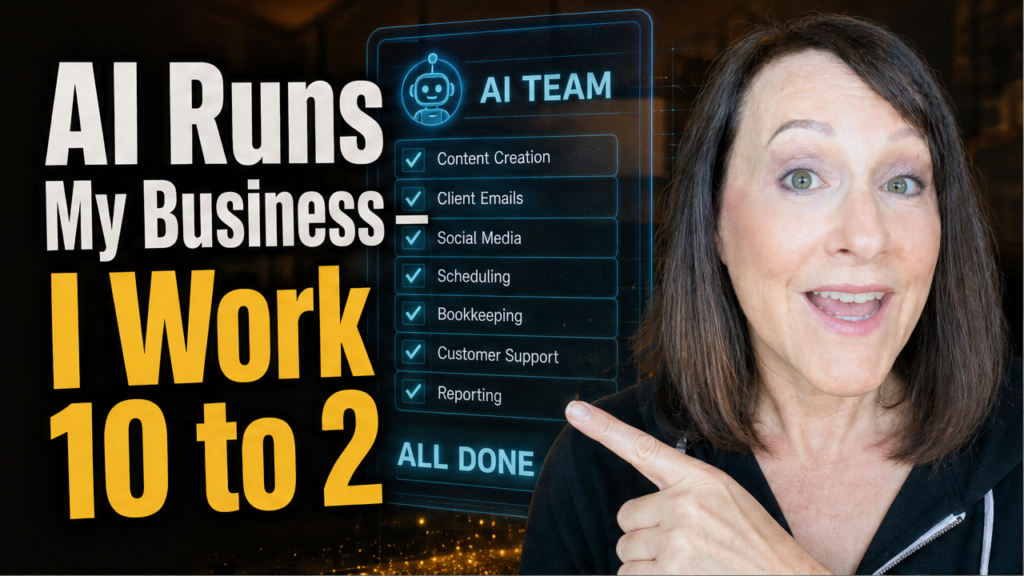
Working a 5-hour day isn’t about working less — it’s about building a business that runs without you being the bottleneck. An AI business team (a set of trained agents each doing a specific job) handles content, emails, client materials, and follow-up in the background so your life can actually happen. The 10 to 2 window only works when your business isn’t fully dependent on you to run it.
Here’s something nobody in the hustle culture conversation wants to say out loud: you can build a thriving business AND be in your garden at 2:00 PM on a Tuesday. Even in summer. Even when ideas are flying.
That’s not a highlight reel moment. That’s a deliberate structure — and it took me two full summers of 12-hour days to finally build it.
If you’re a coach, consultant, or course creator who’s creative, ambitious, and chronically stuck at your desk while life happens outside the window — this is for you. I’m going to walk you through the exact 10 to 2 setup I run, why it only holds because of an AI business team working in the background, and how you can get the same thing going in your own business.
No theory. My actual life.
The Real Cost of Running a Business That Depends on You
The problem isn’t that you work too much. The problem is that your business only works when you do.
That was me. Every summer, my creative energy would spike. Ideas everywhere. New programs, content series, launches — all of it firing at once. And I loved it. Still do. But here’s what actually happened: every good idea became more work on my plate. More content to write. More emails to send. More posts to schedule. More programs to run.
The more I created, the more there was to manage. By August, I wasn’t enjoying the summer — I was barely surviving it. My golf game was flat. My garden was dusty. And I wasn’t there for any of it.
The worst part? I couldn’t even blame the business. The business was doing exactly what I built it to do. The problem was that I hadn’t built it to run without me.
That’s the real issue most coaches and course creators are facing. Not the workload itself — the dependency. Every piece of the operation runs through you, and that means the moment you step away, everything slows down or stops.
Once I named it that clearly, I could actually fix it.
What the 10 to 2 Window Actually Looks Like in Practice
This isn’t a fantasy schedule. It’s a deliberate structure, and the specifics matter.
The work window is 10:00 to 2:00. Five hours. Before 10:00, there’s a non-negotiable morning ritual — no work until it’s done. It sets the tone for the day and makes stepping into work feel intentional rather than reactive.
The window closes at 2:00. There’s a 30-minute flex built in for the end of the day — if something genuinely needs finishing and I’m in a flow, that’s fine. But I watch it closely. The moment the flex starts becoming the rule, something in the system is broken, and that’s the signal to stop and diagnose, not to push harder.
Here’s the part that makes it work inside the window: no two days are blocked the same, but the sequence never changes.
Deep work comes first, when the brain is sharp. Client calls sit in the middle. Admin and quick wins land at the end. That order holds regardless of what the calendar looks like. It means the sharpest thinking never gets wasted on shallow tasks.
Fridays are mine. They’re the start of the transition into the weekend — not a catch-up day, not a half day of email. Saturdays and Sundays are for living. That’s not a summer rule. That’s always.
When work starts piling up — and sometimes it does — the response isn’t to grind harder. It’s to stop, take a breath (or a half day), and figure out what’s actually broken. The pile is telling you something. Listening to it isn’t laziness. That’s how you keep a business sustainable for years, not just sprints.
What an AI Business Team Actually Is (And What It Isn’t)
An AI business team is not a chatbot you type questions into.
It’s a set of agents, each trained to do a specific job inside your business, running while you’re not. Think about the work that happens in your business every single day — content gets written, emails go out, social posts get scheduled, client materials get organized, follow-up happens. All of that can be handled by agents working in the background.
That’s not a pitch. That’s what I built, and it’s what makes the 10 to 2 window hold.
Before my AI business team, my creativity was a liability. Every idea meant more hours at the desk. Now it’s an asset. When I have an idea, I hand it to an agent, and it moves forward — without me staying up until midnight to push it through.
The shift is from being the bottleneck to being the visionary. You still get to have all the ideas. You just stop being the one executing every single piece of them.
My agents run so I can be in my garden or on the golf course at 2:00 PM. That’s not a bonus feature of the system. That’s the entire point of it.
The business is moving. Clients are being served. Content is going out. You just don’t have to be the one grinding out every piece of it anymore.
And here’s what most people get wrong when they first hear this: they think they need a big budget or a tech background to set it up. They don’t. You need the right agents, set up the right way, trained to run your specific business the way you’re running it right now by yourself.
How to Start Building Your Own Version
You don’t need to overhaul everything at once. Here’s where to start:
Identify your dependency points. What tasks only move forward when you’re actively doing them? Those are your bottlenecks — and your first agent targets.
Pick one repeatable output to hand off first. Content is usually the best starting point — it’s high volume, time-intensive, and very teachable to an agent.
Set the window before you set up the agents. Decide your work hours first. The constraint is what forces the system to exist.
Protect the sequence, not just the schedule. Deep work first, calls in the middle, admin at the end. The order matters more than the exact times.
Diagnose pile-up instead of powering through it. When work stacks up, something in the system needs fixing — not more hours.
The first step you can take today: write down every task you did in the last 48 hours and mark which ones only happened because you were the one doing them. That list is your starting point.
Two summers ago, I was at my desk while summer happened outside. This summer, I’m in my garden by 2:00, and the business is still running.
That didn’t happen because I worked smarter in some vague, motivational-poster way. It happened because I built a system that doesn’t need me for every piece of it.
Your business should work for your life — not the other way around.
If you’re ready to build your own AI business team, I put together the Business Team Blueprint. It walks through exactly which agents I use, how I set them up, and how you can get your own version running without needing a tech background or a big team. Grab the link below and go build that.
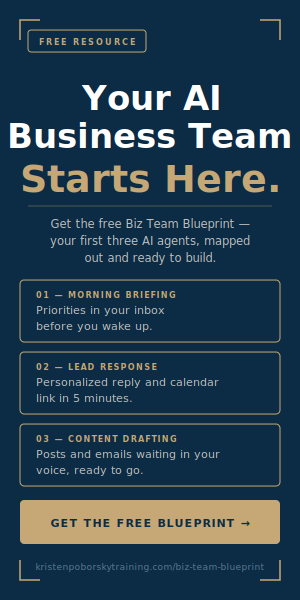
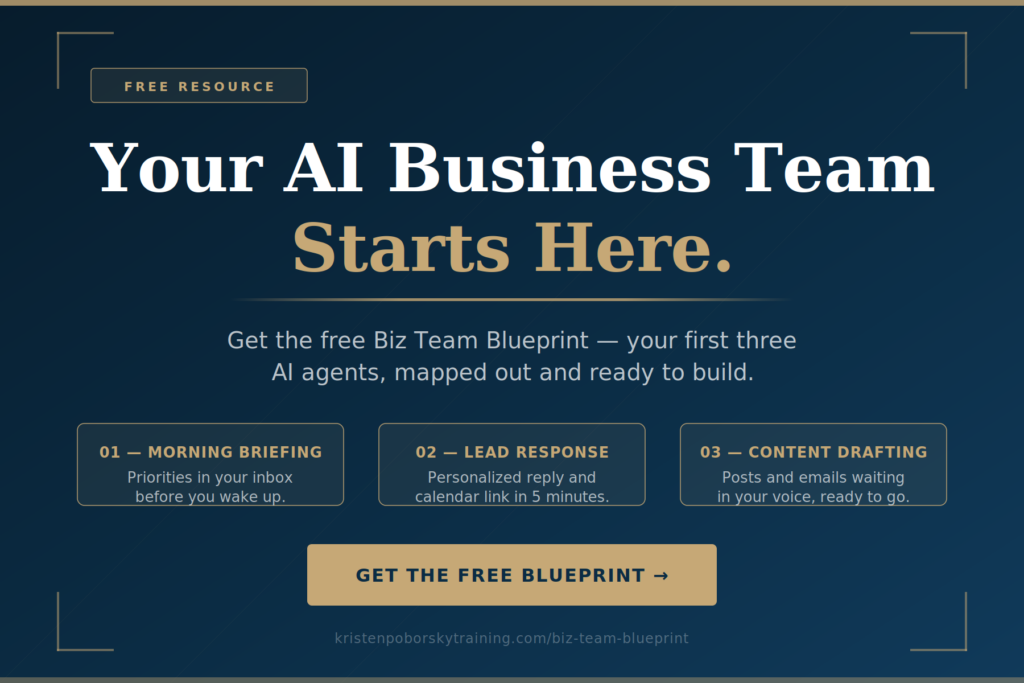
Ready to build your AI business team?
Get the free Biz Team Blueprint and see exactly what your first three agents should be — and how to set them up.
Get the Free Blueprint
Frequently Asked Questions
Q: What is an AI business team for coaches and course creators?
A: An AI business team is a set of trained agents — each one assigned to a specific job in your business — that runs in the background without your involvement. Unlike a chatbot you query manually, these agents handle ongoing tasks like content creation, email outreach, social scheduling, and client follow-up automatically. The goal is to remove you as the bottleneck so the business keeps moving when you step away.
Q: How many hours do you actually need to work with a 10 to 2 schedule?
A: The 10 to 2 window is five hours of focused work. That’s it. The reason it works isn’t about working less — it’s that the work happening inside those hours is protected and sequenced (deep work first, calls in the middle, admin at the end), while everything else gets handled by agents in the background.
Q: Do I need a big budget or technical skills to set up AI agents for my business?
A: No. The most important thing is identifying which tasks in your business are repetitive and teachable. From there, agents can be set up and trained to run those specific jobs the way you currently do them — without requiring any coding knowledge or enterprise-level tools.
Q: What’s the difference between using AI tools and having an AI business team?
A: Using AI tools means you’re still the operator — you prompt it, review it, post it, and move on to the next thing. An AI business team means agents are doing that whole cycle without waiting for you. The difference is between AI as a productivity aid and AI as an actual team member with a defined role and ongoing responsibility.
Q: How do I know if my business is ready for an AI business team?
A: If you’re doing the same types of tasks repeatedly, if your output slows down when you’re unavailable, or if you’re consistently hitting a ceiling on how much you can produce — your business is ready. The clearest signal is that the work only moves when you’re the one moving it.