
Key Takeaways
Landing page isn’t converting? Most often this is usually an audience problem, not a copy problem, and copy is the last thing to check rather than the first.
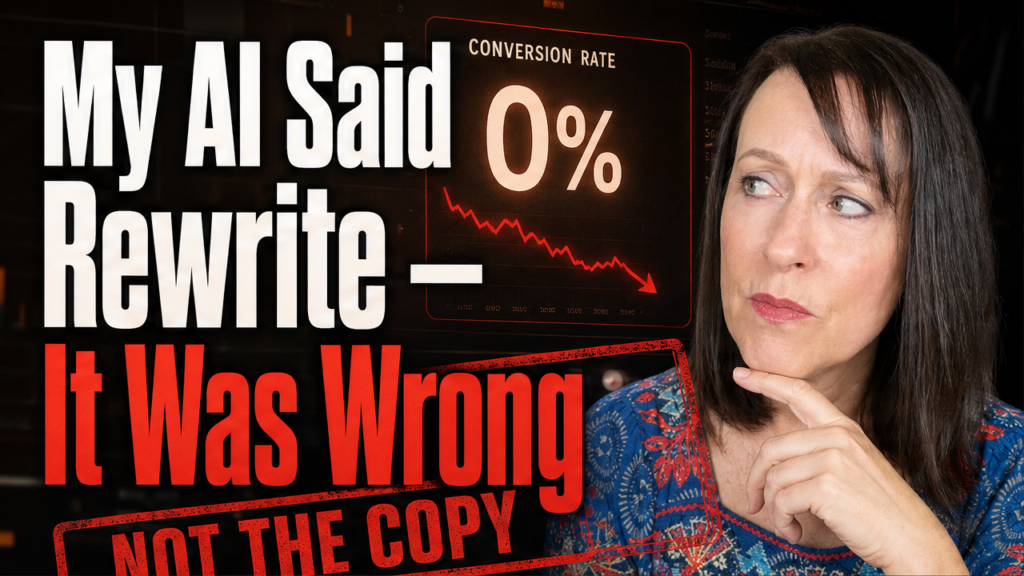
My AI said to rewrite the landing page but it was wrong…
Check in this order: audience, the match between ad and page, whether the mechanics work, then message.
A hundred people hit my new opt-in in a week with zero sign-ups. The same page converted at twenty-five percent once warm traffic saw it.
Dashboards report and do not reason, which is why most people quit measuring after looking once.
My landing page isn’t converting page…I’m sure you have had a similiar problem.
I looked to AI for help and I almost rewrote a landing page that had nothing wrong with it.
Two days of work, for no reason.
Here was the situation. Brand new opt-in, paid traffic pointed at it, running for a week. A hundred people landed on that page.
Nobody opted in.
My first thought was that my copy was off. Rewrite the headline. Redo the page.
That is everybody’s first instinct and it is almost always wrong. The page is usually fine.
This post covers what I found instead, the four places a funnel actually breaks and the order to check them in, how I used AI to reason through it rather than guess, and the twenty minutes a week that keeps you out of this.
What I Checked Before I Touched a Word
When you have traffic but your landing page isn’t converting, the break is in one of four places, and copy is the last of the four rather than the first.
The first check costs about ten minutes. I looked at ad copy against page copy. Did the promise on the ad match the promise on the page?
That break is the cheapest one to find and the most frequent one to happen. Somebody clicks expecting one thing, lands on something that reads slightly differently, and leaves without ever knowing why.
Mine matched. Clean handoff, same language, same promise.
So the copy was aligned and a hundred people had come and gone. Next question: where exactly were they dropping, and were they reading the page at all or gone in three seconds?
That is where it got interesting, because the drop-off pattern did not look like a copy problem. It looked like people who were never going to convert in the first place.
Here is what it actually was. I was showing that ad to cold audiences. People who had never heard of me, never seen my content, no idea who I was.
And I was asking them, right out of the gate, for their email address for a brand new thing they had never heard of.
The page was fine. The offer was fine. The audience was wrong.
I already had a funnel that warms people up. I was not feeding this one from it. Two things I built, sitting side by side, not talking to each other.
We changed who saw it. Same page, same copy, warm traffic this time, people who had already spent time with me. It converted at twenty-five percent.
Not one word of that page changed. Not one.
The Four Places a Funnel Breaks, in Order
The order you check in decides how long the diagnosis takes. Checking backwards is what turns an afternoon into six weeks.
Audience
Who is seeing this, and are they ready to be asked? Cold traffic against a cold ask almost never works. This is the most expensive mistake and the one people check last.
The handoff
Does the ad promise match the page promise? Read them back to back, out loud. You will hear the gap immediately if there is one.
Mechanics
Does the thing actually work? Does the form submit, does the email send, does the button go where you think it goes. I have found dead forms on live pages more than once.
Message
Now you look at copy. If you are launching something brand new, this is real, and you might have the wrong message for that audience. That is worth knowing.
But you cannot know it until the first three are cleared, or you will blame your words for an audience problem.
I watched somebody rebuild a landing page four times in six weeks. New headline, new copy, new colours, every round. She never checked the conversion rate on any version. Four pages, six weeks, no answer, and she was working on number four while number one might have been her winner.
She had skipped to the last item on the list and never touched the first three.
Copy is the loudest thing on the page. That is why you blame it. It is rarely the thing.
Dashboards Report. They Do Not Reason.
Numbers on their own tell you nothing, and that is the part nobody says out loud.
You can stare at a dashboard for an hour. Traffic up, conversions down. Why? The dashboard does not know. It reports.
That gap is why most people quit measuring. They look, they do not understand what they are seeing, they feel stupid, they stop looking. I do not blame anybody for that.
What I did on that opt-in was connect my Facebook ad data directly to Claude and ask it questions. Not a request for my numbers.
Actual questions.
Which audiences are these clicks coming from. What is different about the ones who convert compared to the ones who bounce. Does this pattern look like a copy problem or an audience problem.
It walked through it with me and ruled things out. That is how the audience answer turned up in an afternoon rather than a month.
For years this work belonged to people who had an analyst. The reasoning is now available to anybody willing to ask a question, and that changes what a solo operator can find on their own.
This is also what I mean when I say measuring is how you scale.
Not more ads, not more content, not a bigger budget. You look, you find the actual break, you fix that one thing, and the same assets start working.
My page did not get better. My understanding did.
The businesses I see stall are running on instinct, and instinct is confident and frequently wrong. Mine was.
What To Do Next
Twenty minutes, once a week, same day every week or it will not happen.
Pick three numbers and only three. For a funnel: how many landed, how many opted in, what percentage that is. Write them somewhere permanent, a document is fine.
Record them weekly even when nothing has changed. A number on its own means nothing. The number compared to last week means everything.
When something moves, ask why before you touch anything. Run the four checks in order: audience, handoff, mechanics, message.
Change one thing at a time. If you change three things and results improve, you have learned nothing about which one did it.
Start with the three numbers this week. Everything else follows from having them written down.
You Do Not Need More Traffic
A hundred people came through a page I was about to spend two days rewriting. The break was two funnels that were not talking to each other, and it took an afternoon to find because I asked questions instead of guessing.
If you have traffic but no conversions right now, the answer is probably not in your copy. Run the four checks in order and let the numbers point at it.
You do not need more traffic. You need to know what your traffic is doing. Go pick your three numbers.
Frequently Asked Questions
Q: Why does my landing page get clicks but no sign-ups?
A: Most often the audience seeing the ad is not warm enough to be asked yet. Cold traffic against a direct opt-in ask converts poorly regardless of how good the page is. Check who is being shown the ad before you rewrite anything on the page.
Q: How do I know if it is my copy or my audience?
A: Look at where people drop. If they leave within a few seconds without reading, that pattern points at audience or at a mismatch between the ad and the page. If they read the full page and leave, message becomes a more likely candidate.
Q: What numbers should I track for a simple funnel?
A: Three are enough to start: how many people landed on the page, how many opted in, and the percentage between them. Recorded weekly, those three will show you a break before it costs you a month.
Q: Can AI actually diagnose ad performance, or does it just summarise?
A: It can reason if you ask it questions rather than requesting a report. Ask which audiences the clicks came from, what separates converters from bouncers, and whether a pattern looks like copy or audience. The value is in ruling things out.
Q: How long should I run an opt-in before deciding it does not work?
A: Long enough to have real traffic, and only after audience, handoff and mechanics have been cleared. I ran mine for a week with a hundred visitors and no sign-ups, and the offer turned out to be fine. Deciding an offer failed when it was shown to the wrong people is the most common expensive mistake here.