Key Takeaways
The Business Bottleneck Test Every Owner Should Take
A business bottleneck happens when every decision, every piece of content, and every follow-up has to run through one person — usually the owner. You can spot it with a simple test: if you took two weeks completely off, would your business keep running at the same level? The fix isn’t more hours or more hustle. It’s building an AI team with real jobs, not just AI tools you remember to open when things pile up.
I ruined a vacation for myself once. My family and I went to Palm Springs, and instead of being there with them, I spent the whole week working — checking in, answering questions, making sure nothing broke while I was gone.
That’s the trip where I finally admitted what I’d been avoiding: I was the business bottleneck.
Every decision, every piece of content, every follow-up ran through me. Stepping away for even a day meant things slowed down or stopped, and I knew it, so I stopped stepping away. If that sounds familiar, you’re in good company. It’s the number one pattern I find in the AI business audits I run, across every industry, every business size, every revenue level.
Here’s how to know for sure, and what actually changes it.
How to Know If You’re the Business Bottleneck
There’s a simple test. If you took two weeks off — completely off, no checking in, no replies, no “just this one thing” — would your business keep running at the same level? If the answer is no, or you’re not sure, you’re the bottleneck.
Here’s what that looks like day to day. You’re the one who handles the content, even when you have help, because you’re still the one reviewing, editing, and approving everything before it goes out. You’re the one who follows up with leads and clients, because nobody else knows what to say. You’re the one who gets asked every question, because your team or your clients come to you for answers that should already exist somewhere else.
And you’re the one who makes every decision, big and small, including the ones that don’t actually need you.
I worked with a woman who manages four stores across four locations, each with different staff and different systems. Whenever anything came up — a return, a policy question, a product issue, an incident — they called her.
Every routine question, every procedural gap, every “what do I do when” moment landed on her desk. She wasn’t a bottleneck because she wasn’t doing her job well. She was a bottleneck because the information lived in her head and nowhere else.
Here’s the part that catches people off guard: being the bottleneck doesn’t feel like a problem at first. It feels like being needed. It feels like being good at your job. Right up until you realize your business can’t move faster than you personally can move.
Why This Happens to the Best People
You’re good at what you do — exceptionally good — and because you’re good, it’s almost always faster to do something yourself than to explain it to someone else. I still catch myself thinking this way. I’ve just learned to catch it before I actually go down that road.
So you do the task yourself. Then you do it again. And again. Over time, every process that should be documented and handed off is still sitting with you, because you’re the only one who does it what you believe is the right way. This isn’t laziness, and it isn’t poor leadership.
It happens when you’re running fast with zero infrastructure underneath you.
From every audit I’ve run, three things cause this pattern:
No documented systems — everything lives in your head
No team, human or AI, that can answer questions or run things without you
No infrastructure that keeps working when you’re not there to run it
Most business owners have none of these three things in place. A few have one. Very few have all three. The ones who do have all three are the ones scaling without burning themselves out in the process.
What most people get wrong here is thinking the answer is hiring more people. I hired virtual assistants for years and still hit the same wall, because the information they needed to do the work still only existed in my head.
Information that lives in your head, or in a format nobody else can actually use, works the same as information that doesn’t exist at all.
What Changes When You Have an AI Team Instead of AI Tools
Most people are using AI as a tool. They open Claude, type something in, get something back, close the tab. That’s not a team — that’s a fast calculator. It saves you a few minutes, but it doesn’t actually give you back your time, because it still needs you to show up and ask.
A team runs things without you. A tool waits for you to open it.
Here’s what that looks like in practice. Before, you’d spend three hours turning one recorded video into content. After, your content agent does that work while you’re doing something else with your life. Before, a warm lead would go cold because nobody followed up. After, your follow-up agent sends the right message at the right time, automatically. Before, your team would sit and wait for you to answer a question, eating up your morning. After, they go straight to a knowledge base agent and get the answer instantly — this works just as well inside a coaching program, where it functions like a coach on demand for your students.
Before, you made every decision alone, blind spots and all.
After, a decision support agent pushes back on your thinking before you send the wrong reply or make the wrong call.
I built my own version of this after a meeting problem I kept ignoring in my own business — the exact thing I tell clients not to do. Every meeting ended with a head full of notes, action items I’d promised to send, and recordings sitting there unprocessed, quietly becoming tomorrow’s problem. Now, when a meeting ends, an agent processes the recording automatically. A Google Doc with the recap lands in my inbox. If it’s a client call, the email draft is already sitting in Outlook, ready to send. Five call types, five different outputs, zero manual steps from me.
The part people underestimate is that this takes actual building — an agent trained on your voice, your business, and your clients doesn’t come from one clever prompt.
It comes from setting it up once, correctly, so it keeps running whether or not you remember to open it.
What To Do Next
You know you’re the bottleneck. You know roughly what it’s costing you. Here’s how you start fixing it.
See the picture clearly first. Most business owners don’t actually know where their hours go — they feel busy, but they don’t have the data. Build a real inventory of what currently runs through you, what shouldn’t, and what would happen if it didn’t.
Give AI real jobs, not one-off tasks. Stop asking it to write one email — build an agent that handles the whole email category. Stop asking it to summarize one meeting — build a meeting intelligence agent that processes every meeting for you, automatically.
Start with the three categories that eat the most time: content, decisions, and operations. Build your first agents there, and the rest of your business will start to follow.
The problem is almost never what people think it is. Most business owners believe they’re behind because they need more clients, a better offer, or more visibility. Almost always, the real bottleneck is the infrastructure underneath everything else. The business can’t grow because you personally can’t grow any faster than you’re currently moving.
You went from “I think I might be the problem” to knowing exactly what to do about it.
You’re the bottleneck when every decision, every piece of content, every answer runs through you, and the business can’t move without you in it — and it happens to the best people, not the struggling ones, because expertise naturally concentrates in one person’s head. The fix is an AI team: agents with real jobs that run whether or not you show up to remember them.
Your business is good. Your ideas are good. You just need a team that keeps up with you.
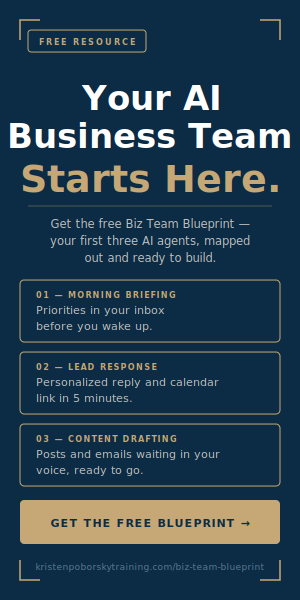
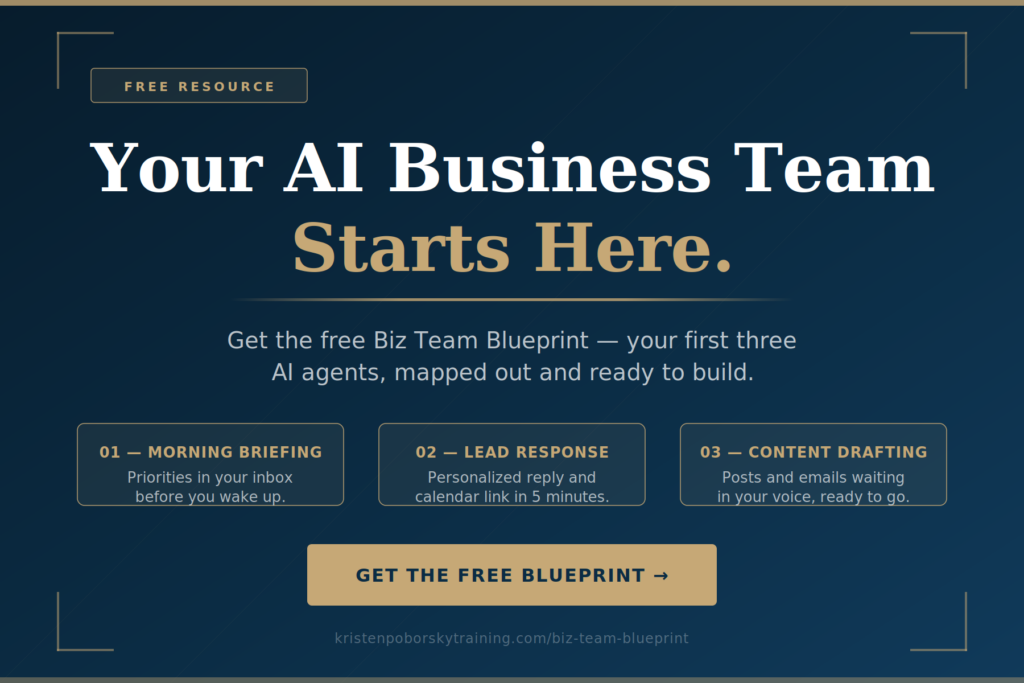
Ready to build your AI business team?
Get the free Biz Team Blueprint and see exactly what your first three agents should be — and how to set them up.
Get the Free Blueprint
Frequently Asked Questions
Q: What is a business bottleneck? A: A business bottleneck happens when every decision, piece of content, follow-up, or answer has to run through one person, usually the owner. It slows or stops the business the moment that person steps away, even briefly.
Q: How do I know if I’m the bottleneck in my own business? A: Take the two-week test: if you stepped away completely for two weeks with no check-ins, would your business run at the same level? If you answer no, or you’re not sure, you’re the bottleneck.
Q: What’s the difference between using AI tools and having an AI team? A: An AI tool waits for you to open it and give it a task, one at a time. An AI team is made up of agents given real, ongoing jobs — like handling content, follow-up, or answering questions — that keep running whether or not you remember to use them.
Q: What actually causes someone to become the bottleneck in their business? A: Three things, usually in combination: no documented systems, no team (human or AI) that can answer questions without you, and no infrastructure that keeps running while you’re away. Most business owners have none of the three in place.
Q: Where should I start if I want to reduce being a bottleneck in my business? A: Start with an honest inventory of where your hours actually go, then build your first agents in the three categories that eat the most time: content, decisions, and operations. Those three tend to buy back the most hours the fastest.
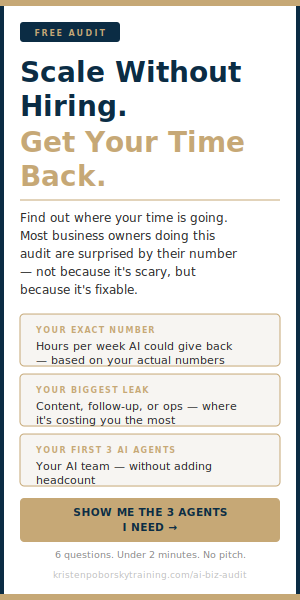
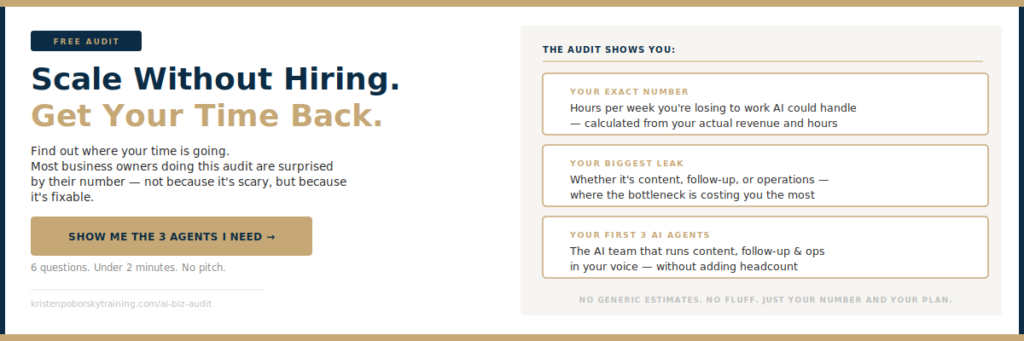
Curious what being the bottleneck is actually costing you in hours?
Take the free AI Team Audit — two minutes, six questions — and get your exact number, plus the three agents that would recover it for your business.