
Last updated: September 2026
Key Takeaways
- Delegating without systems is why most assistants and team members appear to underperform. The work was never handed over, only the responsibility for it.
- If your team could not keep working while you were unreachable for two weeks, you are the bottleneck.
- A 30-person company documented its operation in one month. Three interviews produced more than fifteen written procedures.
- AI installed on top of undocumented work produces generic output, because there is nothing specific for it to run on.
This post is part of my complete guide to why AI isn’t working in your business, and how to fix it.
Read the full guide → Why AI Isn’t Working in Your Business
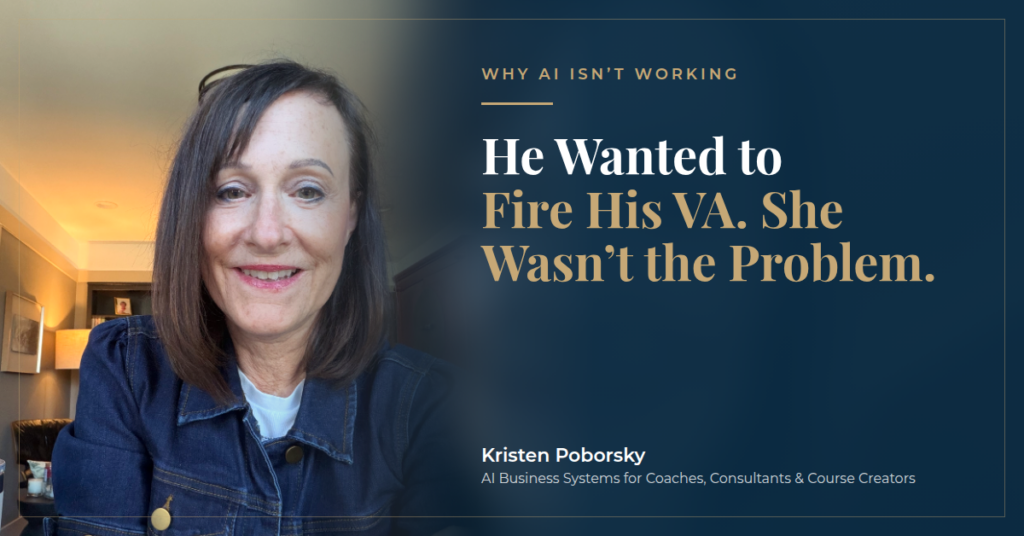
A guy came to me ready to fire his virtual assistant. She was fine. He was the problem.
He had hired her to take content off his plate, and he was still doing every bit of it himself. Not because she could not do the work. Because he had nothing to hand her.
No documented process, nothing written down. The entire way he worked lived in his head, so every time he thought about handing something over, doing it again himself was faster.
I see this constantly. Somebody hires help, does the work anyway, then concludes the help is not working out.
This post covers what delegating without systems looks like from the inside, how a 30-person company fixed it in a month, and what happens if you skip this and go straight to installing AI.
One Person Holding an Entire Company’s Knowledge
Delegating without systems means handing somebody responsibility for work whose steps exist only in your head, which leaves them dependent on you for every decision.
The largest version I have worked on was a company with thirty employees.
Every question any of them had went to one person: the owner. How do we handle this. Where is that file. What did we tell that client last time. What is our process for this. Thirty people, all day, funneling through one human being.
There were no standard operating procedures. Nothing written down anywhere in the business.
So a thirty-person company ran on one person’s memory, and that person could not get any of their own work done, because the day was spent answering questions.
Now think about what happens when somebody in that position decides to add AI.
What would it run on? There is no process to give it and no document to train it on. The knowledge is not anywhere a machine can reach, because it is in a head.
You cannot hand a machine a process that does not exist.
The test is simple and slightly uncomfortable. If you went completely off-grid for two weeks, could your team keep working? Not perfectly, just functionally. If the honest answer is no, you are the bottleneck, and no tool fixes that until the knowledge lives outside you.
One Month to Documented, by Talking Instead of Writing
That thirty-person company took a month, and the reason it moved that fast is that nobody sat down to write.
We interviewed. Three of them. Sat people down and had them talk through how they actually do the work, out loud, messy, in whatever order it came out.
Then AI turned those conversations into operating procedures. More than fifteen of them, step by step, in plain language, usable by somebody who was not in the room.
That is the part that changes the arithmetic. The bottleneck was never the knowing. It was the writing. Nobody wants to sit down and write fifteen procedures, so nobody ever does, and the documentation project stays permanently on next month’s list.
Talking is different. People can talk about their own work for an hour without stopping.
The immediate result was that the employees got one central place to find answers. A question comes up and they check the document rather than walking down the hall. The owner got their days back, and that is what it bought. Not tidiness. Hours.
The result that mattered more came later. When a team member left, the replacement had everything: the departing person’s process and the owner’s, written down and immediately usable. The knowledge did not walk out of the building.
For the entrepreneur with the assistant, the same approach at smaller scale. His team members built the procedures out of what he already knew. His VA now runs his content, with the tools, the procedures and the system to do it. He is not doing it himself anymore, and he never needed to fire anybody.
If you want the step-by-step version of getting what you know onto paper, I walk through it in How to Get Your Business Out of Your Head.
What Happens If You Install AI First
An AI team with nothing to run on does not fix your bottleneck. It makes the bottleneck faster.
Consider what the entrepreneur could have done instead of calling me. He could have set up a stack of agents to write all his content, and he would have ended up in exactly the same place.
There would be no process for running them. No central place holding his intellectual property. And he did not have that written down anywhere at all: his frameworks, his methods, the way he explains things, the material that makes his content sound like him. None of it existed outside his head.
So what would those agents produce? Generic content, at best. Fast, plentiful, and not his.
There is a harder version of this to catch, which is when the system mostly exists but one piece is missing. That happened to me recently. I had ads running, everything set up the way I had been shown, money going out every day. The setup I had been given was missing one part, because nobody told me the audience piece mattered as much as it does. So I was pointing ads at people who had never heard of me and wondering why nothing converted.
I was not doing it wrong. I was doing exactly what I had been taught. The instructions had a hole in them, and the only way I found it was going in and looking at the numbers myself.
So this cuts both ways. Check what you have built, and check what somebody else built for you.
What To Do Next
Do not document your whole business. You will quit by Thursday.
- Pick the question you answer most often. The one that comes at you over and over from your team or your clients. That is your first procedure.
- Talk it through and record it. Voice memo, Loom, whatever is nearest. Do not write. Explain it the way you would explain it to a new hire on their first morning.
- Have AI turn that recording into a written procedure. Steps, in order, in plain language, readable by somebody who was not there.
- Put it where people will actually look. One place, the same place every time. A folder nobody can find is the same as no folder.
Then do the next one. One a week and your business is documented within a few months. Once that exists, AI has something to run on.
If you’d like to see which processes to document first, take the free 2-Minute AI Business Audit below. It shows you the first three agents to build, what not having them is costing you, and what changes once they’re running.
Your Business Already Runs on Something
A capable assistant nearly lost her job over work that had never been handed to her. Thirty people spent every day queuing outside one person’s office, until three interviews and a month turned that into fifteen procedures they could read for themselves.
Delegating without systems is not a hiring problem or a discipline problem. It is a documentation problem, and it is the cheapest one to fix. It is also the first of the four reasons AI isn’t working in most businesses.
You already know how your business runs. It is trapped in your head. Go get one thing out of there this week. Take the free 2-Minute AI Business Audit, or steal my AI org chart, and see which seats your AI team still has empty.
Related: Why AI Isn’t Working in Your Business: The 4 Real Reasons • Your AI Agent Isn’t Broken. You Shipped It Early.
Frequently Asked Questions
Why is my virtual assistant not taking work off my plate?
Usually because the work was never handed over, only the responsibility for it. Without a written procedure, your assistant has to ask you how to do each thing, which costs you more time than doing it yourself. Document one process and hand that over properly before adding anything else.
How long does it take to write SOPs for a small business?
A thirty-person company I worked with took a month and produced more than fifteen procedures from three interviews. The speed comes from talking through each process and letting AI write it up, because the slow part of documentation has always been writing rather than knowing.
What should my first SOP be about?
The question you answer most often. It saves the most time immediately, and it is the easiest to explain because you have already explained it dozens of times.
Can I use AI to run my business if nothing is documented?
You can install it, but it will produce generic output, because there is nothing specific for it to draw from. Your frameworks, methods and language have to exist somewhere outside your head before AI can sound like you or work the way you work.
What happens to my business when a team member leaves?
Without documentation, their process leaves with them and the replacement starts from nothing. With it, the new person inherits both the departing person’s steps and the owner’s, which is what turns a resignation into a handover rather than a setback.
Want to know which AI agents your business needs first? Take the free 2-Minute AI Business Audit. It shows you the first three agents to build, what not having them is costing you, and what changes in your business once they’re running. Or steal my AI org chart and see which of the 7 AI seats your business still has empty.