
Last updated: October 2026
Key Takeaways
- Done beats perfect. Your recording is raw material for AI to multiply, not the final product.
- One take, natural talking and real stories are what build connection with your audience.
- Todd’s YouTube videos have never been professional quality, and they bring him thousands of views and calls every month.
- You don’t need professional equipment. A phone, decent light and clear sound are enough.
- Waiting until you look or feel ready costs you the content you could have shared.
This post is part of my complete guide to turning one recording into a week of content, in your voice.
Read the full guide → One Recording, A Week of Content
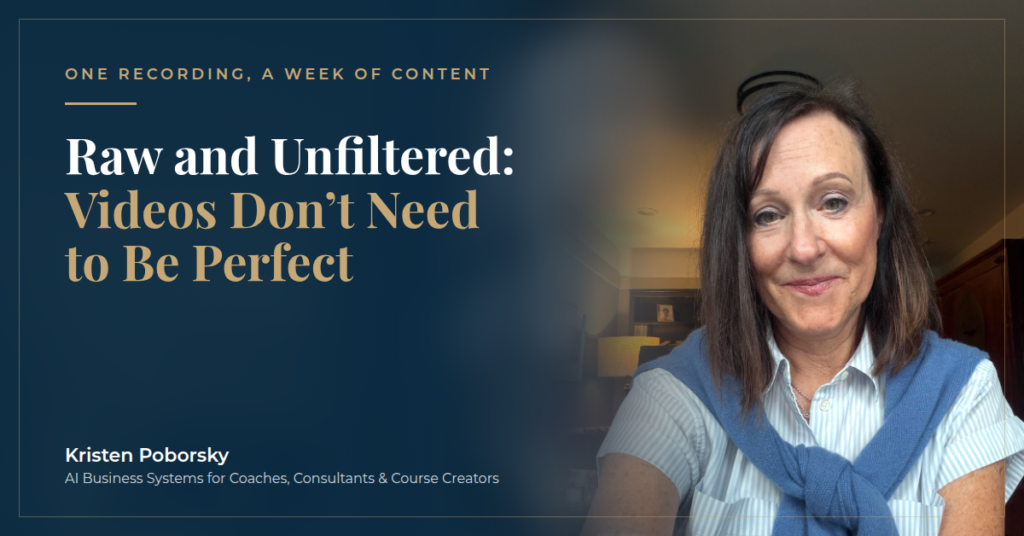
Done beats perfect, especially now, when your recording is raw material for AI to multiply rather than the final product. One take, natural talking and real stories are what build connection, and they’re what the whole system runs on. Here’s why imperfect video wins.
I know the pull of perfectionism on camera. I’ve been the person who didn’t want to look bad in a video, and I’ve also sent out videos that were completely raw and unpolished.
Why Does Perfectionism Stop You From Making Videos?
Perfectionism stops you from making videos because it tells you the video isn’t worth making until everything is flawless: the lighting, your hair, every word.
That standard is impossible, so the video never happens. Or it happens once, takes all day and feels so hard that you don’t do it again for a month. Meanwhile, your message sits in your head instead of reaching the people who need it.
Your skill on camera isn’t the problem. It’s the belief that the video has to be finished and polished the moment you record it.
I learned this one live. Years ago I was doing a Facebook Live with my outline right in front of me, and I got mixed up and skipped it completely. No outline, just me talking. And you know what? It was okay.
People don’t want a made-up image of you. They want you. A flub shows them you’re real, and that’s what builds the connection.
Why Is Done Better Than Perfect Now?
Done is better than perfect now because your video isn’t the only thing you’re making. It’s the source for your blog post, your email, your descriptions and your social posts.
When I record a 10-minute video, AI turns the transcript into a week of content. What matters for that is what I said, not how I looked saying it. A real story told naturally makes better raw material than a polished script read perfectly.
Tools also handle the cleanup now. Descript removes filler words, fixes eye contact and cleans up the sound. The polish happens after you film, not while you’re filming.
One of my clients is a very busy coach who might have 30 minutes free in a week to create something for his audience. He could have treated it as one more thing he had to get done. Instead he decided his audience really needed to hear from him on that topic, sat down and wrote it in less than 30 minutes. He didn’t worry about getting it perfect. It just flowed.
He got lots of positive feedback from his audience about how helpful it was. If he’d held on to the idea that it had to be perfect, it never would have been written, and his audience would never have heard it.
Does Imperfect Video Actually Work?
Yes. Some of the best-performing videos I know are the least polished ones.
Take Todd. We’ve been doing his videos since 2014, and none of them are professional quality. There’s no fancy set and no heavy editing. He still gets thousands of views and calls every single month from his YouTube content. His channel shows you don’t need to be a fancy personality with an over-scripted, over-edited video to get results.
I see the same thing in my own account. I shoot reels that are very simple: short, unedited, just me talking. They’re getting 2,300 views, and they’re building my account.
It does not need to be fancy. People just want real. They want you talking, they want you riffing, and they don’t care if you make a mistake.
Do You Need Professional Video Equipment?
No. A phone, decent light and clear sound are enough for almost every business video.
I film shorts on my iPhone. Face a window or use one simple light, get close enough to the mic that your voice is clear, and keep the background uncluttered. Sound matters more than image quality. People will watch a slightly grainy video with clear audio, but they’ll leave a sharp video they can’t hear.
How Many Takes Should You Do?
One take is fine for most videos. If you stumble, pause and keep going, then cut the stumble out later.
Talk from a short outline instead of a script, so you’re explaining instead of reciting. If a take goes badly wrong, start again right away rather than stopping to fix everything. The goal is to finish the recording, not to make it flawless.
What If You Hate How You Look on Camera?
Almost everyone does at first. It fades with practice, and your audience cares far more about what you’re helping them with than how you look.
What you notice about yourself, the way you talk with your hands, a laugh, an imperfect word, are the things that make you relatable. They’re what separate you from polished, forgettable content. Your viewers came for you, not for a performance.
What To Do Next
Record one imperfect video this week.
- Outline, don’t script. Have AI draft an outline, then add your stories.
- Keep the setup easy. Phone, window light, clear sound.
- Do one take. Pause through the stumbles and keep going.
- Let the tools clean up. Remove filler words and add captions after, not during.
If you’d like to see which parts of your content and business AI should be running, take the free 2-Minute AI Business Audit below. It shows you the first three agents to build, what not having them is costing you, and what changes once they’re running.
A perfect video you never record helps no one. The real one you record this week can become a week of content and reach the people you’re meant to help. Done beats perfect. Take the free 2-Minute AI Business Audit, or steal my AI org chart, and see what else your AI team could be handling.
Related: One Recording, A Week of Content • Effortless Video Scripts with AI: Outline, Talk, Done
Frequently Asked Questions
Do I need professional video equipment?
No. A phone, decent light from a window or one simple lamp, and clear sound are enough for most business videos. Sound matters more than image quality.
How many takes should I do?
One is usually enough. Pause when you stumble, keep going, and cut the mistakes out afterward in an editing tool like Descript.
What if I hate how I look on camera?
Most people do at first, and it fades with practice. Your audience is watching for what you’re helping them with. The small imperfections you notice are what make you relatable.
Do unpolished videos really get views?
Yes. Todd’s YouTube videos have never been professional quality, and they bring him thousands of views and calls every month. My own simple, unedited reels get around 2,300 views. People want real, not fancy.
Why does done beat perfect for video?
Because your recording is raw material. AI can turn it into a blog post, email and social posts, and editing tools handle the cleanup. What you say matters far more than how polished it looks.
Want to know which AI agents your business needs first? Take the free 2-Minute AI Business Audit. It shows you the first three agents to build, what not having them is costing you, and what changes in your business once they’re running. Or steal my AI org chart and see which of the 7 AI seats your business still has empty.