
Last updated: September 2026
Key Takeaways
- A trained AI short-form script writer can take one long-form video transcript and turn it into 20 ready-to-film scripts in about 90 seconds.
- The scripts follow a hook, middle and payoff structure, the same pattern behind most TikToks, Reels and YouTube Shorts that perform well.
- You don’t need clip-hunting skills or hours of your week. You need a transcript and a copy-paste.
- The scripts come back sorted by type, problem-insight-action and myth-busting, so you always know which angle you’re filming.
This post is part of my complete guide to turning one recording into a week of content, in your voice.
Read the full guide → One Recording, A Week of Content
Here’s what nobody tells you about repurposing long-form content: the hard part was never the filming. It was staring at a 45-minute transcript trying to figure out which three minutes were worth turning into a short.
I used to do this the hard way, combing through my own video, guessing at good moments, then still having to write a hook and a close from scratch. Clipping tools helped me find moments, but they still left me writing the scripts myself.
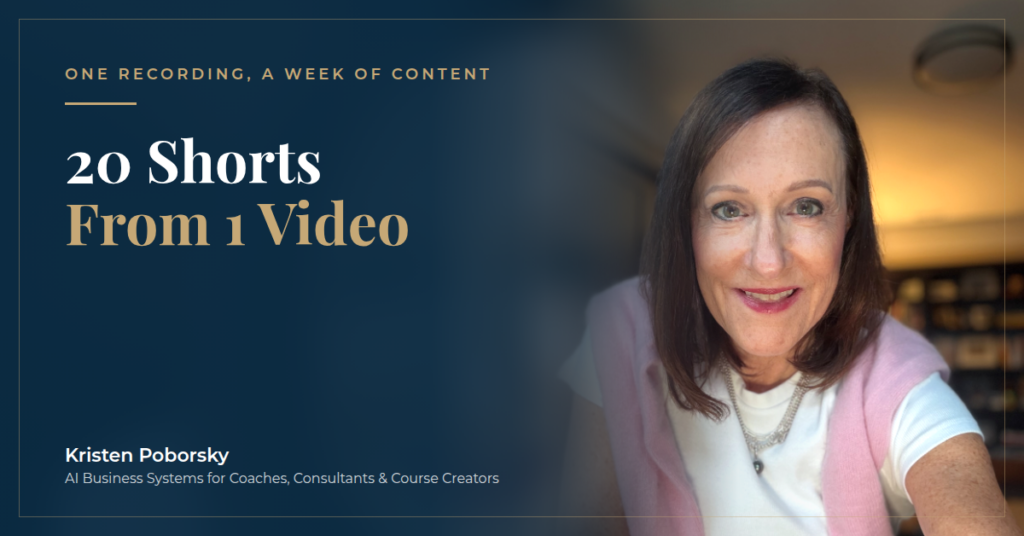
So I built a short-form script skill in Claude that skips all of that. You paste in your transcript, and in under two minutes you have 20 finished scripts, each with its own hook, middle and payoff. No footage to sort through. No blank page.
Here’s exactly how it works, and why the structure behind it matters more than the AI tool itself.
Why Does Most Short-Form Content Fail Before It’s Filmed?
Most short-form videos fail for one reason: they’re missing a structure. Not a bad hook, not bad lighting. A missing structure. A video can have a strong opening line and still fall apart in the middle because there’s nowhere for it to go.
I ran into this constantly with clip-based tools. They’d pull a decent-sounding moment out of my long-form video, but that moment was built to live inside a 45-minute conversation, not to stand alone as a 60-second piece. It had context I’d have to add back in by hand, which meant I was still writing.
What works is building the script around three parts before you ever hit record: a hook in the first three seconds, a middle section that builds tension, and a payoff that delivers on what the hook promised. That structure is what makes a short-form video watchable start to finish, and it’s what most people skip when they’re rushing to “just get something out.”
What Is the Hook, Middle, Payoff Framework?
Every script my script skill writes follows the same three-part shape, and it’s worth understanding why each part exists.
A hook has one job: stop the scroll in the first three seconds with a pattern interrupt, a bold statement or a question people can’t ignore. The middle presents a problem, builds tension around it, and then moves toward the solution. The payoff is the close. You deliver on whatever you promised in the hook and leave the viewer with a clear takeaway, which is what gets a video re-watched and shared.
Here’s where most creators get stuck. They write a hook, then wander into the point without building any tension first. Viewers feel that gap right away and scroll. The middle isn’t filler. It’s the part doing the work of keeping someone watching long enough to reach the payoff.
Once you see content through this lens, you’ll notice it in almost every short-form video that performs well. The framework isn’t a trend. It’s the structure underneath the trend.
How Do You Get 20 Scripts From One Transcript in 90 Seconds?
You paste your long-form transcript into my short-form script skill in Claude, and it returns 20 finished scripts in about 90 seconds, sorted and ready to film.
My scripts come back in a table you can read straight down and start filming from, with no reformatting and no cleanup. They’re grouped into categories, starting with problem-insight-action scripts, because the people watching your content came to solve a problem, not to be entertained first. The skill also pulls out myth-busting angles, since correcting a common misconception is one of the fastest ways to show your audience you’re the person to listen to.
What surprised me the first time I used this wasn’t the speed. It was that every one of the 20 scripts could be spoken in under a minute, with a full hook, middle and close already built in. That’s the piece clipping tools can’t do. They find you a moment. They don’t build you a structure. From one transcript, you walk away with a month of short-form content instead of one lucky clip.
Once they’re filmed, I edit every short in Descript. It adds the captions, removes the filler words and cleans up the sound, so editing takes a few minutes per video.
Can AI Turn Your Script Into a Video?
It can, and I don’t recommend it. Script-to-video AI tools take your script and turn it into a finished video with an avatar, stock footage or an AI voice. It looks efficient. But the robot loses your energy, and your energy is the reason people watch.
AI’s job in my short-form process ends at the script. Everything after that is me:
- Film it yourself. People want to see you. A simple, real video of you talking beats a polished AI video every time.
- Use the script as a guide, not a teleprompter. Know the hook and the payoff, then talk. My best-performing shorts come from the moments I go off script and tell a story from my own experience.
- Let AI handle the edit. I edit every short in Descript. It adds captions, removes filler words and cleans up the sound in a few minutes per video.
- Post everywhere. The same short goes to YouTube, Instagram, Facebook and LinkedIn.
So yes, use AI to go from script to video. Just don’t let it replace the part in the middle, which is you on camera.
What To Do Next
You don’t need all 20 scripts filmed this week. You need the process started.
- Pull a transcript. Use your most recent long-form video, podcast episode or livestream.
- Use a script tool built for short-form. Paste it into an AI skill or assistant trained on hook, middle and payoff, not a generic one-line prompt.
- Sort before you film. Put the scripts into problem-insight-action and myth-busting piles.
- Film the easiest three first. Momentum matters more than perfection on day one.
If you’ve been sitting on months of long-form content that never got repurposed, that’s your starting pile. You already did the hard part when you filmed the original video.
If you’d like to see which parts of your content and business AI should be running, take the free 2-Minute AI Business Audit below. It shows you the first three agents to build, what not having them is costing you, and what changes once they’re running.
Every long video you’ve made is already a month of shorts waiting to be scripted. With a hook, middle and payoff structure and the right AI tool, you can get them out in 90 seconds instead of an afternoon. Take the free 2-Minute AI Business Audit, or steal my AI org chart, and see what else your AI team could be handling.
Related: How I Turn One Video Into 20+ Short-Form Scripts in Under 3 Minutes • My Short-Form Video Strategy
Frequently Asked Questions
Can AI really write short-form scripts that sound natural?
Yes, when it’s trained on the structure behind successful shorts, hook, middle and payoff, rather than just summarizing your transcript. The output reads like a script built to be spoken, not a paragraph chopped into pieces.
How is this different from clip-finding tools?
Clip-finding tools pull existing moments out of your long-form video, which often still need editing and context added back in. A short-form script writer builds new scripts from your transcript, complete with hooks and closes, so there’s no clip-hunting involved.
How many short-form videos can I get from one long-form video?
One well-covered transcript can produce around 20 scripts, each under a minute when spoken aloud. That’s close to a month of content from a single recording.
Do I need technical skills to use an AI short-form script writer?
No. The whole process is copy and paste. You paste your transcript into the script tool and get formatted scripts back.
What makes a short-form script perform well?
The structure matters more than the topic. A strong three-second hook, a middle that builds real tension around a problem, and a payoff that delivers on the hook’s promise are what keep people watching to the end and sharing it after.
Should I use a script-to-video AI tool?
Use AI to write the script and edit the video, but film yourself. AI-generated videos lose your energy and personality, and those are what make people stop scrolling and trust you.
Want to know which AI agents your business needs first? Take the free 2-Minute AI Business Audit. It shows you the first three agents to build, what not having them is costing you, and what changes in your business once they’re running. Or steal my AI org chart and see which of the 7 AI seats your business still has empty.