
Last updated: September 2026
Key Takeaways
- When AI is not working in your business, the cause is almost never the tool. It is one of four things sitting underneath it.
- Those four: no documented systems, deploying before testing, building without measuring, and no clear view of what you already own.
- AI copies whatever structure it finds. Where there is no structure, it copies nothing, at speed.
- Each cause has a different fix, so the first job is working out which one you are in rather than adding another tool.
I spent forty-plus years in systems development before any of this. Software, IT, corporate builds. So when somebody tells me AI is not working in their business, I am not really looking at the AI. I am looking at what it is sitting on.
It is one of four things. Every time.
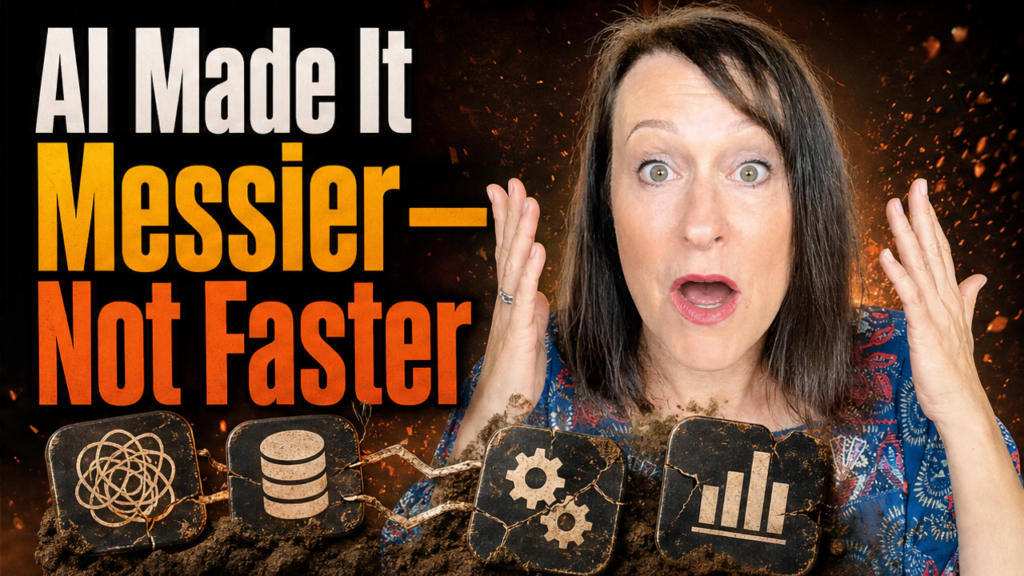
What people describe is usually the same. They had a business with some rough edges, a few things held together by hand. Then they added AI on top, and now the rough edges move faster and multiply. More content, more tools, more half-finished work, and less clarity than a year ago.
Mud on mud.
This post covers all four causes, what each one looks like from the inside, why they compound, and how to work out which one is yours before you spend another month building.
What Actually Goes Wrong
AI is not working in your business almost always because AI has been added on top of a process that was never written down, never tested, never measured, or never inventoried.
That sentence covers every case I have worked on. Not one of them was a tool problem.
Which is worth sitting with, because the instinct when something is not working is to change the tool. Different platform, different agent, different subscription. That instinct costs months and fixes nothing, because the same four gaps travel with you to the new platform.
The four causes:
- Nothing documented underneath it, so there is no process for AI to run on
- Deployed before it was tested, so the output was never going to be right
- Built and never measured, so nobody knows where the break actually is
- No clear view of what you already own, so the same work gets built twice
Each one produces a different symptom. Missing systems produce a bottleneck. Missing testing produces bad output. Missing measurement produces expensive guessing. Missing inventory produces duplicated effort.
They also stack. A business with no documentation usually has no measurement either, because both come from the same place: work that lives in somebody’s head rather than somewhere it can be looked at.
That is why adding AI accelerates the problem rather than solving it. You are speeding up a process nobody has checked.
Cause One: There Is Nothing Underneath It
AI does not create structure. It copies the structure already there, and where there is none it copies nothing, very quickly.
A client came to me ready to fire his virtual assistant. She was fine. He was the problem. He had hired her to take content off his plate and was still doing every piece of it himself, because he had nothing to hand her. No documented process, nothing written down. The whole way he worked lived in his head, so handing anything over was slower than doing it again.
The bigger version showed up in a company with thirty employees.
Every question any of them had went to one person: the owner. Where is that file. What did we tell that client last time. What is our process for this. Thirty people, all day, funneling through one human being who could not get their own work done as a result.
There were no standard operating procedures anywhere in the business. So a thirty-person company ran on one person’s memory.
Now consider either of them deciding to add AI. What would it run on? There is no process to give it and no document to train it on. The knowledge is not anywhere a machine can reach, because it is in a head.
You cannot hand a machine a process that does not exist.
That company took a month to fix, and the method was talking rather than writing. Three interviews produced more than fifteen written procedures. The employees now have one central place to get answers instead of queuing at the owner’s door.
The part that mattered most came later. When a team member left, the replacement had everything: the departing person’s process and the owner’s, written down and immediately usable. That is what documentation actually buys. Not tidiness. Continuity.
Here is the test. If you went off-grid for two weeks, could your team keep working? If the honest answer is no, this cause is yours. I walk through how to fix it in How to Get Your Business Out of Your Head. The full story is in He Wanted to Fire His VA. She Wasn’t the Problem.
Cause Two: You Deployed Before You Tested
Nobody gets an AI agent right on the first attempt, and the failure is treating it as though they should.
The pattern is consistent. Someone builds the thing, turns it on, walks away. Three weeks later there is a pile of output that is not right, and they have decided AI cannot do what they wanted. It could. It could not do it on attempt one, because nothing does.
Build, test, tweak, deploy. That order governed every system I worked on for four decades, and it applies to AI without modification. Nobody in software would write code on a Tuesday and push it to customers on the Tuesday. There would be a testing phase, and somebody whose entire job is finding what got missed.
What makes AI different is that the output looks finished. It is articulate. It is formatted. Bad code crashes and you know instantly. A poorly configured agent hands you a clean-looking paragraph that is quietly wrong, and nothing about the presentation tells you which one you are holding.
I built a skill recently that writes my Instagram reels and pushes them into Canva ready to go. The first runs were not good. The writing did not match what my coach had specified, and at one point nothing was arriving in Canva at all.
Thirty minutes and three rounds of testing fixed it. Now I use it every week.
Thirty minutes stood between a tool I rely on and a tool I would have abandoned while telling people AI cannot do this. Most people quit before those thirty minutes.
There is a second test almost nobody runs, which is testing as the person who will receive the output rather than as the person who built it. That one catches the failures that look like nothing to you and stop your assistant dead. The full breakdown is in Your AI Agent Isn’t Broken. You Shipped It Early.
Cause Three: You Built It and Never Looked at It
Most business owners cannot name a single number from their funnel this week, and that is where this problem does its quietest damage.
Without numbers you cannot find a break, so you rebuild the thing that feels most likely instead. Usually that is copy, and usually copy is fine.
I nearly did it myself. Brand new opt-in, paid traffic pointed at it, running for a week. A hundred people landed on that page. Zero opted in.
My first thought was that my copy was off. Rewrite the headline, redo the page, two days of work.
That is everybody’s first instinct and it is almost always wrong.
So before touching a word I checked. Did the ad copy match the page copy? It did. Then, where were people dropping, and did that pattern look like a copy problem?
It did not. It looked like people who were never going to convert. I was running that ad at cold audiences who had never heard of me, asking strangers for an email address for something brand new. And I already had a funnel that warms people up. I was not feeding this one from it. Two things I built, sitting side by side, not talking to each other.
We changed who saw the ad. Same page, same copy, warm traffic this time. It converted at twenty-five percent.
Not one word of that page changed.
AI does not fix a broken business. It scales one.
The reason most people never find something like that is that dashboards report and do not reason. You look at traffic up and conversions down, and the dashboard has no idea why. I found mine in an afternoon by connecting my ad data straight to Claude and asking questions rather than requesting a report. The full story is in Why Your Landing Page Isn’t Converting.
Cause Four: You Cannot See What You Already Own
I built the same AI agent twice, months apart, with no idea I had already made it.
This one is not about the platforms. They are fine. The mess is what is running inside them: agents, skills, projects, prompts written months ago and never opened again. Good work, sitting behind a wall where none of it is visible, so the building continues on things already owned.
An asset you forget you have is not an asset. It is a file.
My projects were worse than my skills. When I finally audited them I had around twenty, and six or seven were dead, half-built or duplicated. The work was not bad. I had no idea what state any of it was in.
The fix took minutes. I had Claude scan everything, list it, describe what each one does, and push it into Notion. What came back went further than a list. It was an operating system: what I have, what each one is for, and when to reach for it. That last column is the whole point, because a list tells you what exists while an operating system tells you what to use on a Tuesday with a task in front of you.
The payoff is not a tidy folder. Something new ships every few months now. Claude Code. Cowork. Something neither of us has heard of yet. Each time one lands, the people who know what they own move their existing work into it. Everybody else rebuilds from scratch.
You cannot move what you cannot see.
That is not hypothetical. When I worked out that skills are the way to hand work between Claude and Canva, I looked at my inventory and immediately saw which of my existing content agents belonged in that setup. I retweaked those and the handoff was running. I built nothing new. More on that in I Built the Same AI Agent Twice Without Knowing.
Why These Four Compound
One of these causes on its own is a bad week. Two or more is why businesses stall for a year.
Consider what happens when documentation and measurement are both missing, which is the most common pairing. Nothing is written down, so nothing can be handed off, so the owner does the work. Because the owner is doing the work, nobody is watching the numbers. Because nobody is watching the numbers, the break stays invisible and the owner concludes the problem is capacity rather than process.
They hire. The new person has nothing to work from, asks constant questions, and the owner is now doing the work plus answering about it.
Add AI at that point and it copies the undocumented process, produces output nobody has time to check, and generates volume that hides the original problem under a larger version of itself.
There is a harder case worth naming, which is when the system mostly exists but one piece is missing. That happened to me with those ads. Everything was set up the way I had been shown, money going out daily, and the setup I had been given had a hole in it because nobody told me the audience piece mattered as much as it does. I was not doing it wrong. I was doing exactly what I had been taught.
So this cuts both ways. Check what you built, and check what somebody else built for you.
The compounding is also why the order matters. Fixing measurement first in a business with no documentation gives you numbers describing a process that nobody can repeat. Documentation comes first, then testing, then measurement, then inventory once there is enough built to be worth inventorying.
How to Tell Which One Is Yours
Four questions. Answer them honestly and the diagnosis takes about a minute.
Could your team keep working if you were unreachable for two weeks? If no, your problem is missing systems. Everything runs through you, and no tool changes that until the knowledge lives outside your head.
Did you build an AI agent, get output that was not right, and stop using it? If yes, your problem is deployment without testing. That agent was probably one round of specific feedback away from working.
Can you name a single number from your funnel this week? If no, your problem is measurement. You are making decisions on instinct, and instinct is confident and frequently wrong.
Could you list everything currently running in your AI tools right now? If no, your problem is inventory. Expect duplicates.
Most people answer badly to more than one. Start with whichever produced the strongest reaction reading it, because that is usually the one costing the most.
What To Do Next
Diagnose before you build. Fixing the wrong cause costs weeks and leaves the real one running.
- If your answer was systems, pick the one question you answer most often and record yourself explaining it out loud. Have AI turn that recording into a written procedure. One a week and you will be documented within a few months.
- If your answer was testing, go back to the agent you abandoned. Tell it specifically what missed and what it should have done instead, then run it again on real work rather than a test example.
- If your answer was measurement, pick three numbers and write them down weekly. How many landed, how many opted in, the percentage between them. Same day every week.
- If your answer was inventory, run one scan today and put the results somewhere you actually open.
The first step is the diagnosis, not the build. Everything else follows from knowing which of the four you are in.
If you’d like help with that diagnosis, take the free 2-Minute AI Business Audit below. It shows you the first three agents to build, what not having them is costing you, and what changes once they’re running.
The Amplifier, Not the Problem
Four causes: nothing documented, deployed before testing, built without measuring, and no view of what you already own. Every one existed before AI arrived, and every one gets faster with AI on top of it.
If you came here wondering why AI isn’t working in your business, it is worth saying plainly that the AI is doing its job. It is copying and accelerating what it found.
You do not need more tools. You need to see what you have got. That is a good week’s work, and it is completely doable. Start with the question that stung. Take the free 2-Minute AI Business Audit, or steal my AI org chart, and see which seats your AI team still has empty.
Related: Systems Before Agents: How to Get Your Business Ready for AI • AI Business Continuity: What Happens When They Leave? • The Five Places Your Business Leaks Time and Money
Frequently Asked Questions
Why isn’t AI working in my business when it works for other people?
In nearly every case the difference is what sits underneath it. AI runs on documented processes, tested configurations and visible numbers, so a business with those in place gets results from the same tool that produces nothing useful elsewhere. The tool is rarely the variable.
Can AI fix a disorganized business?
No. AI copies the structure it finds and runs it faster, so a disorganized business becomes a faster disorganized business. Some rough written structure has to exist before AI has anything to work from.
Should I fix my systems or my measurement first?
Systems first. Numbers describing a process nobody can repeat will not tell you anything you can act on. Once a process is written down and being followed, measurement tells you whether it works.
How long does it take to document a business well enough to use AI?
A thirty-person company I worked with took a month, using three interviews to produce more than fifteen written procedures. The speed comes from talking through each process and letting AI write it up, rather than sitting down to write.
My AI agent produces output that is close but wrong. Do I start over?
No. Close on the first attempt is normal. Tell it specifically what missed and what it should have done instead, then run it again on real work. Most abandoned agents were one round of feedback from working.
Want to know which AI agents your business needs first? Take the free 2-Minute AI Business Audit. It shows you the first three agents to build, what not having them is costing you, and what changes in your business once they’re running. Or steal my AI org chart and see which of the 7 AI seats your business still has empty.